Business setup in Dubai runs in five steps: choose jurisdiction, select activity codes, reserve a trade name, submit shareholder documents, and receive your licence. Free zone setup costs start from AED 12,000. Corporate tax applies at 9% on income above AED 375,000, effective June 2023, with 0% below that threshold.
Dubai issues over 40,000 new business licenses annually (Dubai Department of Economic Development, 2026). A free zone e-license takes as little as 48 hours from document submission. Free zone setup costs start from AED 12,000. The UAE ranked 16th globally for ease of doing business (World Bank, 2024). Corporate tax is 9% on income above AED 375,000, effective June 2023 (UAE Ministry of Finance, 2023). VAT registration is mandatory at AED 375,000 taxable turnover (Federal Tax Authority, 2018). Residence visas cost AED 3,000-5,500 and process in 7-14 days. These numbers matter, because the step by step business setup in Dubai process is faster and more affordable than most US-based founders expect, provided you follow the right sequence.
Business setup in Dubai involves more decisions than most founders expect, but the actual process, when broken into clear steps, is straightforward. This guide walks you through every step in the right order, with exact AED costs, realistic timelines, and specific guidance on where Dubai South Business Hub Free Zone fits into your fastest path to trading legally in the UAE.
What Is Step by Step Business Setup in Dubai and How the Process Works
Step by step business setup in Dubai means registering a legal business entity in the UAE by choosing a structure, selecting a business activity, reserving a trade name, submitting documents, paying for a trade license, and obtaining visas. The full Dubai business setup process takes 3 days to 8 weeks depending on structure and banking. Understanding the sequence before you start is what separates founders who are trading in three weeks from those still waiting on paperwork two months later.
Three Business Structures You Must Choose Between First
Your first decision shapes every step that follows. There are three options:
Free zone: 100% foreign ownership, fast setup, activity restricted to free zone-to-free zone or international trade. Ideal for consultants, e-commerce operators, and international service businesses. Over 45 free zones operate across the UAE (UAE Ministry of Economy, 2024).
Mainland: Licensed by the Department of Economic Development (DED), allows unrestricted UAE market access including government contracts. Requires a physical office. Foreign ownership caps were removed for most activities under the 2021 amendments to the UAE Commercial Companies Law (UAE Ministry of Economy, 2021).
Offshore: No UAE residency visa, no physical office required. Used for asset holding, international trading, and tax structuring via structures like RAK ICC or JAFZA Offshore. Not suitable for active UAE trading.
A US-based SaaS founder, for example, would almost always choose free zone, fast, low-cost, and 100% foreign-owned from day one. Mainland only becomes necessary if you plan to bid on UAE government contracts or sell directly to local retail customers in person. Read the full company formation in Dubai step-by-step guide for a deeper structure comparison.
Free Zone vs Mainland vs Offshore: Key Setup Factors Compared
Feature | Free Zone | Mainland | Offshore |
|---|---|---|---|
Foreign Ownership | ‚úÖ 100% from day one | ‚úÖ 100% for most activities (post-2021 law) | ‚úÖ 100% foreign-owned |
Setup Cost (AED) | AED 12,000-25,000 | AED 15,000-50,000+ | AED 10,000-20,000 |
Time to License | 1-3 business days | 5-15 business days | 3-7 business days |
UAE Market Access | Free zone and international only | ‚úÖ Unrestricted UAE market | ‚ùå No active UAE trading |
Visa Eligibility | ‚úÖ UAE residency visa included | ‚úÖ UAE residency visa included | ‚ùå No UAE residency visa |
Office Requirement | Flexi-desk or virtual office accepted | Physical office lease required | ‚ùå No UAE office permitted |
Corporate Tax | 0% on qualifying income; 9% otherwise | 9% on income above AED 375,000 | Varies by structure and jurisdiction |
Why the Sequence of Steps Matters for Your Timeline
The most common mistake founders make is choosing a jurisdiction before confirming it supports their specific business activity. One fintech founder I've seen in practice applied to a free zone, only to discover the zone didn't carry the ISIC-aligned activity code for their payment processing business. They had to restart with a different jurisdiction, losing 10 days and paying duplicate application fees.
Two other sequencing rules matter just as much. Start your corporate bank account application in parallel with Step 5 (document submission), not after your license arrives, this saves 2-4 weeks. And remember: visa applications can't begin until your trade license is issued, so any delay at Step 6 cascades directly into your residency timeline. The setup free zone company in Dubai guide covers activity selection in detail if you need more help at that stage.
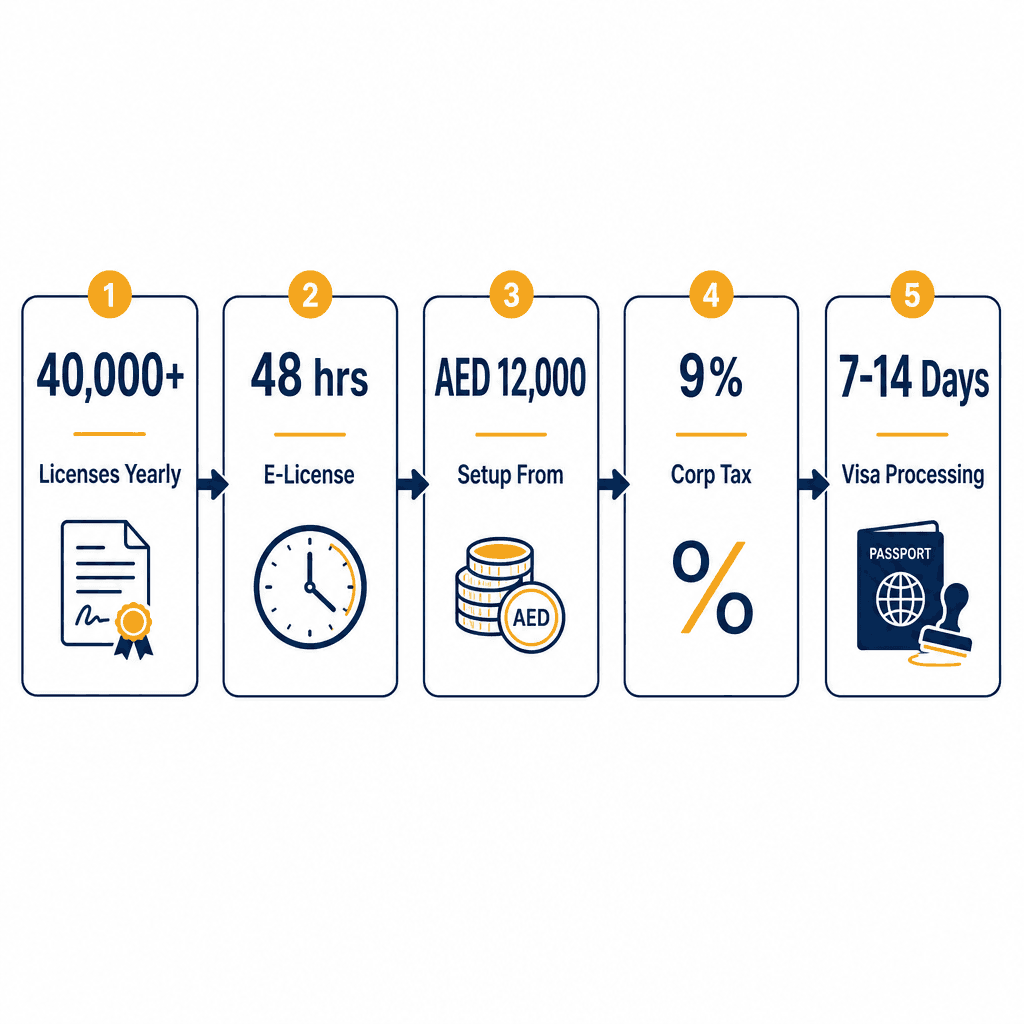
Dubai Business Setup: Key Numbers at a Glance
A quick-reference visual showing the core metrics every founder needs before starting the step by step business setup in Dubai process.
40,000+ new licenses issued in Dubai annually (DED, 2026)
AED 12,000-25,000: typical free zone setup cost
3 business days: fastest free zone license timeline
AED 375,000: VAT and corporate tax registration threshold
7-14 days: residence visa processing time
2-8 weeks: corporate bank account approval range
The Complete Dubai Business Setup Process: Ten Steps in Order
The Dubai business setup process has ten steps: choose your structure, select your business activity, pick a jurisdiction, reserve your trade name, submit your application and documents, pay for and receive your trade license, apply for a residence visa, open a corporate bank account, register for VAT and corporate tax, then start trading. Here's exactly how to do it, step by step, with timelines and AED costs at each stage.
Step 1: Choose Your Business Structure, Time: 1 Day
Use this single decision filter: will you sell directly to UAE-based customers in person? If yes, consider mainland. If no, free zone is almost always faster and cheaper. A UK-based digital marketing consultant, for instance, chose Dubai South Business Hub Free Zone over a mainland DED license, all her clients are international, so she saved AED 10,000+ in year-one setup costs by avoiding the mandatory physical office lease.
Offshore structures (RAK ICC, JAFZA Offshore) are valid only for holding companies or international operations, they don't grant UAE residency, so they're not suitable if you plan to live in Dubai. Free zone is the recommended starting point for most international founders. You can always add a mainland branch later once revenue justifies it.
Step 2: Select Your Business Activity, Time: 1 Day
Every UAE trade license must specify one or more licensed business activities. These determine what you can legally invoice for, get this wrong and you face compliance risk, VAT classification issues, and potential license cancellation. Activities are drawn from standardised lists aligned with ISIC Rev.4 classifications (UN Statistics Division, 2008); each free zone and mainland authority maintains its own approved version of that list.
The good news: you can typically add 3-10 activities to one license for AED 500-1,000 per additional activity. An e-commerce founder needing both "General Trading" and "Electronic Commerce" on one license, a common combination, can achieve this at most free zones without issue. Worth noting: ISIC Rev.4 classifies e-commerce by the nature of goods or services provided, not the sales channel, and UAE licensing mirrors this approach exactly.
Step 3: Choose Your Jurisdiction and Free Zone, Time: 1 Day
Four factors should drive your jurisdiction decision:
Does the zone permit your specific activity?
What is the all-in cost including visa packages?
Does the zone have established banking referral relationships?
What is the visa quota per license?
Dubai South Business Hub Free Zone scores well on all four. It supports trading, consulting, logistics, and technology activities under one roof, with visa quotas scalable from solo founder to multi-employee setups. Its location within the Dubai South ecosystem, adjacent to Al Maktoum International Airport, makes it a particularly strong choice for logistics and import/export businesses. A logistics startup choosing Dubai South specifically for cargo hub access can reduce freight coordination overhead from day one. Zones with strong bank relationships reduce account opening time by 2-4 weeks compared to zones without them, a material advantage given typical bank timelines of 2-8 weeks.
Ready to confirm your activity and jurisdiction? Launch your company at Dubai South Business Hub Free Zone and get your activity confirmed before committing.
Steps 4 Through 10: From Trade Name to Trading, Timelines and Costs
Step 4, Reserve your trade name (same day, AED 500-2,000): Check availability via the free zone portal. Names can't reference UAE government bodies, include offensive terms, or duplicate an existing registered name. Approval is typically same-day once you submit.
Step 5, Submit application and documents (1-3 days): Standard docs are a passport copy, passport-size photo, completed application form, and a business plan (required at some zones). Start your bank account application the same day, don't wait for the license.
Step 6, Pay and receive your trade license (1-2 days): E-license issued digitally within 1-2 days of payment. Total cost AED 12,000-25,000 for most free zones.
Step 7, Apply for residence visa if needed (7-14 days, AED 3,000-5,500): Entry permit, then status change if already in UAE, then medical fitness test, then Emirates ID biometrics and visa stamp.
Step 8, Open corporate bank account (2-8 weeks): Apply to Emirates NBD, Mashreq, RAK Bank, or ADIB with your license, passport, and business plan. Starting this at Step 5 is the single biggest time-saver in the entire process.
Step 9, Register for VAT and corporate tax (1-2 days, free): Mandatory VAT registration at AED 375,000 taxable turnover; corporate tax at 9% on income above AED 375,000 effective June 2023 (UAE Ministry of Finance, 2023).
Step 10, Start trading: Set up your invoicing system, accounting software, and compliance calendar for quarterly VAT returns.
One founder who set up at Dubai South Business Hub Free Zone received their e-license in 48 hours, started the bank application on day one alongside document submission, and was fully operational, including Emirates ID in hand, within 19 days total. That's Scenario B in practice. Use the cost calculator to get exact AED figures for your specific setup. And before you submit, check the common mistakes to avoid when setting up in Dubai to protect your timeline.
A process timeline showing the ten steps of Dubai business setup from structure selection to trading, with key milestones at steps 1, 3, 6, and 10. Step by Step Business Setup in Dubai 1 Structure Day 1 3 Jurisdiction Day 2-3 6 Trade License Day 3-7 10 Start Trading Week 3-8
Dubai business setup process: key milestones from structure selection to trading. Timelines based on Dubai South Business Hub Free Zone typical processing, 2026-2026.
What is the first step to setting up a business in Dubai?
The first step is choosing your business structure: free zone, mainland, or offshore. This single decision determines your ownership rights, market access, visa eligibility, and setup cost. For most international founders, a free zone structure is the fastest and most cost-effective starting point, with licenses issued in as little as 48 hours.
Why Dubai South Business Hub Free Zone Stands Out for Your Setup
the free zone offers 100% foreign ownership, fast e-license issuance, scalable visa quotas, and a strategic location near Al Maktoum International Airport. It supports trading, consulting, logistics, and tech activities with competitive all-in packages starting from AED 12,000, making it a strong choice for international founders using this business setup guide for Dubai.
Build Your Case: Five Reasons to Choose Dubai South Business Hub Free Zone
Location advantage: Situated within the Dubai South ecosystem, adjacent to Al Maktoum International Airport and Expo City Dubai. Al Maktoum is projected to become the world's largest airport by capacity upon full completion (Dubai Airports, 2024), a direct operational advantage for logistics and import/export businesses.
Activity flexibility: Supports a broad range of ISIC-aligned activities across trading, professional services, logistics, and technology. Unlike single-sector zones like DIFC (finance) or DMCC (commodities), Dubai South Business Hub Free Zone is multi-sector by design, reducing the risk of activity mismatch that causes costly restarts.
Competitive pricing: All-in packages with transparent AED pricing and no hidden renewal fees. An Indian entrepreneur relocating from Singapore chose Dubai South specifically for its logistics activity permissions and cargo hub proximity, cutting freight coordination costs from day one.
Scalable visa quotas: Visa allocation scales with your team, from solo founder packages through to multi-employee setups of 6+ visas per license.
Banking support: Established relationships with UAE banks reduce corporate account opening time, critical given that bank approval can take 2-8 weeks and is often the longest single step in the Dubai business setup process.
Launch your company at Dubai South Business Hub Free Zone and get your activity confirmed and license issued within 48 hours of document submission.
What It Costs to Set Up a Business in Dubai: AED Figures by Step
Business setup costs in Dubai range from AED 12,000 for a basic free zone license to AED 50,000+ for a mainland setup with office space. Key cost components are the trade license (AED 12,000-25,000), trade name reservation (AED 500-2,000), residence visa (AED 3,000-5,500), and bank account opening, typically free to open, but some banks require a minimum balance of AED 50,000-250,000 depending on account type. These are the business setup steps in Dubai where most founders underestimate their budget.
Cost Breakdown by Step With AED Ranges
Trade license (free zone): AED 12,000-25,000 all-in, depending on zone and number of activities
Trade name reservation: AED 500-2,000, paid to the free zone authority, same-day approval
Residence visa (per person): AED 3,000-5,500 covering entry permit, medical fitness test, Emirates ID, and visa stamp
Corporate bank account: Account opening is typically free; minimum balance requirements range from AED 50,000 to AED 250,000 depending on bank and account type
VAT registration: Free via the Federal Tax Authority's EmaraTax portal (Federal Tax Authority, 2018)
Additional activities on license: AED 500-1,000 per activity added
In practice, a Dubai South Business Hub Free Zone all-in package (license plus one visa) saves approximately AED 15,000-20,000 in year one compared to an equivalent mainland DED license plus mandatory office lease. Use the cost calculator to get a precise figure for your activity and visa count before committing.
Free Zone vs Mainland: Year-One Cost Comparison
Cost Component | Free Zone (Dubai South Business Hub) | Mainland (DED) |
|---|---|---|
Trade License | AED 12,000-25,000 | AED 15,000-30,000 |
Office Requirement | ‚úÖ Flexi-desk included | ‚ùå Physical lease: AED 15,000-40,000/yr |
Residence Visa (1 person) | AED 3,000-5,500 | AED 3,000-5,500 |
Time to License Useful Resources |