
Topic Summary
By Editorial Team , Business setup specialists covering UAE free zone regulations, mainland licensing, and corporate structuring for international founders. Full bio →
Last updated: June 2026
By Editorial Team, Business setup specialists covering UAE free zone regulations, mainland licensing, and corporate structuring for international founders. Full bio →
In 2026, Dubai hosts over 45 free zones (UAE Ministry of Economy, 2026). The UAE ranks among the top 10 globally for ease of doing business (World Bank Doing Business Index, 2024). Over 40,000 new commercial licenses are issued in Dubai each year (Dubai DED, 2025). Corporate tax sits at just 9% above AED 375,000 net profit (UAE Federal Tax Authority, 2023). Personal income tax remains 0%. The AED has been pegged to the USD since 1997, eliminating currency risk for dollar-denominated businesses.
Dubai company formation is one of the most streamlined processes in the world for international entrepreneurs, but only when you understand the options in front of you. This guide to company formation in Dubai covers every decision you'll face: jurisdiction type, legal structure, business activity selection, trade name registration, the step-by-step formation process, required documents, costs in AED, realistic timelines, and what you must do after your license lands in your inbox. Whether you're a solo founder or scaling a multinational, this is the reference you'll keep coming back to.
What Is Company Formation in Dubai and Why It Matters for International Entrepreneurs
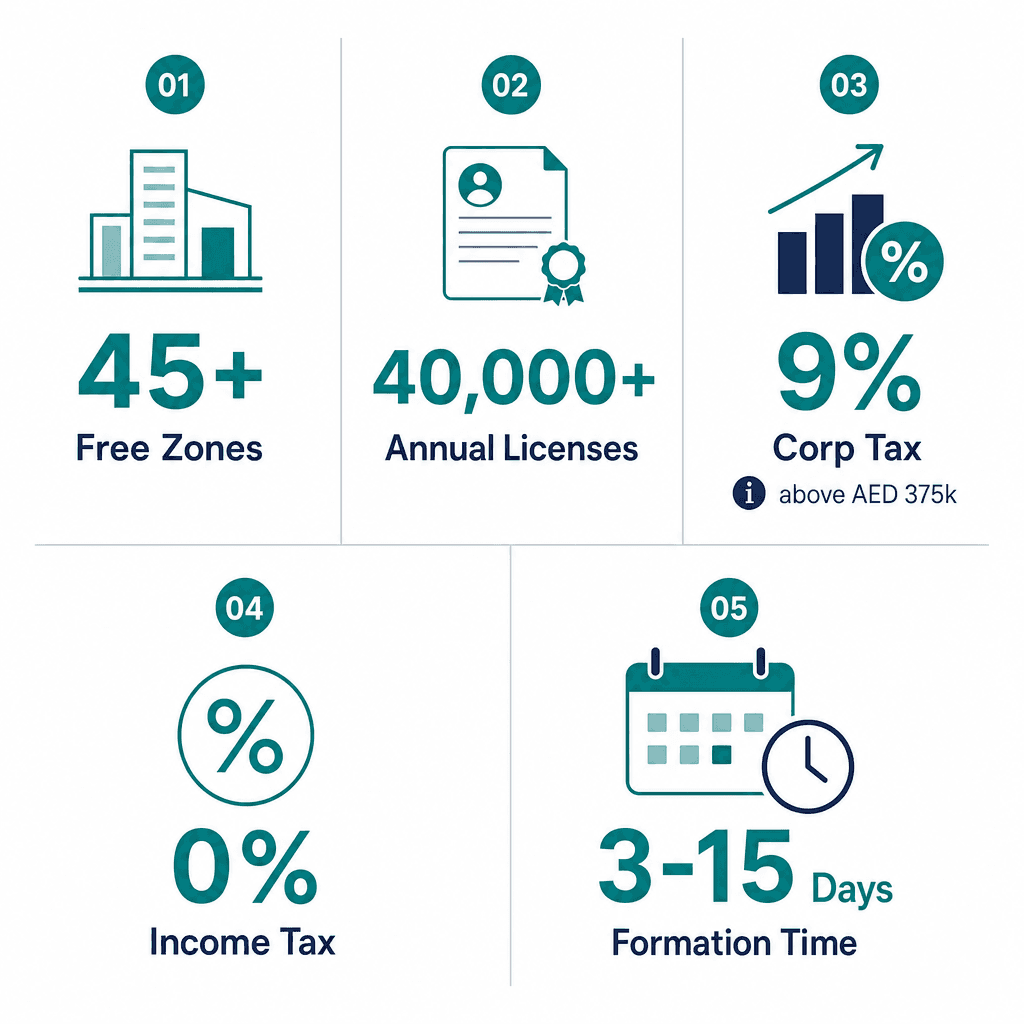
Company formation in Dubai is the legal process of registering a business entity in the UAE, choosing a jurisdiction (free zone, mainland, or offshore), selecting a legal structure, obtaining a trade license, and fulfilling regulatory requirements. The process typically takes 3–15 business days depending on jurisdiction and activity type. Getting this right from the start means you avoid costly restructuring, compliance penalties, and operational restrictions down the line.
Why Dubai Attracts Over 40,000 New Business Registrations Each Year
The numbers speak for themselves. Dubai's appeal for international founders comes down to a combination of tax efficiency, strategic geography, and genuine ease of doing business. Here's what drives those 40,000+ annual registrations (Dubai DED, 2025):
0% personal income tax. Corporate tax is 9%, but only on taxable income above AED 375,000, most early-stage businesses pay nothing (UAE FTA, 2023).
Geographic reach. Dubai sits within a 4-hour flight radius of 2.5 billion consumers across Europe, Asia, and Africa (Dubai Chamber, 2024). A US-based SaaS company establishing its MENA headquarters in Dubai South Business Hub Free Zone can serve Gulf, African, and South Asian markets from a single entity, with no currency conversion risk on USD transactions.
Full foreign ownership. Since the 2021 amendments to UAE Federal Law No. 32 of 2021 (Commercial Companies Law), 100% foreign ownership is permitted in over 1,000 mainland activities and all free zone activities, no local partner required in most sectors.
USD-pegged currency. The AED has been fixed at 3.67 to the USD since 1997, making financial planning predictable for international founders.
45+ free zones. Each zone is tailored to specific industries, giving founders the ability to choose an environment that matches their sector (UAE Ministry of Economy, 2026).
Free Zone, Mainland, and Offshore: The Three Paths Explained
Your first and most consequential decision in this company setup guide UAE is choosing your jurisdiction. Each path has distinct rules about who you can sell to, what taxes apply, and what physical presence you need.
Free zone: You get 100% foreign ownership, tax exemptions, and a simplified setup process. The trade-off is that free zone companies can't directly trade on the UAE mainland without appointing a local distributor or setting up a mainland entity. They're ideal for businesses operating internationally or serving other free zone companies. Dubai South Business Hub Free Zone, for example, offers dedicated visa quotas, no customs duty within the zone, and sector-focused support for logistics, aviation, and professional services.
Mainland: Licensed by the Dubai Department of Economic Development (DED), a mainland company can operate anywhere in the UAE, win government contracts, and retail directly to UAE consumers. Since the 2021 Commercial Companies Law amendments, 100% foreign ownership is permitted in most sectors, the old requirement for a 51% UAE national partner is gone for the majority of activities. A logistics firm needing to bid on Abu Dhabi government freight contracts must register on the mainland; a free zone license simply won't qualify it for that work.
Offshore: Not a physical presence in the UAE at all. Offshore structures (registered through authorities like JAFZA or RAK ICC) are used for holding assets, intellectual property, or international trading. They can't conduct business inside the UAE. Think of them as a corporate holding vehicle, not an operational entity.
Free Zone vs Mainland vs Offshore: Side-by-Side Comparison
Feature | Free Zone | Mainland (DED) | Offshore |
|---|---|---|---|
Foreign Ownership | ✅ 100% | ✅ 100% (most sectors) | ✅ 100% |
UAE Mainland Trading | ❌ Via distributor only | ✅ Direct access | ❌ Not permitted |
Government Contracts | ❌ Generally ineligible | ✅ Eligible | ❌ Not applicable |
Physical Office Required | Flexi-desk option available | Min. 200 sq ft (Ejari) | ❌ Not required |
Typical Setup Cost (Year 1) | AED 12,000–25,000 | AED 30,000–80,000+ | AED 8,000–15,000 |
Residency Visa Eligibility | ✅ Yes (quota-based) | ✅ Yes (office-based) | ❌ No |
Best For | International ops, exports | UAE market, retail, govt | Holding, IP, assets |
Choosing Your Legal Structure for Dubai Company Formation
The four main legal structures for Dubai company formation are the Free Zone Establishment (FZE, single shareholder), Free Zone Company (FZCO, 2–50 shareholders), Limited Liability Company (LLC, for mainland), and Branch Office. Your choice affects liability, ownership, capital requirements, and the markets you can legally serve. Choosing the wrong structure at the start means paying amendment fees and potentially restarting parts of the process, so get this right early.
FZE vs FZCO: Single Founder or Multi-Shareholder Free Zone Entity
FZE (Free Zone Establishment): One shareholder, 100% ownership, the simplest structure for solo founders. Most free zones require minimum share capital of AED 10,000–50,000.
FZCO (Free Zone Company): 2–50 shareholders, which can be individuals or corporate entities. Ideal for partnerships, joint ventures, or when a parent company wants to hold shares alongside an individual founder.
Limited liability for both: Your personal assets are protected beyond the paid-up capital amount in either structure.
Shareholder agreements: For FZCOs, draft your shareholder agreement before submission. Amending it after registration triggers additional fees and delays.
Take two UK-based co-founders launching a fintech platform. They choose an FZCO structure at a UAE free zone, split shares 60/40, and cap personal liability to their AED 50,000 paid-up capital. Neither founder is personally exposed beyond that amount if the business fails. That's the practical value of the limited liability protection in this structure.
Minimum share capital varies considerably: AED 10,000 at some free zones, up to AED 1,000,000 for certain regulated activities. Always confirm the threshold with the specific free zone authority before you commit.
LLC and Branch Office: Mainland and International Expansion Structures
The LLC (Limited Liability Company) is the most common mainland structure in Dubai, accounting for the majority of DED-licensed entities (Dubai DED Annual Report, 2024). It supports 2–50 shareholders, permits 100% foreign ownership in most sectors under UAE Federal Law No. 32 of 2021, and has no federally mandated minimum capital, though specific activities (banking, insurance, healthcare) impose sector-level minimums.
A Branch Office is an extension of a foreign parent company, not a separate legal entity. The parent bears full liability for the branch's obligations. A German engineering firm, for instance, can open a Dubai mainland branch to execute infrastructure contracts, the parent retains full liability, but the branch can legally invoice UAE government clients directly. Non-free zone branches require a UAE national as a local service agent, though this agent has no ownership stake.
Two other structures worth knowing: a Representative Office can only handle marketing and liaison work, it can't generate revenue in the UAE. And for sophisticated holding structures, the DIFC (Dubai International Financial Centre) and ADGM (Abu Dhabi Global Market) offer common-law frameworks with their own court systems, popular for regional holding companies and fund structures.
Selecting Your Business Activity and Trade Name Before You Register
Your business activity determines your license type (commercial, professional, industrial, or tourism), which jurisdiction accepts your application, and what approvals you need. Your trade name must be unique, not offensive, not contain religious references without approval, and match the activity scope on your license application. Both decisions lock in key parameters of your company setup guide UAE, change them later and you're paying amendment fees.
How to Pick the Right Business Activity from the UAE Activity List
Check the approved list first. The DED mainland list includes 2,000+ permitted activities (Dubai DED, 2025). Each free zone maintains its own narrower list. Selecting an unlisted activity requires prior approval and can delay formation by 2–4 weeks.
Multiple activities on one license. You can list several activities on a single license. Each additional activity typically adds AED 100–500 to the annual fee, far cheaper than running two separate entities.
Regulated activities need extra approvals. Healthcare, financial services, legal, education, and food businesses require sign-off from sector-specific authorities (12+ government bodies in Dubai, per DED) before the trade license is issued. Budget extra time.
ISIC alignment. The UAE's national activity classification maps to ISIC Revision 4, the internationally standardised framework approved by the UN Statistical Commission in 2008. This matters for reporting, banking due diligence, and cross-border operations where counterparties verify your activity codes.
A practical example: an entrepreneur wanting to offer both management consulting and IT services lists both activities on a single professional license at a Dubai free zone. One entity, one renewal fee, no need to maintain two separate companies.
Trade Name Rules and Reservation in Dubai
Uniqueness check: The DED or free zone authority runs your proposed name against their existing registry. A name already in use is rejected outright.
Prohibited conventions: Names implying government affiliation, containing offensive terms, or using a personal name where that person isn't a shareholder will be rejected.
Reservation window: Valid for 60–90 days. Cost ranges from AED 620 at DED mainland (Dubai DED Fee Schedule, 2026) to AED 2,000 at some free zones.
Trademark is separate: A trade license does not grant trademark protection. Register your trademark simultaneously with the UAE Ministry of Economy, the two processes run in parallel and don't interfere with each other.
One founder attempted to register "Dubai Global Holdings." The word "Dubai" requires special DED approval and the name implies government affiliation, the application was rejected and the resubmission cost four extra days. Submit 3–5 name options in order of preference to avoid this bottleneck entirely.
6 Steps to Complete the Dubai Company Formation Process
The Dubai company formation process involves six steps: choose your jurisdiction and structure, reserve your trade name, prepare and submit documents, obtain initial approval, pay license fees and sign the Memorandum of Association, then collect your trade license. Free zone formation typically takes 3–7 business days; mainland formation takes 7–15 business days. Here's how each step works in practice.
Step 1: Choose Jurisdiction and Legal Structure
Map your market first. Mainland if you're selling to UAE consumers or bidding on government work. Free zone if you're operating internationally or want 100% ownership with lower overheads. Offshore if you need a holding vehicle with no physical presence.
Check activity permissions. Not every activity is permitted in every jurisdiction. Confirm your intended activity is on the approved list before proceeding.
Visa quota planning. Free zones allocate visas by office package, a flexi-desk typically covers 2–3 visas, a physical office can support more. Mainland LLCs can apply for as many visas as their Ejari-registered office space supports.
Benchmark free zones. With 45+ options across the UAE (UAE Ministry of Economy, 2026), costs and amenities vary significantly. Use the Dubai free zones complete comparison guide before committing.
A solo e-commerce founder targeting international customers with no UAE retail presence chooses a free zone FZE, 100% ownership, lower overheads, and a flexi-desk package covering 2 visa quotas. Total year-one cost: roughly AED 15,000–18,000, compared to AED 40,000+ for an equivalent mainland setup.
Step 2: Trade Name Reservation and Initial Approval
Submit 3–5 name options in order of preference to the free zone authority or DED. The first available name gets assigned, so ordering matters. Name reservation takes 1–3 business days.
Initial approval (called a No Objection Certificate in some jurisdictions) confirms the authority accepts your activity and structure before you spend money on notarised documents. This step takes 2–5 business days and is worth treating as a genuine checkpoint, if your activity needs extra approvals, you'll find out here rather than after incurring attestation costs.
Step 3: Submit Documents, Pay Fees, and Collect Your License
Compile your full document pack (detailed in the next section) and submit digitally, most free zones now accept digital submissions, and some mainland DED services are available via the Invest in Dubai portal.
Sign the Memorandum of Association (MOA) or Articles of Association (AOA). Free zone authorities provide a standard template; mainland LLCs require notarisation at a Dubai Notary Public (cost: AED 1,000–2,000).
Pay all fees in a single consolidated invoice, most free zones bundle license, registration, and office fees together.
License issued digitally within 3–7 business days for free zones; 7–15 business days for mainland DED (Dubai DED, 2025). Physical license courier delivery adds 2–3 days.
Dubai South Business Hub Free Zone has built an end-to-end digital application portal, meaning founders outside the UAE can launch your company at Dubai South Business Hub Free Zone without a single physical visit to the UAE. For US-based entrepreneurs, that's a significant practical advantage.
Documents Required for Dubai Company Formation
Standard documents for Dubai company formation include a passport copy, visa/entry stamp copy, Emirates ID (for UAE residents), No Objection Certificate from a current UAE employer (if applicable), business plan (for some activities), and, for corporate shareholders, attested company documents including Certificate of Incorporation and Memorandum of Association. Missing even one document delays your application, so prepare the full pack before submission.
Personal Documents Every Individual Applicant Must Provide
Passport copy with at least 6 months validity from the application date.
Coloured passport-size photograph against a white background (biometric standard).
UAE resident visa copy and Emirates ID copy, if you're already resident in the UAE.
No Objection Certificate (NOC) from your current UAE employer if you hold a UAE employment visa, required for both free zone and mainland applications.
Bank reference letter or 3–6 months of personal bank statements, required by some jurisdictions and most UAE banks during the subsequent account opening process.
Corporate Documents When a Company Is the Shareholder
Certificate of Incorporation, attested by the UAE Embassy in the country of origin and then re-attested by UAE Ministry of Foreign Affairs (MOFA).
Memorandum and Articles of Association (attested).
Board Resolution authorising the UAE company formation and naming the authorised signatory.
Power of Attorney if the authorised signatory isn't a director of the parent company.
Good standing certificate issued within 6 months of the application date.
A Singapore-based holding company setting up a Dubai subsidiary must attest incorporation documents at the UAE Embassy in Singapore, then re-attest at UAE MOFA. That process takes 7–10 days if not pre-planned, and attestation costs run AED 500–2,000 per document depending on country of origin (UAE MOFA Fee Schedule, 2026). Build this into your timeline before you begin.
Does a non-resident need to visit Dubai to form a company?
No. Most free zones, including Dubai South Business Hub, accept digital document submissions and issue licenses electronically. Non-residents can complete the entire process remotely. A physical visit is only needed if you're collecting a residency visa, which requires in-country biometrics and a medical fitness test.
Dubai Company Formation Costs and Timeline: What to Budget in 2026
Dubai company formation costs in 2026 range from AED 10,000–20,000 for a basic free zone package (license + flexi-desk + 1 visa quota) to AED 25,000–60,000+ for a mainland LLC with a physical office. Timelines run 3–7 business days for free zones and 7–15 business days for mainland entities. The gap between those two ranges is real, and it's the primary reason many international founders start with a free zone entity.
Free Zone Formation Cost Breakdown
License fee: AED 5,000–15,000 per year, depending on free zone and activity category.
Registration/establishment fee (one-time): AED 1,000–5,000.
Office solution: Flexi-desk AED 5,000–10,000/year; dedicated desk AED 10,000–20,000/year; physical office AED 20,000–80,000+/year.
Visa quota: AED 3,000–7,500 per visa, including medical, Emirates ID, and status change fees.
Total year-one cost (solo founder, flexi-desk, 1 visa): AED 12,000–25,000 (free zone authority published fee schedules, 2026).
A freelance marketing consultant launching as an FZE at Dubai South Business Hub pays approximately AED 15,500 in year one, covering license, registration, flexi-desk, and one investor visa. That's a fully operational UAE business entity, including residency, for the cost of a mid-range US accountant's annual retainer.
Mainland LLC Cost Breakdown and Hidden Fees to Watch
DED trade license: AED 10,000–30,000 depending on activity category and number of activities listed.
Office lease (Ejari-registered): Minimum 200 sq ft for most activities; budget AED 25,000–80,000/year in central Dubai.
Municipality fee: 5% of annual office rent contract value (Dubai Municipality, 2026), often overlooked in initial budgets.
MOA notarisation: AED 1,000–2,000 at a Dubai Notary Public.
Local service agent fee: AED 5,000–15,000/year for activities that still require one.
Chamber of Commerce registration:
References
Editorial sources available on request. Full citation list is being compiled.