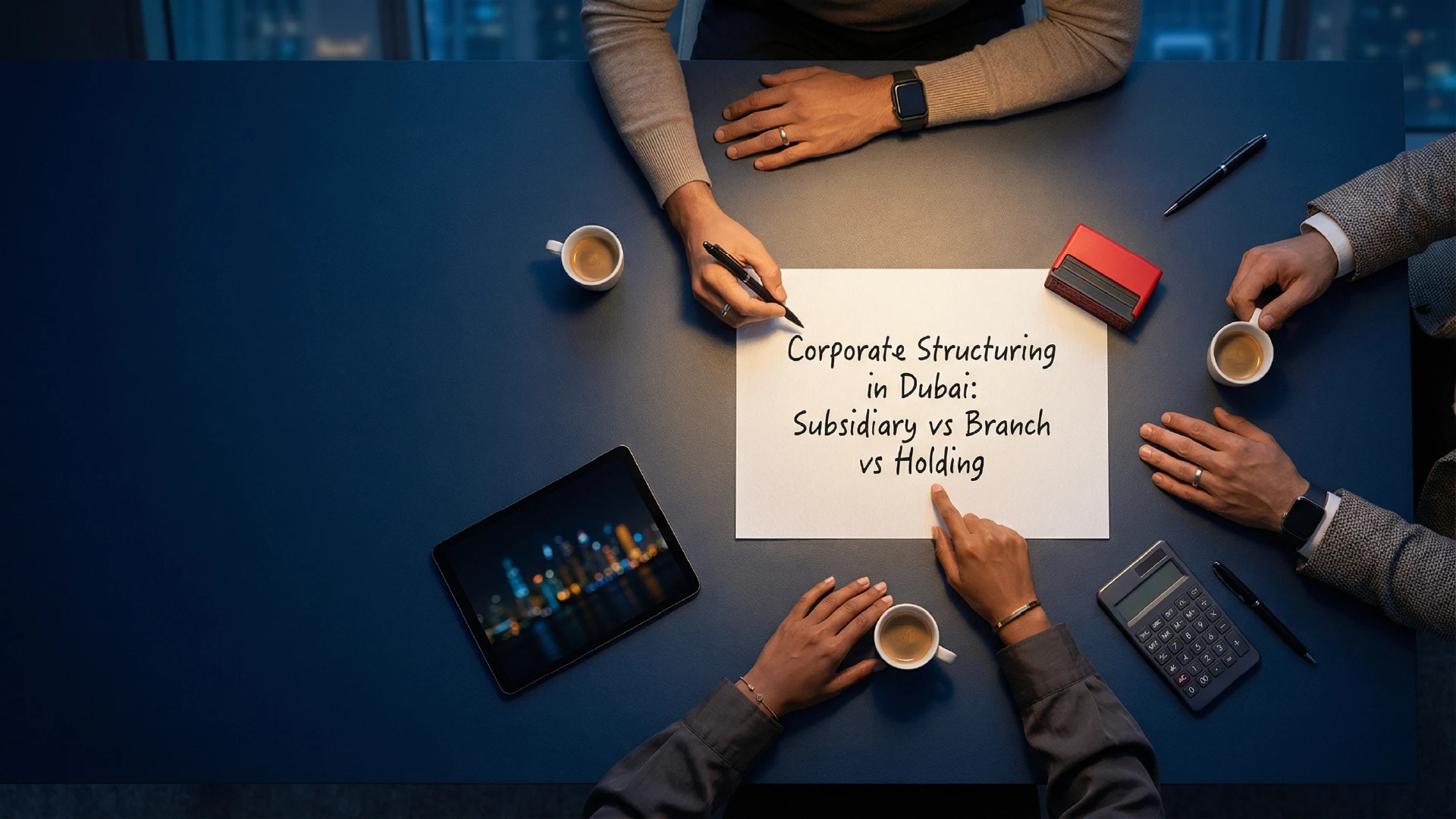

A subsidiary is a separate legal entity that ring-fences liability. A branch is an extension of the parent and carries its liabilities. A holding company owns shares in other entities and does not trade itself. Recent reforms allow 100% foreign ownership in many mainland activities, which changed the calculus — branches are far less often necessary now.
Corporate structuring in Dubai determines how your UAE entity contracts, manages liability, meets compliance requirements, and scales across the mainland and free zones.
Despite the UAE attracting approximately USD 45.5 billion in foreign direct investment, many companies still select structures based on initial speed rather than long-term contractual scope and risk allocation.
Corporate structuring in Dubai is a governance decision. It defines where liability sits, how contracts are executed, how reporting obligations are handled, and how the business expands.
Dubai's economy recorded AED 355 billion in GDP in the first nine months of 2026, with 4.7% growth, based on Government of Dubai reporting. At this scale, entity structure is no longer administrative; it directly affects compliance exposure and operational flexibility.
The central question becomes: should you establish a subsidiary, open a branch, or form a holding company in Dubai?
There is no universal answer, which is why the subsidiary vs branch UAE discussion remains commercially significant.
Structural comparison: subsidiary, branch, and holding company in the UAE
Below is a simplified overview to clarify how each structure typically works in the UAE.
The comparison below summarises the key structural differences:
Feature | Subsidiary | Branch | Holding Company |
Legal Identity | Separate legal entity | Extension of parent company | Separate legal entity |
Liability | Limited to the entity (subject to legal form and compliance) | Parent entity responsible | Depends on structure and intercompany arrangements |
Market Access | Within approved license scope | Within approved license scope | Indirect (through subsidiaries) |
Typical Setup Complexity | Medium | Generally lower | More complex |
Tax Treatment | Subject to UAE corporate tax framework | Subject to UAE corporate tax framework | Depends on income type, structure, and compliance status |
Suitability for Multiple Business Lines | Yes | Generally suited to a single line | Yes |
Subsidiary
A subsidiary is a separate legal entity. It may be wholly or partly owned by a parent company but remains legally independent.
It files its own accounts
It carries its own liability
It operates within the activities and license scope approved for that entity
This structure is relevant where operational separation between business lines is required, for example separate subsidiaries for trading and technology services.
The UAE updated its Commercial Companies Law (Federal Decree-Law No. 32 of 2021), allowing 100% foreign ownership in many mainland activities. As a result, subsidiaries have become more accessible for foreign investors.
In the subsidiary vs branch UAE comparison, legal separation is typically the primary differentiator. For long-term contracts or external investment, subsidiaries are often preferred due to clearer risk containment.
Branch Office
A branch office differs in a key respect: it is an extension of the parent company and not a separate legal entity.
It is typically simpler to establish and is characterised by:
The same legal identity as the parent
Parent-level responsibility for debts and obligations
Direct expansion of an existing international brand
If the branch incurs debt or claims in the UAE, the parent entity typically remains responsible. This distinction may be less material for low-risk service activities, but becomes significant in trading, logistics, construction, or other higher-liability sectors.
In the subsidiary vs branch UAE assessment, liability allocation is often the deciding factor.
Holding Company
A holding company does not conduct operational trading activities. Instead, it holds shares in subsidiaries or other entities.
A holding structure is typically used to:
Manage risk across multiple businesses
Support group governance and ownership planning
Separate assets across entities
A holding company may own multiple subsidiaries operating across different business lines.
The UAE introduced 9% corporate tax on taxable income above AED 375,000. The tax treatment of holding structures and free zone entities depends on specific activities, elections, and compliance requirements. For this reason, structure should be assessed alongside the intended revenue model and where contractual obligations will be performed.
Why initial free zone setup does not replace long-term structuring decisions
Many founders begin in a free zone because the setup pathway can be more straightforward for clearly defined activities. Dubai South Business Hub Free Zone provides a digital-first setup process designed to improve accuracy and reduce repetition during incorporation.
However, initial setup decisions do not eliminate the need for long-term structuring review.
As businesses expand, additional considerations typically arise:
Access to mainland contracts
Increased visa requirements
Institutional banking relationships
Multi-entity group structures
Asset separation and liability management
At this stage, corporate structuring in Dubai becomes a strategic governance decision rather than an administrative formality. The original setup model may require adjustment to support expanded operations, contractual exposure, and regulatory obligations.
Practical implications of choosing the wrong structure
An unsuitable structure can create operational and regulatory constraints over time.
Some tenders and contracting frameworks may apply eligibility conditions that affect branches differently from subsidiaries. If government or semi-government contracting is part of your plan, confirm eligibility requirements early to avoid rework later.
For this reason, the subsidiary vs branch UAE assessment requires careful evaluation of contracting authority and liability exposure.
Banking and account-opening considerations also differ between structures. Financial institutions may assess branches and subsidiaries differently for credit facilities, trade services, and risk exposure.
Structure affects day-to-day operations, particularly in contracting, banking, and liability allocation.
Regulatory developments affecting free zone and mainland interaction
In Dubai, Executive Council Resolution No. (11) of 2026 introduced a framework under which eligible free zone establishments may conduct certain activities outside their designated free zone within the Emirate.
Such activity remains subject to approval, Department of Economy and Tourism (DET) licensing or permitting requirements, and ongoing compliance obligations. Separate accounting records may be required for activities conducted onshore.
These developments increase structuring flexibility but do not remove the need for careful license alignment and regulatory review.
Corporate structuring Dubai: choosing between a subsidiary, branch, or holding company
A structured way to assess the appropriate entity model is to consider the following:
Whether ring-fenced liability is required for employees, assets, or contractual obligations
Whether expansion into other GCC jurisdictions is anticipated within the next 12-24 months
Whether significant local hiring will be required
What the bank may require for account opening, credit facilities, and ongoing compliance
In the UAE, all corporate structures carry compliance obligations, but these obligations differ in scope and exposure:
Subsidiaries are subject to local company law and regulatory requirements aligned with their approved license and activity scope.
Branches remain legally linked to the parent entity and must comply with both parent-level and UAE regulatory obligations.
Holding companies must meet governance, reporting, and ownership requirements appropriate to their structure and income profile.
Addressing these considerations at the structuring stage reduces operational friction and limits the need for restructuring as the business grows.
Common scenarios and the structure that typically fits
The following examples illustrate how each structure may align with different commercial objectives:
Scenario | Typical Structuring Approach |
Entering the market with a single operational business line | A subsidiary is often appropriate where independent contracting authority and ring-fenced liability are required. |
Expanding into the UAE through an existing parent company | A branch may be suitable where the parent intends to contract directly and does not require a separate legal entity. |
Managing multiple subsidiaries or separating assets across business lines | A holding company structure can provide group-level governance and ownership oversight. |
Conclusion
Corporate structuring in Dubai is a foundational governance decision. A subsidiary, branch, or holding company determines how liability is allocated, how contracts are executed, how regulatory obligations are met, and how future expansion is structured.
There is no universal model. The appropriate structure depends on commercial objectives, contracting requirements, risk allocation, and long-term growth plans.
For founders establishing operations through Dubai South Business Hub Free Zone, the advantage lies in beginning with a structured pathway by selecting activities carefully, aligning license scope with intended operations, and planning for future expansion at the outset.
Addressing structuring considerations early reduces operational friction and limits the need for restructuring as the business evolves.