Topic Summary
In 2026, Al Maktoum International Airport, the centrepiece of the dubai south location , is already processing millions of tonnes of air cargo annually, and the surrounding master-planned city spans 145 sq km of…
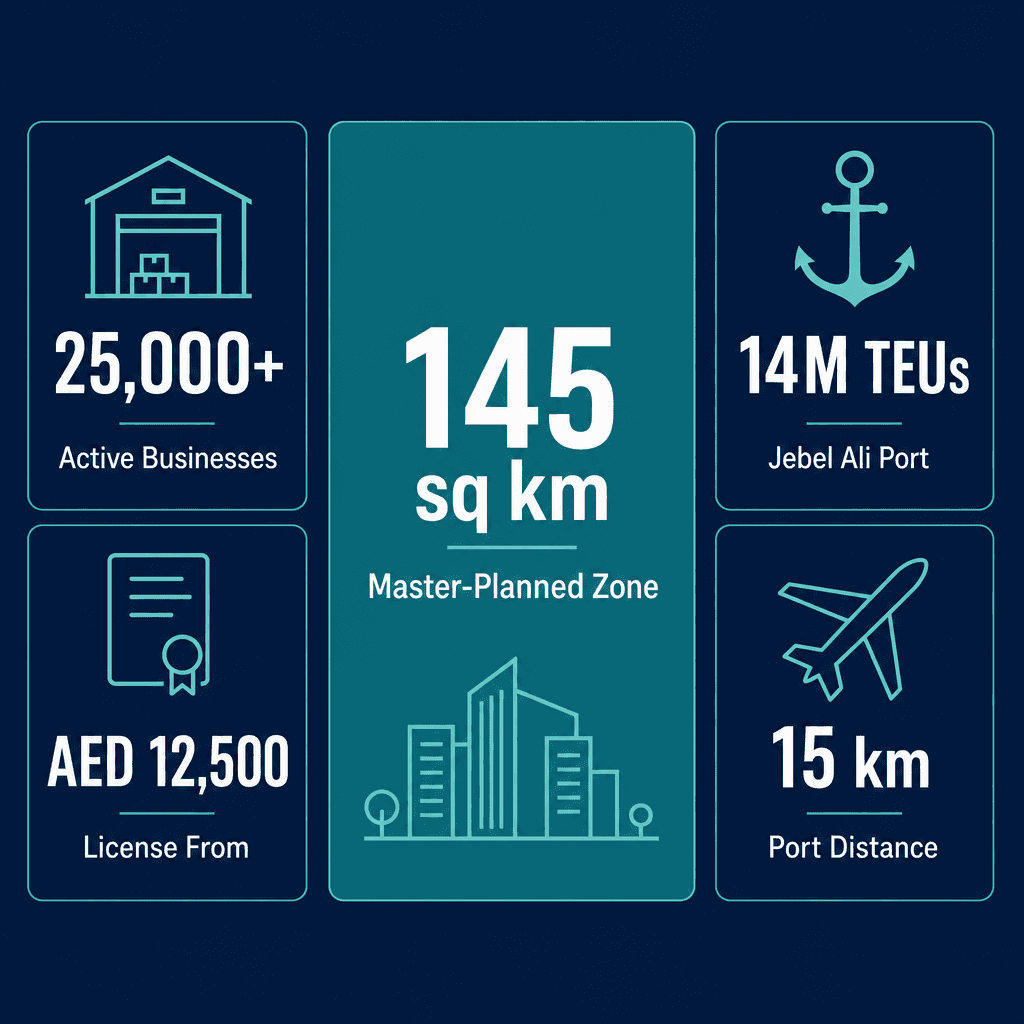
In 2026, Al Maktoum International Airport, the centrepiece of the dubai south location, is already processing millions of tonnes of air cargo annually, and the surrounding master-planned city spans 145 sq km of purpose-built economic infrastructure (Dubai South, 2025). Over 25,000 active businesses operate across the zone (DSBH, 2025). Free zone licenses start from AED 12,500 (DSBH, 2026). Jebel Ali Port, 15 km away, handles over 14 million TEUs annually (DP World, 2024). Al Maktoum is planned to reach 260 million passengers per year at full build-out (Dubai Airports, 2023).
This article covers exactly where Dubai South sits within the emirate, precise drive times and distances to key commercial hubs, every road and planned transport link serving the zone, and, most importantly, why that geography translates into hard competitive advantage for logistics operators, traders, and regional HQ businesses.
What Is Dubai South Location and Why It Matters for Business
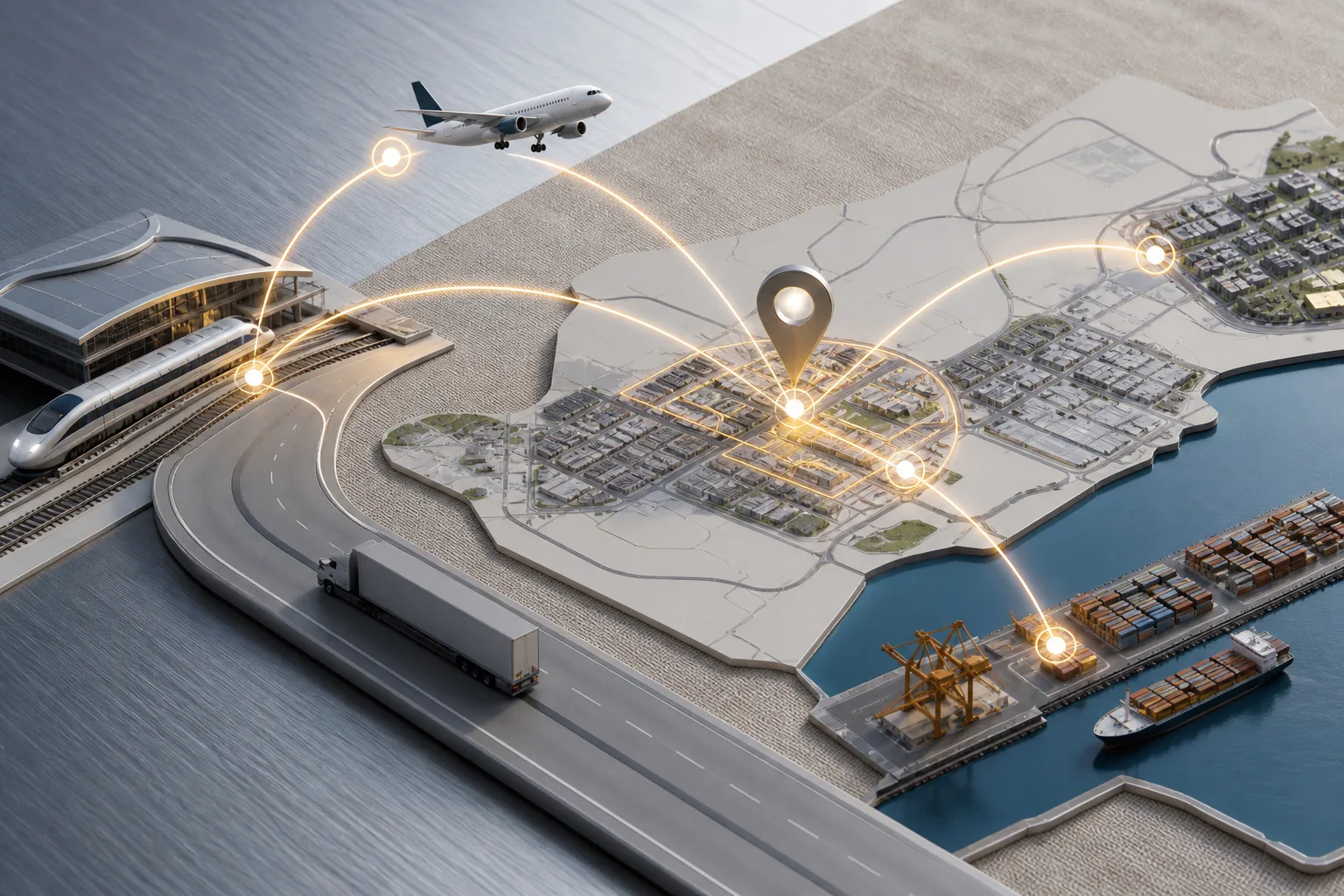
Dubai South is a 145 sq km master-planned city in the south-western corner of the Dubai emirate, roughly 40 km from Downtown Dubai. It is built around Al Maktoum International Airport and sits within 15 km of Jebel Ali Port, giving businesses simultaneous air and sea freight access from a single base. No other UAE free zone address combines both gateways at this proximity. For a deeper look at the zone's structure and licensing options, see our guide on what Dubai South is.
Where Exactly Is Dubai South on the Map
The dubai south location sits at approximately 24.9°N, 55.1°E, the south-western quadrant of the Dubai emirate. Its key boundaries and road access points are:
Sheikh Mohammed Bin Zayed Road (E311), runs through the zone's core, connecting north to Downtown Dubai and south toward Abu Dhabi
Emirates Road (E611), forms the eastern boundary, linking to the broader UAE highway network
Expo City Dubai, directly adjacent on the northern boundary, the legacy site of Expo 2020
A freight forwarder relocating from Business Bay can reach Dubai South in roughly 35 minutes during off-peak hours via E311, cutting last-mile distance to Al Maktoum cargo terminals to near zero. That's a meaningful operational shift for any business paying drayage costs from a central Dubai address. For a detailed breakdown of the sub-districts within the zone, visit our guide on which area is called Dubai South.
How Dubai South Fits Into the Wider UAE Geography
Dubai South sits roughly halfway between Dubai city centre and Abu Dhabi, approximately 100 km from Abu Dhabi city centre. That positions it squarely on the Dubai–Abu Dhabi economic corridor, the most commercially active stretch of road in the UAE. Businesses here can serve clients in both emirates without a dual-office structure.
The proximity to both Jebel Ali Port (15 km) and Abu Dhabi's Khalifa Port (accessible via the same corridor) creates a rare dual-port supply chain option. A regional FMCG distributor, for example, can receive container shipments at Jebel Ali and airfreight consignments at Al Maktoum within a 15 km radius, consolidating their entire UAE distribution from a single Dubai South warehouse.
Dubai South: Distances and Drive Times to Key Destinations
Destination | Distance | Drive Time (Off-Peak) |
|---|---|---|
Al Maktoum International Airport | On-site / 0 km | Direct landside access, no drayage |
Jebel Ali Port | ~15 km | ~15 min via dedicated freight corridor |
Expo City Dubai | ~5 km | ~5 min, adjacent northern boundary |
Downtown Dubai | ~40 km | ~35–45 min via E311 (off-peak) |
Dubai International Airport (DXB) | ~45 km | ~40–50 min via E311/E611 |
Abu Dhabi city centre | ~100 km | ~60–70 min via Sheikh Zayed Road |
Key Distances From Dubai South to Major Destinations
From the dubai south location, Downtown Dubai is roughly 40 km (35–45 min off-peak), Dubai International Airport 45 km (40–50 min), Abu Dhabi city centre 100 km (60–70 min), Jebel Ali Port 15 km (15 min), and Expo City Dubai is directly adjacent at under 5 km. All routes use major UAE highways.
Distances and Drive Times at a Glance
The table above captures the headline numbers. Worth flagging: those drive times assume off-peak conditions. Peak-hour traffic on E311 heading toward Downtown can add 15–25 minutes, so logistics operations that need predictable cut-off times should schedule freight runs before 7 AM or after 8 PM.
Jebel Ali Port is the standout figure. At 15 km, it's the closest major destination on the list, and for import/export businesses, that gap matters more than any other distance. A customs broker with clients at both Jebel Ali and Al Maktoum can service both facilities in a single morning run without leaving the Dubai South corridor. That's an operational efficiency most competing free zone addresses simply can't offer.
Expo City Dubai being under 5 km is relevant for businesses that attend or host large-scale events and trade exhibitions. The venue now operates year-round as a business and events district, and having it on your doorstep is a genuine networking and client-hosting advantage.
Why Short Distances Translate Into Real Cost Savings
Here's the thing most location analyses miss: distance isn't just a time metric, it's a cost metric. Every kilometre between a warehouse and a port or airport adds drayage cost, driver time, and fuel. Dubai South's proximity to Jebel Ali eliminates most of that overhead for sea freight operations.
For time-sensitive air cargo, being 5 minutes from Al Maktoum's cargo apron versus 45 minutes from DXB cuts cut-off compliance risk significantly. A pharmaceutical cold-chain operator established in Dubai South's Logistics District reported reducing drayage spend by consolidating air and sea freight handling within a 15 km radius (Dubai South, 2025). That's a real-world outcome, not a theoretical saving. Abu Dhabi accessibility also means businesses can serve federal government contracts without opening a second office, a consideration that often gets overlooked until the first Abu Dhabi tender lands.
Dubai South Connectivity: Road, Air, and Sea Access
Dubai South sits at the intersection of Sheikh Mohammed Bin Zayed Road (E311) and Emirates Road (E611), with direct airport access via dedicated cargo roads. Al Maktoum International Airport is on-site, and Jebel Ali Port, the world's largest man-made harbour, is 15 km away, making multimodal freight connectivity exceptional.
Road Infrastructure Serving Dubai South
E311 is the spine of the zone. It runs directly through Dubai South, connecting north toward Downtown and south toward Abu Dhabi, so businesses get both markets on a single arterial. E611 provides an eastern bypass and feeds into the broader UAE highway network without requiring transit through urban Dubai.
Within the zone itself, a dedicated internal road network links the Aviation District, Logistics District, Business Park, and residential sub-zones. Tenants moving freight between sub-districts don't need to join public highways. Heavy goods vehicles moving bonded cargo between Jebel Ali Port and Dubai South's Logistics District can use a direct freight corridor that avoids urban traffic entirely, a detail that matters enormously for predictable delivery scheduling.
Air Freight and Passenger Access via Al Maktoum International Airport
Al Maktoum International Airport is physically within Dubai South. Businesses on-site have direct landside access to cargo terminals, no external road journey, no cut-off risk from traffic. The expansion programme targets 12 million tonnes of air cargo per annum at full build-out (Dubai Airports, 2023), and the airport is planned to become the world's largest by passenger throughput at 260 million passengers annually.
The cargo city within the airport complex integrates directly with free zone warehousing, enabling bonded storage adjacent to the apron. An e-commerce fulfilment operator established in Dubai South's Aviation District can load consolidated air cargo onto departing freighters without the consignment ever leaving the free zone boundary. That's a customs and compliance advantage that businesses in other UAE free zones simply can't replicate.
Build Your Sea Freight Strategy Around Jebel Ali Port
Jebel Ali Port handles over 14 million TEUs annually, making it the busiest port in the Middle East (DP World, 2024). At 15 km from Dubai South's core, it's the closest major deep-water port to any UAE free zone, a fact that shapes the economics of sea freight for any business operating here.
DP World operates both Jebel Ali Port and a logistics park within Dubai South, creating an integrated port-to-warehouse offering through a single operator. A trading company importing containerised goods through Jebel Ali can clear customs, truck cargo to a Dubai South bonded warehouse, and re-export by air from Al Maktoum, all within a 15 km operational radius. For detail on structuring operations around this proximity, see our guide on the Dubai South Logistics District.
5 Reasons the Dubai South Location Gives Businesses a Strategic Edge
Dubai South's strategic value comes from five factors: on-site airport access, proximity to Jebel Ali Port, position on the Dubai–Abu Dhabi corridor, planned metro connectivity, and a free zone structure that allows 100% foreign ownership with 0% corporate tax on qualifying profits, all from a single location.
The Five Location Advantages, Ranked by Business Impact
On-site airport: No other UAE free zone has a commercial international airport within its boundary. Air freight drayage cost is zero for on-site tenants.
Jebel Ali Port proximity: 15 km to the Middle East's busiest port creates a genuine multimodal hub. Free zones in Dubai's northern corridor can't replicate this.
Dubai–Abu Dhabi corridor position: Roughly equidistant between the UAE's two largest economic centres. One office serves both markets.
Planned Route 2020 Metro extension: The existing metro line serving Expo City is expected to extend further into Dubai South, improving white-collar workforce commutability from across the emirate.
Free zone fiscal structure: 100% foreign ownership, 0% corporate tax on qualifying profits up to AED 375,000 (UAE FTA, 2023), and full repatriation of capital and profits. Licenses start from AED 12,500 (DSBH, 2026).
A European aerospace MRO company chose Dubai South over a competing Sharjah free zone specifically because the on-site airport allowed direct aircraft movement to their maintenance hangars without airspace transit permits. That single operational requirement made the location decision straightforward.
Is Dubai South Worth It for Businesses Outside Logistics?
Yes, particularly for regional HQs. The fiscal structure compounds the location advantage. A business paying AED 12,500 for a license, operating tax-free on qualifying profits, and avoiding dual-office costs across Dubai and Abu Dhabi can redirect that saving into headcount or inventory. The location advantage isn't only for freight operators; it's for any business that touches the physical movement of goods or needs credible access to both UAE economic capitals. For a full overview of what the zone offers, see our Dubai South overview guide.
Public Transport and Future Connectivity Planned for Dubai South
Dubai South is currently served by road and the Route 2020 Metro line at the adjacent Expo City terminus. The RTA has announced plans to extend metro and bus rapid transit coverage deeper into the zone, with phased delivery aligned to Al Maktoum Airport's expansion timeline, improving workforce access significantly.
How to Get to Dubai South Right Now
By car: E311 from most Dubai locations. 35–45 min from Downtown off-peak.
By metro: Route 2020 Red Line to Expo City terminus, then taxi or ride-hailing for the final leg.
By taxi / ride-hailing: Uber and Careem serve the zone reliably. Dubai Marina to Dubai South takes approximately 20–25 minutes off-peak.
By bus: RTA routes connect Dubai South to Ibn Battuta Mall metro station, a viable option for staff commuting on public transit.
Staff commuting from Dubai Marina can combine the Route 2020 Metro to Expo City with a 10-minute taxi, keeping the total commute under 35 minutes on most mornings. It's not as convenient as a zone with a direct metro stop, but it's workable, and it improves materially once the planned extension is delivered.
Planned Transport Upgrades and Their Business Implications
RTA's long-term transport master plan includes metro extensions and bus rapid transit corridors aligned with Al Maktoum's phased expansion. Improved public transit directly expands the labour catchment area, businesses can recruit from a wider geographic pool without funding staff transport.
A call centre operation that evaluated Dubai South noted that the planned metro extension would open recruitment from Sharjah and Ajman commuter populations, materially widening their talent pool. Logistics operators signing long-term warehouse leases should also factor in the planned E311 interchange upgrades, which will increase freight throughput capacity as Al Maktoum scales toward its full cargo target.
Who Benefits Most From the Dubai South Location
Logistics and freight companies gain most from Dubai South's multimodal access, but aviation MRO operators, e-commerce fulfilment businesses, regional HQs serving the Middle East and Africa, and trading companies all benefit from the zone's position between two international gateways and two major cities.
Logistics, Freight, and Supply Chain Operators
The combination of on-site airport, Jebel Ali proximity, and bonded warehousing makes the dubai south location the strongest logistics address in the UAE. Third-party logistics (3PL) providers can offer clients genuine air-sea intermodal solutions from a single facility, something that typically requires two separate locations elsewhere in the emirate.
A 3PL company serving Gulf retail chains established its regional hub in Dubai South's Logistics District, citing the ability to receive sea freight from Jebel Ali and dispatch urgent replenishment by air from Al Maktoum as the deciding factor. DP World's integrated presence across both Jebel Ali and Dubai South means port handling and inland logistics can be contracted through a single operator, reducing vendor complexity. See our Logistics District guide for warehouse specifications and licensing detail.
Regional HQs and Trade-Facing Businesses
What does it mean to be within an 8-hour flight of roughly 4.5 billion people? For an HQ business managing a MEASA (Middle East, Africa, South Asia) regional team, it means your executive travel costs and response times are structurally lower than from almost any competing hub city.
Dubai South free zone licenses start from AED 12,500 (DSBH, 2026), cost-effective entry for businesses that need a credible UAE address with genuine operational infrastructure. A Singapore-based commodities trader established its MEASA regional HQ in Dubai South specifically to reduce travel time between Abu Dhabi government clients and Dubai-based banking partners, without maintaining two offices. With over 25,000 active businesses already operating across the ecosystem (DSBH, 2025), there's an established B2B network on-site from day one.
Dubai South Location: What to Check Before You Commit
Before establishing in Dubai South, verify which sub-district matches your activity, Aviation, Logistics, Business Park, or Residential, because each has different license types, plot sizes, and infrastructure specs. Confirm current road access to your specific plot, check planned construction timelines, and review the RTA transport schedule for your workforce's commute needs.
Matching Your Business Activity to the Right Sub-District
Dubai South contains five primary sub-districts: the Aviation District, Logistics District, Business Park, Golf District, and Residential District. Each has distinct licensing, infrastructure, and access specifications. A logistics operator needs the Logistics District's bonded warehousing and freight road access, the Business Park's office-focused layout won't serve freight volumes. An aviation MRO business must be in the Aviation District for direct airside access.
An SME that initially licensed in the Business Park sub-district later relocated to the Logistics District after realising its freight volumes required direct bonded warehouse access. The relocation was costly and time-consuming. Getting the sub-district right at the outset is far cheaper than fixing it later. For a detailed breakdown of the sub-zones, see our guide on which area is called Dubai South.
Infrastructure Readiness and Construction Phasing
Dubai South is still in active development. Some sub-districts are fully built out; others are in phased construction. Confirm road completion status for your specific plot, particularly for large-footprint logistics facilities on the outer edges of the zone. Al