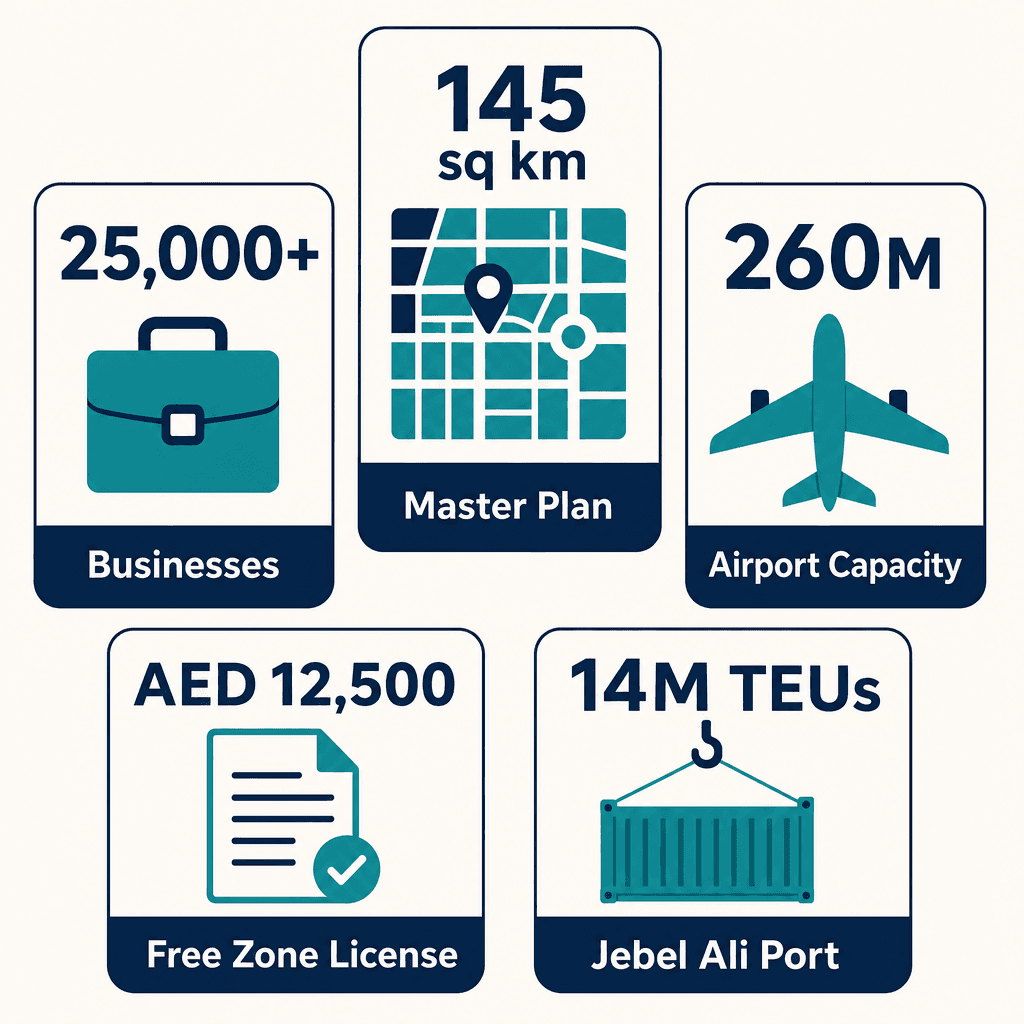
In 2026, Dubai South spans 145 sq km of master-planned urban infrastructure (Dubai South, 2025) and is home to over 25,000 active businesses (DSBH, 2025).
In 2026, Dubai South spans 145 sq km of master-planned urban infrastructure (Dubai South, 2025) and is home to over 25,000 active businesses (DSBH, 2025). Al Maktoum International Airport targets 260 million passengers at full build-out (Dubai Airports, 2023). Free zone licenses start from AED 12,500 (DSBH, 2026). The Route 2020 Metro extension has been operational since 2021 (RTA, 2021). And Jebel Ali Port, 15 km away, handles 14 million TEUs annually (DP World, 2024). Yet the dubai south residential side of this city-within-a-city remains one of the UAE's most underrated living propositions.
This guide covers the dubai south residential landscape: the key communities, lifestyle amenities, and, critically, how living here connects to the wider business and employment ecosystem at one of the world's most ambitious aviation and logistics hubs.
What Is Dubai South Residential and Why It Matters
Dubai South residential refers to the purpose-built housing zones within Dubai South's 145 sq km master-planned city. Designed to accommodate workers, families, and professionals, it includes communities like The Pulse and the Residential District, offering apartments and townhouses within direct reach of Al Maktoum International Airport and the Free Zone. If you're working in the zone, it's a genuinely practical place to call home, not just a dormitory suburb.
A Planned City Designed Around People, Not Just Business
Dubai South wasn't conceived as a standalone free zone. The master plan integrates residential, commercial, logistics, and aviation districts into a single urban framework, a deliberate design choice that sets it apart from older UAE free zones where housing was an afterthought. The residential zones sit directly adjacent to the business and logistics clusters, which means the commute question is largely solved before you sign a lease.
Compare that to the typical experience at JAFZA or DAFZA, where staff routinely commute 45 to 60 minutes from Dubai Marina or JLT. A logistics manager based at a Dubai South Free Zone company can live in The Pulse, a 10-minute drive from their office, rather than sitting on Sheikh Zayed Road for an hour each way. That's not a minor convenience, it's a meaningful quality-of-life difference.
Who Typically Lives in Dubai South
If you work in Dubai South, why commute when the community is already here? The primary residents are employees of Dubai South Free Zone companies, airport and logistics staff, and aviation sector professionals. Airline and ground-handling crews based at Al Maktoum International Airport are among the most natural residents, proximity to the airport is a direct operational benefit, not just a lifestyle preference.
There's also a growing segment of families and young professionals attracted by rents that sit below comparable units in central Dubai. And investors are increasingly purchasing dubai south apartments for rental yield, drawn by the large and expanding employed workforce in the zone.
The Pulse vs. Dubai South Residential District: Community Comparison
Feature | The Pulse | Residential District |
|---|---|---|
Developer | Dubai South Properties (the zone's own developer) | Multiple developers; phased delivery aligned with airport expansion |
Property types | Apartments, townhouses, The Pulse Beachfront sub-community | Studios, 1-bed and 2-bed apartments, townhouse clusters |
Retail and dining | The Pulse Boulevard: walkable cafes, supermarkets, gyms, F&B | Limited on-site retail; residents rely on The Pulse Boulevard or Ibn Battuta Mall |
Community maturity | Most established residential community in Dubai South; pools and parks in place | Still developing; infrastructure delivery phased through late 2020s |
Best suited for | Professionals and families wanting walkable amenities and lifestyle focus | Cost-conscious residents and investors seeking affordable entry into a growing city |
Key Communities in Dubai South Residential
The two primary dubai south residential communities are The Pulse, a retail-anchored mixed-use neighbourhood developed by Dubai South Properties, and the Dubai South Residential District, a larger planned zone offering affordable apartments and townhouses. Both provide access to parks, retail, and transport links within the master-planned city.
The Pulse: Dubai South's Retail-Anchored Neighbourhood
The Pulse is developed by Dubai South Properties, the zone's own master developer, which gives it unusually strong alignment with the broader city plan. You get a mix of apartments, townhouses, and a retail boulevard anchored by supermarkets, cafes, gyms, and leisure outlets. The Pulse Beachfront, a newer sub-community, adds a resort-style dimension that's genuinely distinctive for this part of Dubai.
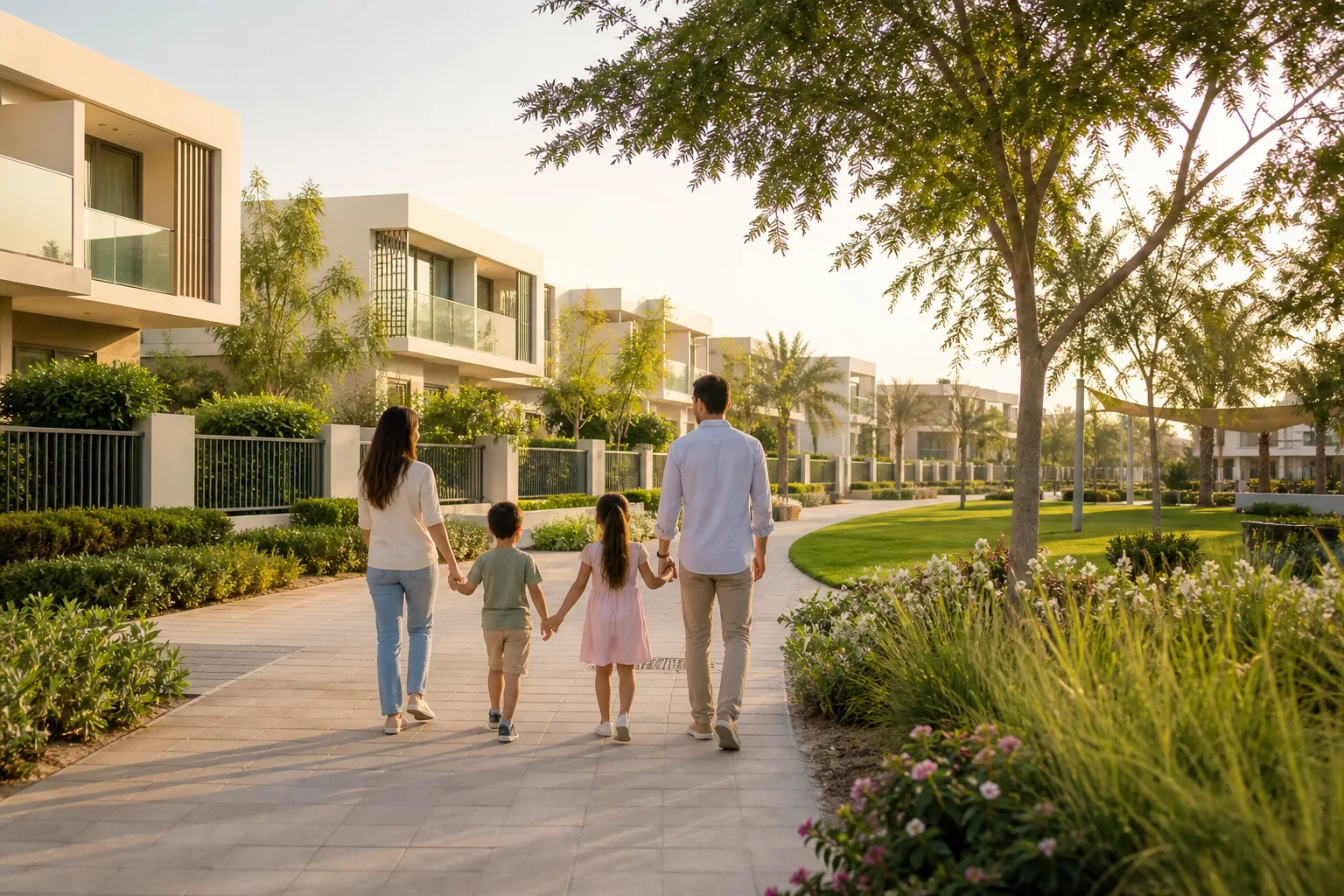
The Pulse Boulevard functions as the community's high street. Residents can walk to cafes, gyms, and convenience retail without leaving the neighbourhood, a rarity in Dubai's typically car-dependent suburbs. Community pools and landscaped parks are established, giving The Pulse a lived-in feel that newer developments in the area haven't yet matched.
Dubai South Residential District: Scale and Affordability
The broader Residential District is the larger-scale housing zone planned to accommodate the city's growing population. It offers studios, 1-bed, and 2-bed dubai south apartments alongside townhouse clusters, with rents generally sitting below comparable units in JLT, Dubai Marina, or Business Bay.
A 1-bedroom apartment in the Dubai South Residential District typically rents at a meaningful discount to a comparable JLT unit (Property Monitor, 2025), making it attractive for zone professionals who want to reduce their total cost of living. Infrastructure delivery is phased alongside the Al Maktoum airport expansion timeline, so expect continued development through the late 2020s. Early movers get the best rents; later arrivals get a more complete amenity set.
Lifestyle and Amenities: What Daily Life Looks Like
Daily life in the dubai south residential communities centres on walkable retail at The Pulse Boulevard, community parks, schools, and healthcare facilities within the master plan. Residents benefit from a quieter, less congested environment than central Dubai, with the trade-off of a developing rather than fully mature amenity ecosystem.
Retail, Dining, and Day-to-Day Convenience
The Pulse Boulevard is the primary retail spine: supermarkets, cafes, restaurants, and lifestyle retail within walking distance. For bigger shopping trips, Ibn Battuta Mall is roughly 20 minutes by car via Sheikh Zayed Road. Residents frequently cite that split as practical rather than problematic, The Pulse handles the everyday, Ibn Battuta handles the rest.
It's worth being honest here: the F&B scene within the community is growing but still maturing. If you're used to the variety of JLT or Downtown, you'll notice the difference. That said, the trade-off, lower rent, less congestion, quieter streets, works well for many professionals and families who've made the move.
Schools, Healthcare, and Community Infrastructure
Living in dubai south means relying on the broader Jebel Ali and Discovery Gardens corridor for schooling while on-site education options continue to develop. Healthcare is covered by clinics and pharmacies within the community, with major hospitals accessible via Emirates Road or Sheikh Zayed Road.
Parks, jogging tracks, and community pools: established within The Pulse
Schools: Jebel Ali and Discovery Gardens corridor options; on-site education still building out
Healthcare: community clinics and pharmacies in place; hospital access via main arterials
Public transport: RTA bus routes serve the area; Route 2020 Metro operational since 2021 (RTA, 2021)
The Route 2020 Metro extension, serving Expo City Dubai station adjacent to Dubai South, is the most significant public transport asset for residents without a car. It connects the community to the broader Dubai Metro network, making car-free living viable, if not entirely effortless yet.
Is living in Dubai South suitable for families?
Dubai South residential suits families who prioritise space, lower rents, and a quieter environment over central Dubai's density. Schools are accessible via the Jebel Ali corridor, community parks and pools are established within The Pulse, and healthcare clinics operate within the neighbourhood. It's a practical family base, particularly for those employed in the zone.
5 Reasons Professionals Choose Dubai South Residential Over Central Dubai
Professionals choose living in dubai south primarily for proximity to the Free Zone and airport, lower rents versus central Dubai, reduced commute time, a quieter community environment, and improving transport links via the Route 2020 Metro. For those employed in the zone, the live-work proximity case is compelling and financially straightforward.
The Five-Point Case for Living in Dubai South
Live-work proximity: Cut your commute to under 15 minutes if you're employed in the Free Zone or at Al Maktoum Airport.
Rental affordability: Lower per-sq-ft rents than JLT, Business Bay, or Dubai Marina for comparable unit sizes.
Community environment: Less congested, lower traffic density, quieter streets, a real draw for families and professionals who want calm.
Metro access: Route 2020 extension connects residents to the broader Dubai Metro without needing a car.
Growth upside: Al Maktoum's full build-out to 260 million passengers (Dubai Airports, 2023) is decades away, the community will only grow, which matters if you're buying or locking in a long-term lease.
A free zone business owner who licenses through Dubai South (from AED 12,500 as of 2026, DSBH) and lives in The Pulse can walk or take a short drive to the office, attend meetings at the airport, and return home, all within a single master-planned precinct. That operational simplicity has genuine daily value that's hard to put a price on.
Living and Working in Dubai South: The Live-Work Advantage
The live-work advantage of dubai south residential is direct: residents employed in the Free Zone, at Al Maktoum International Airport, or in the logistics corridor eliminate long cross-city commutes. For business owners and employees alike, proximity to workplace, clients, and cargo infrastructure within one master-planned city is a measurable quality-of-life and productivity gain.
How Residential Proximity Supports Business Operations
What makes Dubai South different from older free zones isn't just the license cost, it's the intentional co-location of where you work and where you live. Business owners licensing through Dubai South Free Zone can live in The Pulse, attend client meetings at the business hub, and reach the airport cargo terminal in under 20 minutes. For SMEs and solo operators, eliminating a 90-minute round-trip commute frees up real time and cuts transport costs.
An e-commerce operator running a Dubai South Free Zone license and using the zone's warehousing can live in The Pulse Residential District, manage their warehouse operation, and process customer returns, all within a 5 km radius. That operational density is genuinely unusual in the UAE, and it's one of the reasons the zone targets e-commerce, logistics, aviation, and trading businesses as its core sectors (DSBH, 2025).
Build a Life Around Your Business Hub
Compare a JAFZA-licensed business where the owner commutes daily from Dubai Marina versus a Dubai South Free Zone business where the owner lives in The Pulse. The latter saves 10+ hours of commute time per week, a non-trivial operational advantage for a small team where every hour counts. Jebel Ali Port sits 15 km away, handling 14 million TEUs annually (DP World, 2024), so the logistics infrastructure surrounding the residential community is world-class.
For startups and growing SMEs, having founders and key staff living locally can accelerate decision-making and reduce operational friction in ways that are hard to quantify but easy to feel. As Al Maktoum Airport scales and the residential community matures, this live-work proposition only gets stronger.
What types of businesses benefit most from living in Dubai South?
Aviation, logistics, e-commerce, and trading businesses gain the most from the Dubai South residential live-work model. Founders and staff can access warehousing, cargo terminals, and the Free Zone business hub within a single 5 km precinct. The 8-hour flight radius from Al Maktoum covers approximately 4.5 billion people (DSBH, 2025), making it a natural base for import-export and distribution operations.
Is Dubai South Residential Right for You? Key Considerations
Dubai South residential suits professionals and families employed in the zone or at Al Maktoum Airport, those prioritising affordability and live-work proximity over central Dubai lifestyle density. It's less suited to those who want the nightlife and retail variety of Downtown or Dubai Marina, or who work in a different part of the city.
Who It Works Well For
Professionals employed in Dubai South Free Zone, Al Maktoum Airport, or the logistics and warehousing corridor
Families seeking a quieter, lower-density community at more accessible rents
Investors purchasing dubai south apartments for rental yield from the zone's large employed workforce
Early movers who want to establish roots before full infrastructure maturity pushes rents higher
Aviation and ground-handling professionals based at Al Maktoum are arguably the ideal Dubai South resident profile. Proximity to the airport is both a lifestyle and operational benefit, and as the airport scales toward its 260 million passenger target (Dubai Airports, 2023), that resident base will only grow.
Honest Trade-Offs to Consider
Amenity ecosystem is still maturing, JLT or Downtown offer more variety right now
Car dependency remains real outside the Metro corridor; a vehicle improves daily convenience significantly
Population density isn't yet at the level that supports a full high-street dining and retail scene
Follow the development timeline: infrastructure is phased and tied to airport expansion milestones
Residents who moved to The Pulse in its early phases consistently note the trade-off: lower rent and less congestion, but you'll drive to Ibn Battuta for a wider dining or shopping choice. That's a fair exchange for many, but it's worth knowing upfront rather than discovering after you've signed a 12-month contract.
Where to Go From Here
Dubai south residential offers a genuinely compelling live-work proposition for professionals connected to the zone's business and aviation ecosystem. The communities are growing, the infrastructure is maturing, and for those employed in the area, the case for living here is practical, financial, and increasingly lifestyle-driven.
Next Steps for Prospective Residents and Business Owners
If you're exploring living in dubai south, visit The Pulse community in person before committing. The neighbourhood has a distinct feel, quieter, more spacious, less frenetic than central Dubai, and a ground-level visit will tell you quickly whether it suits your lifestyle.
If you're a business owner, think about how co-locating your license