
Last updated: June 2026 By Editorial Team , UAE business setup specialists with direct experience guiding foreign nationals through free zone and mainland company formation.
Last updated: June 2026
By Editorial Team, UAE business setup specialists with direct experience guiding foreign nationals through free zone and mainland company formation. Full bio →
Table of Contents
Can Foreigners Start a Business in Dubai? The Direct Answer
What the 2021 Ownership Reforms Changed for Foreign Nationals in Dubai
Free Zone vs. Mainland: Which Structure Works Best for Foreign-Owned Companies
6 Steps to Set Up a Business in Dubai as a Foreign National
Investor and Partner Visas: What Residency Rights Come with Your Foreign-Owned Company
Why Dubai South Business Hub Free Zone Is the Smart Entry Point for Foreign Entrepreneurs
Common Questions: Can Foreigners Start a Business in Dubai?
In 2026, over 200,000 foreign-owned businesses operate across Dubai's free zones and mainland (Dubai Chamber of Commerce, 2024). The UAE hosts more than 45 active free zones (UAE Ministry of Economy, 2024). Since June 2021, UAE Federal Decree-Law No. 26 of 2020 opened nearly all mainland sectors to 100% foreign ownership (UAE Official Gazette, 2021). Free zone license issuance can take as little as 3–5 business days (DSBH, 2026). Setup packages at entry-level free zones start from approximately AED 10,000 (DSBH pricing, 2026). Investor visas are valid for 2–3 years and renewable (UAE ICA, 2024). The UAE ranked 16th globally on the World Bank's Ease of Doing Business Index (World Bank, 2020, still referenced as of 2026).
This guide gives you a definitive, step-by-step answer to whether foreigners can start a business in Dubai as a foreign national, covering ownership rules, document requirements, remote setup options, restricted sectors, visa entitlements, and real cost figures. By the end, you'll know exactly which structure fits your situation and what to do next.
Can Foreigners Start a Business in Dubai? The Direct Answer
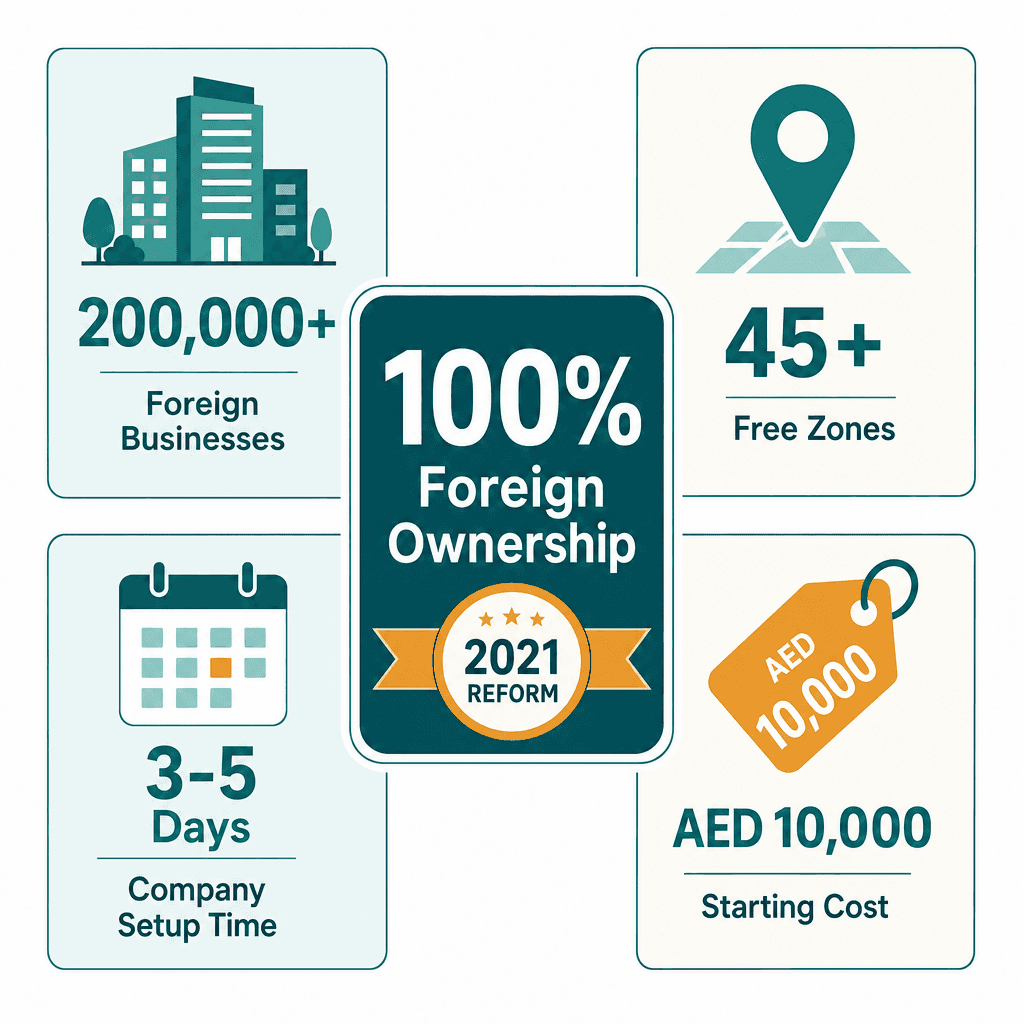
Yes, foreigners can 100% own and operate a business in Dubai. Free zones have always permitted full foreign ownership since their inception. Since 2021, UAE Federal Decree-Law No. 26 of 2020 extended 100% foreign ownership to most mainland sectors, eliminating the historic local sponsor requirement for the vast majority of business activities. This is one of the most significant policy shifts in UAE commercial history, and it directly affects every foreign national business Dubai setup today.
The Historic Local Sponsor Requirement and Why It No Longer Applies
Before 2021, UAE federal law required a UAE national to hold at least 51% of any mainland company. This "local sponsor" model shaped decades of expat business setup, foreign entrepreneurs either partnered with an Emirati sponsor (often paying an annual fee for a passive stake) or routed their company through a free zone to avoid the restriction entirely. Free zones like JAFZA, DAFZA, and Dubai South were always exempt from this rule, which is precisely why they became the default entry point for foreign entrepreneurs from the 1980s onward.
UAE Federal Decree-Law No. 26 of 2020, effective June 2021, abolished the 51% Emirati shareholding requirement for most commercial and professional activities on the mainland (UAE Ministry of Economy, 2021). A UK entrepreneur who set up a marketing consultancy on Dubai mainland in 2019 was legally required to give 51% ownership to a UAE national. The same setup in 2022 required zero local equity partner, full 100% foreign ownership, registered directly with the Dubai Department of Economic Development (DED).
Restricted and Strategic Sectors That Still Require Emirati Ownership
A defined list of strategic and restricted activities still mandates Emirati majority ownership. The UAE Cabinet periodically updates this list, and checking it before selecting your activity code is a non-negotiable first step. Restricted categories include:
Oil and gas exploration and production
Private security and armoured vehicle services
Military manufacturing and defence contracting
Certain government-related and public utility services
Recruitment agencies (partial restrictions apply)
For most foreign entrepreneurs, in tech, consulting, trading, logistics, media, healthcare, education, and hospitality, the restricted list is simply irrelevant. A Canadian fintech founder launching a payment-technology consultancy faces zero ownership restrictions. A foreign national applying to operate an armoured vehicle security service, however, would need an Emirati majority partner. The UAE Cabinet Resolution on restricted activities lists approximately 13 broad categories (UAE Cabinet, 2021). Outside those categories, the DED now processes 100% foreign-owned mainland LLCs as standard.
What the 2021 Ownership Reforms Changed for Foreign Nationals in Dubai
The 2021 reforms under UAE Federal Decree-Law No. 26 of 2020 eliminated the mandatory 51% Emirati shareholding rule for most mainland business activities. Foreign nationals can now own 100% of a mainland LLC without a local sponsor, making Dubai one of the most open business environments in the GCC for non-UAE resident business setup.
Free Zone Ownership vs. Mainland Ownership: A Side-by-Side View
Free zones have offered 100% foreign ownership since their inception, no reform was needed. That's always been their core value proposition. The 2021 change brought the mainland into alignment, but a key difference remains: it's not about ownership, it's about market access. Mainland companies can trade directly anywhere in the UAE. Free zone companies typically need a local distributor or a separate DED branch to supply UAE retail outlets directly.
A German e-commerce brand setting up in Dubai South Free Zone can sell globally duty-free but needs a mainland agent or branch to supply UAE retail outlets directly. That distinction drives the structural decision for most foreign nationals, not ownership percentage.
What Documents a Foreigner Actually Needs to Set Up
The document requirement is genuinely straightforward. You do not need a UAE residence visa to incorporate a company in Dubai. Here's what you'll typically need:
Passport copy, the primary and often only mandatory document
Passport-size photo, digital format accepted at most free zones
Proof of address, a utility bill or bank statement (some free zones waive this)
Completed application form, provided by the free zone or DED
Business plan summary, required only for certain regulated activity categories
A US-based consultant incorporated a Dubai South Free Zone company entirely via email and courier in under two weeks. Passport copy, photo, and completed application form were the only requirements. No UAE bank account was needed at incorporation, banking follows license issuance, not the other way around. Some free zones now accept fully notarised digital document submissions, enabling remote setup without a single in-person visit.
Free Zone vs. Mainland: Which Structure Works Best for Foreign-Owned Companies
For most foreign nationals entering Dubai, a free zone company offers the fastest, lowest-cost path to 100% ownership, zero corporate tax on qualifying income, and straightforward visa eligibility. Mainland suits businesses that need direct UAE market access or government contracts. The right choice depends on your sales geography and activity type, not a single universal answer.
Free Zone vs. Mainland: Head-to-Head for Foreign-Owned Businesses
Feature | Free Zone | Mainland (DED) |
|---|---|---|
Foreign Ownership | ✅ 100% always | ✅ 100% (most sectors, post-2021) |
Direct UAE Market Access | ❌ Requires local distributor or branch | ✅ Unrestricted |
Setup Cost (entry-level) | AED 10,000–25,000 | AED 15,000–40,000+ |
Corporate Tax | 0% on qualifying income | 9% on taxable income above AED 375,000 |
License Timeline | 3–10 business days | 7–15 business days |
Remote Setup | ✅ Fully remote at many free zones | ❌ In-person visit typically required |
Physical Office Required | Virtual office options available | Physical address usually required |
A Singapore-based IT services firm targeting global clients chose Dubai South Free Zone; a Turkish food distributor targeting UAE supermarket chains chose a mainland LLC for unrestricted local trading rights. Neither decision was wrong, they reflect different revenue geographies. UAE corporate tax at 9% applies to taxable income above AED 375,000 (effective June 2023), while free zone qualifying income remains taxed at 0% under the UAE Corporate Tax Law (UAE Federal Tax Authority, 2023).
Can You Set Up a Foreigner Company in Dubai Remotely Without Visiting?
Yes, and this is one of the most underappreciated advantages of the free zone model for non-UAE resident business setup. Multiple Dubai free zones, including Dubai South Business Hub, support fully remote incorporation. The process runs: digital document submission, virtual approval, license issued and couriered to your home address, then bank account opened (select UAE banks now allow video KYC for business accounts).
An Australian founder incorporated her consulting firm at a Dubai free zone without leaving Sydney. Documents were submitted digitally; the license arrived by courier in 10 business days. Mainland setup is a different story, it typically requires at least one in-person visit for DED notarisation and the Emirates ID biometrics appointment once the investor visa is approved. For non-residents testing the Dubai market before committing to relocation, remote free zone setup is the obvious starting point. Explore free zone vs mainland for foreign-owned companies in detail before deciding.
6 Steps to Set Up a Business in Dubai as a Foreign National
Setting up a business in Dubai as a foreign national takes six core steps: choose your business activity, select a jurisdiction, reserve your trade name, submit incorporation documents, obtain your trade license, and apply for your investor or partner visa. The full process typically takes 1–3 weeks for free zone setups, here's exactly how each stage works.
Step 1: Choose Your Business Activity and Legal Structure
Start by identifying your activity code. UAE free zones and the DED map all licensed activities to internationally standardised classifications, including the UN's ISIC Rev.4 framework, which organises every productive economic activity into a four-level hierarchy (Section, Division, Group, Class). Your activity determines your license type (commercial, professional, or industrial) and whether any restricted sector rules apply.
A US-based logistics entrepreneur selected "freight transport by road" as her activity, a classification that maps directly to ISIC Division 49 and is fully open to 100% foreign ownership at Dubai South. Getting the activity code right at this stage prevents costly amendments later. Legal structure options for foreigners include: Free Zone Establishment (FZE) for sole proprietors, Free Zone Company (FZC) for multiple shareholders, or a mainland LLC registered with the DED.
Steps 2 Through 6: From Trade Name to Visa
Select your jurisdiction, free zone (Dubai South, DMCC, DIFC, DAFZA) or DED mainland. Base the decision on market access needs and your budget.
Reserve your trade name, submit three name options to the free zone authority or DED. Names must comply with UAE naming conventions (no religious references, no offensive terms, no names identical to existing registered entities).
Submit incorporation documents, passport copy, photo, completed application form, and any activity-specific approvals from external regulators (e.g., health authority approval for medical activities).
Receive your trade license, issued digitally or physically. Typical free zone timeline: 3–10 business days. Mainland DED: 7–15 business days.
Apply for your investor or partner visa, your license triggers eligibility for a 2–3 year renewable UAE residence visa. Emirates ID follows your biometrics appointment, typically within 5–7 working days of visa stamping (UAE ICA, 2024).
A Brazilian entrepreneur followed this exact sequence at Dubai South Business Hub Free Zone: name reserved on Day 1, license issued Day 7, visa application submitted Day 10, Emirates ID collected Day 21. Dubai South Business Hub compresses steps 2 through 5 into a single managed process, a dedicated relationship manager handles name reservation, document submission, and license issuance as a bundled service.
Investor and Partner Visas: What Residency Rights Come with Your Foreign-Owned Company
Once your Dubai trade license is issued, you're eligible to apply for a UAE investor or partner visa, a 2–3 year renewable residence visa that grants full UAE residency rights. This visa allows you to sponsor dependants, open a UAE bank account, and apply for an Emirates ID, making it the practical foundation of your UAE life as an expat business Dubai owner.
Investor Visa vs. Partner Visa: Which One Applies to You
The investor visa applies to shareholders in a mainland LLC or free zone company who hold equity in the business. It's the most common route for foreign entrepreneurs. The partner visa covers company partners specifically, terminology varies by emirate and free zone, but both functionally deliver the same residency entitlement. Neither requires a minimum salary; equity ownership in your own company is the qualifying criterion.
Both visas are valid for 2–3 years, renewable, and confer full UAE residency, allowing you to live, work, and travel freely. A Dutch national who owned 100% of her Dubai South free zone consultancy applied for an investor visa immediately after license issuance. It was approved in 12 business days, including medical examination and biometrics. Dependant visa sponsorship becomes available once your investor visa is active. For a detailed breakdown, see our guide on partner visa Dubai.
Follow-on Benefits: Emirates ID, Banking, and Golden Visa Pathways
Your Emirates ID is issued after biometrics. It functions as your national ID within the UAE and is required for banking, utilities, and most government services. UAE business bank account opening follows Emirates ID issuance, major banks including Emirates NBD, ADCB, FAB, and Mashreq require in-person KYC for business accounts, so plan for one UAE visit after license issuance if you set up remotely.
Foreign nationals who invest AED 2 million or more, or meet specific criteria for specialised talent or outstanding entrepreneurs, may qualify for a 10-year UAE Golden Visa (UAE ICA, 2024). A South Korean tech founder used his Dubai free zone license as the foundation for a Golden Visa application after his startup crossed AED 2 million in investment valuation. The sequence, business license, investor visa, Emirates ID, bank account, is linear and well-defined. There's no ambiguity once you start.
Why Dubai South Business Hub Free Zone Is the Smart Entry Point for Foreign Entrepreneurs
Dubai South Business Hub Free Zone offers foreign nationals 100% ownership, a strategic location inside Dubai's logistics and aviation corridor next to Al Maktoum International Airport, competitive setup packages, and end-to-end incorporation support. For non-UAE residents who want to launch your company at Dubai South Business Hub Free Zone without relocating first, it's one of the most practical entry points available.
Build Your Business Inside Dubai's Logistics and Commerce Corridor
Dubai South spans 145 square kilometres and is home to Al Maktoum International Airport, projected to reach a capacity of 260 million passengers annually at full build-out (Dubai South Authority, 2024). That scale matters for foreign entrepreneurs in logistics, supply chain, aviation services, and trade, the free zone's position gives license holders natural proximity to the businesses and partners they need to grow.
DSBH offers flexible desk-space, virtual office, and warehousing options, ideal for foreign nationals who want a UAE business address without committing to long-term physical office leases. A Canadian freight forwarding startup chose DSBH specifically for its proximity to Al Maktoum Airport, allowing the team to meet airline cargo partners within a 10-minute drive of their registered office. For activity types spanning logistics, consulting, trading, media, and tech, DSBH's license portfolio covers the full range.
How DSBH Compares to Other Free Zones for Foreign-Owned Startups
While DMCC anchors commodities and DIFC anchors financial services, DSBH's strength sits in logistics, aviation-adjacent services, and general trading. Setup packages at DSBH are competitively positioned against premium free zones, DIFC and DMCC entry costs regularly exceed AED 50,000, while DSBH packages start from a significantly lower threshold (DSBH pricing, 2026). License issuance at DSBH runs
References
Editorial sources available on request. Full citation list is being compiled.