

Topic Summary
In 2026, Dubai Customs processes over 16 million trade declarations annually, and every single one requires a valid HS code to clear (Dubai Customs, 2025).
In 2026, Dubai Customs processes over 16 million trade declarations annually, and every single one requires a valid HS code to clear (Dubai Customs, 2025). An HS code (Harmonized System code) is a 6-digit international product classification number required on every import and export shipment. The UAE extends this to 8 digits for its national tariff schedule. Over 200 countries use the same system (World Customs Organization, 2024). Standard GCC import duty sits at 5% of CIF value for most goods. Penalties for misdeclaration start from AED 1,000 per declaration (Dubai Customs Tariff Law). The WCO HS 2022 revision changed over 350 subheadings, so codes from older shipment files may already be wrong.
This guide covers what HS codes are, how to run a dubai customs hs code check using official portals, how UAE customs duty rates are structured by code, and the common mistakes that cause clearance delays, plus how your free zone setup affects your customs obligations.
What Is an HS Code and Why It Matters for Dubai Importers
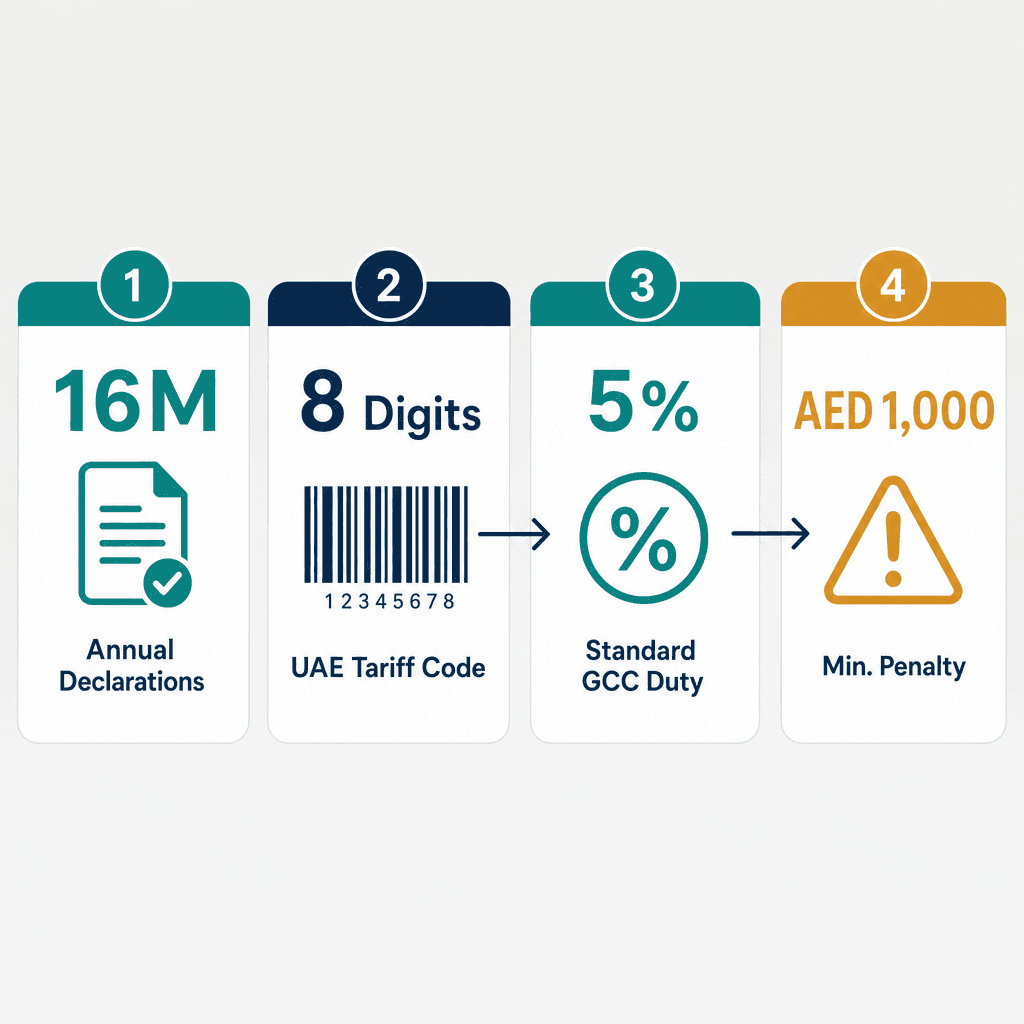
An HS code is a standardised numerical code developed by the World Customs Organization to classify traded goods. In the UAE, the 6-digit international base code is extended to 8 digits for the UAE Customs Tariff. Every shipment entering or leaving Dubai must carry the correct hs code dubai to determine duty rates and clear customs.
The Harmonized System - A Global Standard Managed by the World Customs Organization
The Harmonized System has been in continuous use since 1988 and covers over 5,000 commodity groups at the 6-digit level globally (World Customs Organization, 2024). It's the backbone of international trade documentation, every commercial invoice, bill of lading and customs declaration must reference it. The structure is logical: the first 2 digits identify the chapter (product family), digits 3-4 identify the heading, and digits 5-6 identify the subheading.
In the UAE, both Dubai Customs and the Federal Customs Authority (FCA) extend the 6-digit harmonized system code dubai to 8 digits to reflect GCC-specific tariff lines. Those final 2 digits matter, they determine the precise duty rate applicable to your goods under the GCC Common External Tariff.
Take smartphones as a concrete example. A shipment falls under HS Chapter 85 (Electrical Machinery), heading 8517, subheading 851712, a 6-digit global code that the UAE then extends to an 8-digit national code. Searching the wrong heading (say, 8525 for transmission equipment) would produce a different duty rate and trigger a customs query on arrival.
Why the Right HS Code Directly Affects Your Import Costs
The hs code dubai you declare determines your customs duty rate. Getting it wrong means either overpaying (money tied up unnecessarily) or underpaying (which triggers a recalculation, interest charge and potential penalty). Both outcomes cost you more than getting it right the first time.
Misclassification can trigger a shipment hold at Jebel Ali Port or Al Maktoum International Airport, a formal re-examination of goods, or an administrative penalty starting from AED 1,000 per declaration under the Dubai Customs Tariff Law. For businesses holding a trading business license in Dubai, HS code accuracy across all shipments is a compliance requirement, not an optional detail. Insurance certificates, Letters of Credit and trade finance documents all reference HS codes, so an error cascades through the entire transaction.
A practical example: a Dubai trading company importing industrial lubricants under a generic 'chemicals' code rather than the specific Chapter 27 petroleum lubricant subheading could face a duty recalculation and an AED 5,000+ administrative penalty from Dubai Customs. The correct code was always there, the cost was avoidable.
How to Find Your HS Code for Dubai Customs - Step-by-Step
To find your hs code dubai, go to dubai.customs.gov.ae or the UAE Federal Customs Authority portal at fcauae.gov.ae, use the tariff search tool to search by product keyword, browse to the most specific matching subheading, confirm the applicable duty rate, then include the 8-digit UAE code on all shipping documents and commercial invoices.
Steps 1 Through 5 - Using the Dubai Customs Tariff Search Portal
Go to the portal. Visit dubai.customs.gov.ae or the UAE Federal Customs Authority portal at fcauae.gov.ae, both give you access to the full UAE tariff schedule.
Enter a product keyword. Navigate to the Tariff Search tool and type a product description: 'mobile phone', 'cotton shirt', 'motor vehicle parts'. Keep it specific, generic terms return too many results.
Drill down to the most specific code. Browse results and select the most precise subheading that matches your product. Never settle for a parent category when a specific subheading exists.
Verify the duty rate. Check the customs duty rate shown against the specific 8-digit UAE code. Note whether any preferential rates apply under GCC agreements or UAE bilateral Free Trade Agreements.
Apply the code to all documents. Include the full 8-digit UAE HS code on your commercial invoice, packing list, bill of lading and customs declaration for every shipment, consistently.
Searching 'laptop' on the Dubai Customs tariff tool returns results under Chapter 84 (Machinery), specifically heading 8471 for automatic data processing machines. The portal shows the current duty rate (typically 5%) alongside the code, so you can confirm both the classification and the cost in a single search.
Worth flagging: UAE tariff codes are 8 digits in total. The first 6 align with the WCO international HS; the final 2 are UAE/GCC-specific extensions that you won't find on the WCO database alone. Always use the Dubai Customs portal for the complete national code.
When to Consult a Licensed Customs Broker in Dubai
For complex goods, machinery with multiple components, chemical compounds, dual-use items, a licensed customs broker can provide a formal tariff classification ruling. Dubai Customs allows importers to request an Advance Ruling on HS classification before a shipment arrives, giving you legal certainty on the applicable code before goods leave the country of origin.
A medical device importer bringing in diagnostic equipment, for example, may face a genuine classification question between Chapter 90 (optical and medical instruments) and Chapter 84 (machinery). An Advance Ruling from Dubai Customs removes that ambiguity entirely. The Advance Ruling service is available via dubai.customs.gov.ae. Note that legal liability for the correct declaration always rests with the importer, not the broker. The broker assists; you're responsible.
UAE Customs Duty Rates by HS Chapter - 2026 Reference Table
Product Category | HS Chapter | Standard UAE Duty Rate |
|---|---|---|
Most manufactured goods | Various chapters | 5% of CIF value |
Food and beverages | Chapters 01-24 | 0-5% (most basic foods 0%) |
Tobacco products | Chapter 24 | 100% |
Alcohol | Chapter 22 | 50%+ |
Gold and jewellery | Chapter 71 | 5% (0% in designated zones for re-export) |
Electronics and electrical equipment | Chapter 85 | 5% |
Vehicles and parts | Chapter 87 | 5% |
Pharmaceuticals | Chapter 30 | 0% (most lines) |
UAE Customs Duty Rates by HS Code - What Dubai Importers Pay in 2026
Most goods imported into the UAE attract a standard 5% GCC customs duty rate. Key exceptions include food items at 0%, tobacco at 100%, and alcohol at 50% or above. Free zone imports for re-export are typically duty-exempt. The rate is determined entirely by the hs codes dubai customs entry you file, which is why accuracy matters so much.
GCC Unified Customs Tariff - Standard Rates and Key Exceptions
The UAE applies the GCC Common External Tariff, meaning duty rates are consistent across the UAE, Saudi Arabia, Kuwait, Bahrain, Oman and Qatar. The standard rate for most manufactured goods is 5% of CIF (cost plus insurance plus freight) value. A shipment of AED 100,000 CIF value in consumer electronics (Chapter 85) attracts AED 5,000 in import duty, payable to Dubai Customs at clearance.
Food and beverage items spanning HS Chapters 1-24 are generally 0%, though some processed food categories attract 5%. Tobacco products (Chapter 24) attract 100% duty under the GCC Common Customs Law; alcohol (Chapter 22) attracts 50% or above depending on the specific product line. Pharmaceuticals (Chapter 30) carry 0% on most lines. Gold and jewellery (Chapter 71) sits at the standard 5%, though designated zone rules change that picture for re-export businesses.
Preferential rates may apply under UAE bilateral Free Trade Agreements. Check the Federal Customs Authority portal for active FTA partner lists before assuming the standard rate applies to your origin country. Some HS codes also carry additional excise or VAT obligations on top of customs duty, worth confirming separately for electronics and luxury goods categories.
Gold bullion imported for re-export through a Dubai free zone jewellery trading business typically clears at 0% under designated zone rules. But the Chapter 71 customs tariff code UAE must still be accurately declared on the customs entry. The duty exemption doesn't remove the classification obligation.
HS Code vs Customs Code vs Trade License Code - Understanding the Three
An HS code classifies the product you are trading. A customs trader code is your company's registered account number with Dubai Customs. A trade license code identifies your permitted business activities issued by DED or your free zone authority. All three are different, and all three are required for legal import and export operations in Dubai.
The Three Codes Every Dubai Trading Business Must Know
Confusing these three identifiers is one of the most common errors I see among new UAE trading businesses. Here's how they differ:
HS Code, the international product tariff classification number (6 to 8 digits). Applied per shipment, per product line. Changes with each WCO revision cycle.
Customs Trader Code, your company's unique registration number with Dubai Customs. Required to file any import or export declaration. This is a one-time company registration, not a per-shipment identifier. Registered via dubai.customs.gov.ae.
Trade License Activity Code, the activity classification on your trade license, issued by DED (mainland) or your free zone authority. Determines what categories of goods you're legally permitted to trade.
All three must align. Your trade license must cover the goods you're importing; your customs trader code must be active; your HS code must correctly describe those goods. A company holding a general trading license in Dubai at Dubai South Business Hub Free Zone will have a free zone trade license with specific activity codes, a separate Dubai Customs trader account number, and will declare individual HS codes on each shipment, three distinct identifiers serving three distinct compliance functions.
How to Register Your Customs Trader Code in Dubai
Go to dubai.customs.gov.ae and select 'Register as a Trader' under e-services.
Prepare your documents: valid trade license, Emirates ID of the authorised signatory, company Memorandum and Articles of Association, and a valid UAE bank account.
Submit the application online. Processing typically takes 2-5 working days.
Once issued, your customs trader code is used on all import and export declarations filed through the Dubai Trade portal.
For a full step-by-step walkthrough, see the Dubai customs import code registration guide.
Common HS Code Mistakes That Cause Customs Delays in Dubai
The most common HS code errors in Dubai include selecting a broad parent category instead of the most specific subheading, using an outdated code from a previous WCO revision, failing to apply UAE-specific 8-digit extensions, and declaring goods under a single code when a shipment contains multiple product types. Each of these errors can hold your shipment at the port.
Classification Errors That Trigger Dubai Customs Holds
Using a 6-digit code instead of the full 8-digit UAE code. Dubai Customs requires the extended national tariff code. A 6-digit international code alone is incomplete.
Selecting a generic parent heading. 'Electrical goods' is not sufficient when the correct code is 'LED light-emitting diodes, 8541400000'. Drill down every time.
Using codes from the 2017 WCO revision. The WCO HS 2022 revision introduced changes to over 350 subheadings, including key reclassifications in Chapters 84, 85 and 87. Old codes from previous shipment files may now be wrong.
Declaring multiple product types under one catch-all code. A mixed shipment of phone cases (Chapter 39, plastics), charging cables (Chapter 85, electrical) and screen protectors (Chapter 70, glass) needs three separate HS codes on the commercial invoice, not a single generic electronics code.
How to Verify Your HS Code Before a Shipment Arrives
Run a pre-shipment check on dubai.customs.gov.ae using the product description before instructing your supplier to finalise the commercial invoice.
Cross-reference with the WCO HS database at wcoomd.org to confirm the international base code before applying the UAE 8-digit extension.
For recurring product lines, maintain an internal HS code register. This cuts per-shipment classification time and ensures consistency across all declarations.
Request your supplier's HS code from the country of origin as a starting reference, origin and destination codes can differ, but supplier classification is a useful cross-check.
A trading company at Dubai South Business Hub Free Zone importing automotive spare parts quarterly maintains a master HS code register cross-referenced against their trade license activity codes. The result: customs query rates close to zero across all shipments.
HS Codes for the Most Common Product Categories Traded Through Dubai
Dubai's most traded product categories and their HS chapters include electronics (Chapter 85), vehicles and parts (Chapter 87), food and beverages (Chapters 1-24), textiles and apparel (Chapters 50-63), gold and jewellery (Chapter 71), and pharmaceuticals (Chapter 30). Each chapter contains multiple subheadings, always drill down to the 8-digit UAE code for your dubai trade hs code.
High-Volume Trade Categories and Their HS Chapters in the UAE
Electronics and electrical equipment, Chapter 85: mobile phones (8517), laptops (8471), batteries (8507), LED components (8541). One of Dubai's highest-volume import categories.
Vehicles and automotive parts, Chapter 87: passenger vehicles (8703), commercial vehicles (8704), parts and accessories (8708). A major category given the UAE's substantial vehicle re-export market.
Food and beverages, Chapters 1-24: live animals through prepared foods and beverages. Most attract 0% duty, though some processed categories attract 5%.
Textiles and apparel, Chapters 50-63: natural fibres (silk Chapter 50, cotton Chapter 52, wool Chapter 51) through made-up garments (Chapters 61-62). A significant Dubai re-export category.
Gold, jewellery and precious metals, Chapter 71: unwrought gold (7108), gold jewellery (7113), diamonds (7102). Chapter 71 consistently ranks among the UAE's top 3 export categories by value (
World Customs Organization (wcoomd.org)