
Table of Contents Can Indian Citizens Start a Business in Dubai Indian Entrepreneurs in Dubai - The Numbers Business Ownership Rights for Indian Nationals Documents Required from India India-UAE Tax Treaty Benefits…
Table of Contents
Can Indian Citizens Start a Business in Dubai
Indian Entrepreneurs in Dubai - The Numbers
Business Ownership Rights for Indian Nationals
Documents Required from India
India-UAE Tax Treaty Benefits
Setup Costs for Indian Entrepreneurs in AED
Investor Visa for Indian Business Owners
How Dubai South Business Hub Free Zone Helps
In 2026, over 2.4 million Indian nationals reside in the UAE, making Indians the single largest expatriate community in the country (UAE Government, 2026). Indian-owned businesses account for more than 30% of all SME registrations in Dubai (Dubai Department of Economy and Tourism, 2026). India-UAE bilateral trade hit USD 85 billion in 2025, boosted by the Comprehensive Economic Partnership Agreement (CEPA) covering 80% of traded goods (Ministry of Commerce India, 2026). Free zone licenses start from AED 12,500. Setup takes as few as 3 to 5 working days.
Yes, Indian citizens can do business in Dubai with 100% ownership and no local sponsor required. Launch your company at Dubai South Business Hub Free Zone and get operational in days, not months.
Can Indian Citizens Start a Business in Dubai
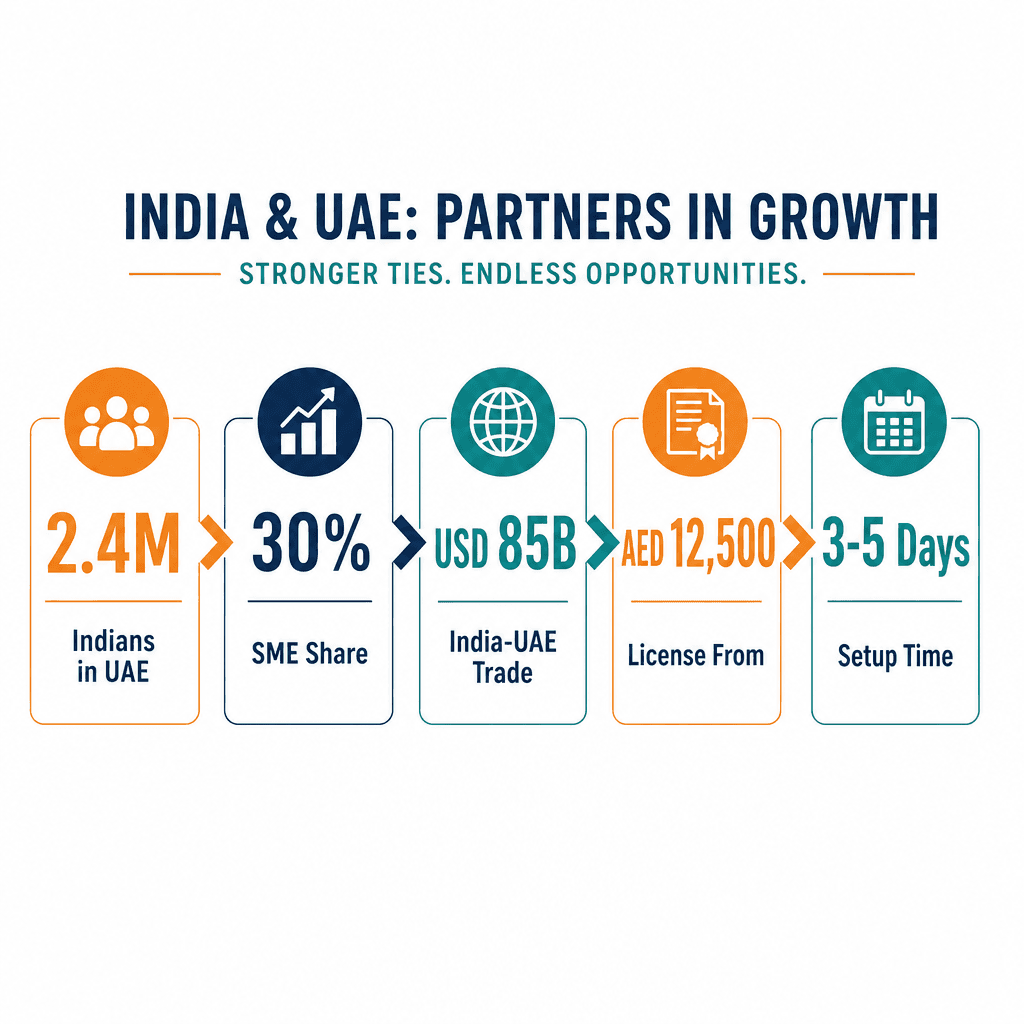
Yes, Indian citizens can start a business in Dubai with 100% foreign ownership inside a free zone. No local Emirati sponsor is required. Free zone licenses start from AED 12,500, and the setup process takes as few as 3 to 5 working days with the right documentation in place.
What the UAE Commercial Companies Law Means for Indian Nationals
UAE Federal Decree-Law No. 32 of 2021 on Commercial Companies was a turning point. It permits 100% foreign ownership across mainland sectors listed by the Ministry of Economy (economy.gov.ae, 2021). Before this reform, most mainland businesses required a 51% Emirati majority shareholder. That requirement is now gone for the vast majority of commercial activities.
Free zones have always offered 100% foreign ownership, and Indian nationals qualify with a valid passport alone. There's no requirement for UAE residency at the time of incorporation. A Mumbai-based IT consultant, for example, can incorporate a free zone LLC at Dubai South Business Hub Free Zone with zero local partner requirement, sign all documents digitally, and receive the license by courier.
The Dubai Economic Department (DED) registers mainland companies; free zone authorities register free zone entities. Both are legally recognised structures for Indian entrepreneurs, and both grant the right to open a UAE corporate bank account and apply for an investor visa.
Free Zone vs Mainland - Which Works Best for Indians Doing Business in UAE
Free zones offer 100% ownership, zero corporate tax on qualifying income below AED 375,000, and no import/export duties within the zone. That combination makes free zones the default choice for Indian entrepreneurs targeting international clients or running service-based businesses remotely.
Mainland via DED gives you direct access to the UAE domestic market without needing a local distributor. However, certain sectors including legal services and some retail categories still require a local service agent under DED rules. Indian entrepreneurs whose primary clients are UAE-based companies should weigh whether a mainland DED license or a free zone license paired with a local distributor agreement better fits their revenue model.
Worth flagging: over 40 active free zones operate in Dubai alone, each with its own licensing authority and activity list. The UAE corporate tax rate is 9% on taxable income above AED 375,000 (Federal Tax Authority, 2026). An Indian logistics firm, for instance, chose Dubai South Business Hub Free Zone specifically for its proximity to Al Maktoum International Airport and the 0% customs duty applicable within the zone.
Indian Entrepreneurs in Dubai - The Numbers
Indians are the largest single nationality group in the UAE, with 2.4 million residents in 2026. They own more than 30% of Dubai SMEs and collectively contribute an estimated AED 110 billion to the UAE economy annually, making them the most commercially active expatriate community in the country.
Key Statistics on Indians Doing Business in UAE
The numbers tell a clear story. Indians own more than 30% of all SME registrations in Dubai (Dubai Department of Economy and Tourism, 2026). India-UAE bilateral trade reached USD 85 billion in 2025, with the CEPA signed in 2022 reducing tariffs on 80% of traded goods (Ministry of Commerce India, 2026). Indian-owned trading companies in Dubai's Deira district, for example, actively use CEPA preferential tariff rates to supply goods back to India at reduced import duties, a direct commercial advantage unavailable before 2022.
Top Industries Where Indian Business Owners Operate in Dubai
Trading and wholesale (ISIC Section G) remains the dominant sector for Indian-owned Dubai businesses. The UAE's position as a global re-export hub, with Jebel Ali Port handling over 14 million TEUs annually, gives Indian traders a natural gateway between Asia, Africa, and Europe.
IT services, software development, and digital agencies (ISIC Section J, Information and Communication) are the fastest-growing category among new Indian free zone incorporations. IT accounts for 22% of new Indian free zone registrations (Dubai Chamber, 2026). Indian fintech founders are incorporating at Dubai free zones specifically to serve both UAE and GCC markets under a single license, avoiding the cost and complexity of separate national registrations.
Financial consulting, real estate advisory (regulated by RERA), and healthcare (regulated by DHA) are established sectors with strong Indian professional representation. Each of these requires sector-specific approvals beyond the standard trade license, so factor that into your timeline.
Business Ownership Rights for Indian Nationals
Indian nationals have the right to own 100% of a Dubai free zone company with no local sponsor required. Under 2021 mainland reforms, Indians can also own 100% of mainland companies in most sectors approved by the Ministry of Economy and registered through the DED.
100% Ownership in Free Zones - What Indian Founders Need to Know
Every Dubai free zone grants 100% foreign ownership by default. There's no Emirati shareholder requirement, no local service agent, and no equity dilution of any kind for free zone entities. An Indian national can be the sole shareholder, director, and manager of a Free Zone Establishment (FZE), the single-shareholder structure available at Dubai South Business Hub Free Zone, with full signing authority from day one.
MOHRE (Ministry of Human Resources and Emiratisation) regulates employee visas across both mainland and free zone companies. Free zones do have their own labour regulations that can differ from mainland DED rules, so check the specific free zone's employment framework before hiring. FZE minimum share capital varies by free zone, with some requiring as little as AED 1,000.
Mainland Ownership Rights After the 2021 Reforms
Federal Decree-Law No. 32 of 2021 removed the mandatory 51% Emirati ownership requirement for most commercial activities registered with DED. The reforms, effective June 2021, opened full foreign ownership across hundreds of mainland activity codes. That said, certain strategic sectors including oil and gas, utilities, and defence retain ownership restrictions. Always verify your specific DED activity code against the Ministry of Economy's positive list at economy.gov.ae before applying.
A local service agent is still required for professional licenses in some DED categories, but this agent holds zero equity. Think of it as a fixed annual fee arrangement. An Indian management consultancy, for example, can register a mainland professional license with DED using a local service agent, pay a set annual fee, and retain 100% equity throughout.
Is a local sponsor required for Indian nationals in Dubai?
No. Indian nationals setting up a free zone company in Dubai do not need a local Emirati sponsor or partner. For mainland companies, Federal Decree-Law No. 32 of 2021 removed the 51% local ownership rule for most sectors. A local service agent (not a shareholder) may still be required for specific DED professional license categories.
Documents Required from India
Indian nationals setting up a Dubai company need a valid passport, recent passport-size photographs, a No Objection Certificate if currently employed in the UAE, and attested educational or professional certificates for regulated activities. Documents issued in India require attestation from the UAE Embassy in India and the UAE Ministry of Foreign Affairs.
Step-by-Step Document Checklist for Indian Entrepreneurs
Valid Indian passport: Minimum 6 months validity. Provide 3 recent passport-size photographs with a white background.
No Objection Certificate (NOC): Required from your current UAE employer if you're already on a UAE residence visa. GDRFA and ICP require this for any visa status change at icp.gov.ae.
Attested degree certificates (regulated activities): For healthcare, legal, and engineering activities, attest first at the Indian HRD Ministry, then at the UAE Embassy in New Delhi or Mumbai, then at the UAE Ministry of Foreign Affairs (MOFA) portal at mofa.gov.ae. An Indian doctor setting up a telemedicine consultancy, for instance, must complete all three attestation stages before DHA registration can proceed.
Bank reference or statement: A 3-month bank statement from your Indian bank is typically required for corporate account opening in the UAE.
Full document set per shareholder: If the company has multiple Indian shareholders, each must provide their own complete document set independently.
Documents Needed After Incorporation - Visa and Banking
Initiate investor visa: Submit your trade license, Memorandum of Association, and passport copy to ICP via icp.gov.ae immediately after license issuance.
Corporate bank account: Banks require a 6-month business plan, proof of business activity, and audited accounts for established businesses. Read the full walkthrough on how to open a corporate bank account Dubai for step-by-step guidance tailored to free zone companies.
Emirates ID: Issued by ICP after visa stamping and biometric registration. The fee is AED 370 (ICP, 2026). Your Emirates ID is mandatory for all business and personal transactions in the UAE. Complete visa stamping at a GDRFA typing centre within 30 days of UAE entry to activate your investor visa status.
India-UAE Tax Treaty Benefits
India and the UAE signed a Double Taxation Avoidance Agreement (DTAA) that prevents Indian business owners from being taxed twice on the same income. Dividends, royalties, and capital gains earned through a UAE company are typically exempt from Indian tax if the UAE entity is genuinely managed and controlled in the UAE.
How the India-UAE DTAA Works for Indian Business Owners
The India-UAE DTAA was signed in 1993 and updated to align with OECD BEPS (Base Erosion and Profit Shifting) standards, with updated provisions active from 2016 (still accurate as of 2026). It covers income tax specifically, not indirect taxes like VAT. Indian residents earning business income through a UAE company pay UAE corporate tax at 9% above the AED 375,000 threshold (Federal Tax Authority, 2026) and are not additionally liable to Indian income tax on the same profits, provided the UAE entity has genuine substance.
Substance requirements are the critical piece here. Your UAE company must have a physical address, at least one UAE-based employee or manager, and demonstrable local activity. A mailbox registration alone won't satisfy DTAA substance tests. An Indian software firm generating AED 2 million in UAE revenue through a Dubai South Business Hub Free Zone entity, for example, pays 9% corporate tax in the UAE on income above AED 375,000 and is not additionally taxed in India under the DTAA, provided real operations exist in Dubai.
Remitting Profits to India - What Indian Founders Should Know
The UAE imposes zero withholding tax on dividends or profit remittances from a UAE company to an Indian shareholder. That means 100% of after-tax profits can be repatriated. An Indian founder repatriating AED 500,000 in annual profit to India pays nothing to the UAE government on that transfer.
Indian founders must comply with India's Foreign Exchange Management Act (FEMA) when repatriating profits. Report through the Liberalised Remittance Scheme (LRS) or as business income in your Indian tax filings. The interaction between FEMA, DTAA, and UAE corporate tax is genuinely complex. Get coordinated advice from a SEBI-registered tax advisor in India and your UAE corporate advisor before your first profit distribution.
Setup Costs for Indian Entrepreneurs in AED
A Dubai free zone company for an Indian entrepreneur starts from AED 12,500 for a license and registration. Adding an investor visa, Emirates ID, and medical insurance brings the realistic first-year total to between AED 18,000 and AED 35,000 depending on the free zone, activity type, and visa package chosen.
AED Cost Breakdown Table for Indian Entrepreneurs in 2026
Here's what a typical Indian e-commerce entrepreneur spends: AED 12,500 license + AED 5,000 investor visa package + AED 1,190 (Emirates ID, medical fitness, visa stamping) = AED 18,690 total first-year cost. Use the cost calculator to get a personalised AED breakdown for your specific activity and visa requirements.
Dubai Free Zone Setup Costs for Indian Entrepreneurs - AED 2026
Cost Item | AED Amount (2026) |
|---|---|
Free Zone License and Registration (Dubai South Business Hub Free Zone) | From AED 12,500 |
Investor Visa - 3-Year Package | AED 4,000 to AED 7,500 |
Emirates ID Fee (ICP) | AED 370 |
Medical Fitness Test (DHA-approved centre) | AED 320 |
Visa Stamping Fee | AED 500 |
Corporate Bank Account Minimum Balance (typical UAE bank) | AED 25,000 to AED 50,000 |
Document Attestation in India (HRD + UAE Embassy + MOFA) | INR 5,000 to INR 15,000 per set |
Estimated Total First-Year Cost (license + visa + ID/medical/stamping) | AED 18,000 to AED 35,000 |
Hidden Costs Indian Founders Often Miss
The bank minimum balance is the biggest surprise. Most UAE banks require AED 25,000 to AED 50,000 as a minimum balance for free zone business accounts (typical UAE banks, 2026). One Indian founder setting up with Emirates NBD hit this threshold unexpectedly and resolved it by switching to a challenger bank with lower requirements for free zone accounts. Factor this into your initial capital planning before you incorporate.
Document attestation in India typically totals INR 5,000 to INR 15,000 per document set across HRD, UAE Embassy, and MOFA stages. Annual license renewal costs typically run 80% to 90% of the initial license fee. Add audit fees (mandatory in some free zones after Year 1) and MOHRE fees for any employees hired, and your Year 2 recurring costs become a real budget line item.
Investor Visa for Indian Business Owners
Indian business owners who incorporate a Dubai free zone company qualify for a UAE investor visa valid for 3 years. The visa grants full UAE residency, an Emirates ID, and the ability to sponsor dependants. Applications are submitted through ICP at icp.gov.ae and processed in 5 to 10 working days.
Step-by-Step Investor Visa Process for Indian Nationals
Receive your trade license and free zone establishment card from your free zone authority. These are the primary supporting documents for the visa application.
Apply for an entry permit via ICP at icp.gov.ae or through your free zone's visa desk. Processing takes 2 to 4 working days.
Enter the UAE on the entry permit (or change status inside the UAE if already resident) and complete the medical fitness test at a DHA-approved centre. The fee is AED 320.
Submit biometrics at an ICP-approved typing centre for Emirates ID registration. The fee is AED 370 (ICP, 2026).
Receive visa stamping in your Indian passport. The investor visa is valid for 3 years and renewable upon license renewal. An Indian founder based in Bengaluru, for example, can fly to Dubai, complete medical and biometrics within 72 hours, and receive their Emirates ID within 7 working days of arrival.
Sponsoring Family Members and the Golden Visa Option
UAE investor visa holders can sponsor a spouse, children under 18, and parents. GDRFA (gdrfad.gov.ae) processes dependent visa applications, with fees applying per dependent. This makes the investor visa a genuine family relocation pathway, not just a business registration tool.
Indian entrepreneurs investing AED 2 million or more in UAE property or a qualifying UAE business can apply for the UAE Golden Visa (10-year residency) through ICP at icp.gov.ae. The Golden Visa does not require trade license renewal for continued validity, giving established Indian business families long-term security independent of their commercial structure. An Indian property investor purchasing AED 2 million in Dubai real estate, for instance, secures 10-year residency for their entire family in a single transaction (ICP, 2026).
How Dubai South Business Hub Free Zone Helps
Dubai South Business Hub Free Zone offers Indian entrepreneurs 100% foreign ownership, licenses from AED 12,500, and a strategic location adjacent to Al Maktoum International Airport. Dedicated setup advisors guide Indian founders through licensing, visa applications, and document attestation in one coordinated process.
Build Your Dubai Business from India with Dubai South Business Hub Free Zone
Dubai South Business Hub Free Zone allows Indian founders to complete the entire incorporation process remotely. Passport copies and signed documents are submitted digitally, and the physical license is couriered directly to India. You don't need to be in Dubai to get your company registered. An Indian import-export firm, for example, licensed at Dubai South Business Hub Free Zone to access Al Maktoum Airport for direct air freight between India and Dubai, bypassing the congestion at Dubai International entirely.
The free zone sits within Dubai South, adjacent to Al Maktoum International Airport and Expo City Dubai. That location gives Indian trading and logistics companies direct access to one of the world's top air cargo corridors. License packages start from AED 12,500, including trade name registration, certificate of incorporation, and a free zone establishment card. Launch your company at Dubai South Business Hub Free Zone to begin the process today.
Follow a Proven Path: Services Tailored for Indian Entrepreneurs
Dedicated relationship managers at Dubai South Business Hub Free Zone have processed hundreds of Indian incorporations. They understand Indian document attestation sequences, FEMA repatriation considerations, and the specific CEPA advantages available to Indian traders. That's practical, operational knowledge, not generic setup advice.
Investor visa processing, Emirates ID coordination through ICP, and introductions to UAE banking partners are included in the onboarding package. An Indian tech startup founder in Hyderabad, for instance, completed Dubai South Business Hub Free Zone incorporation in 5 working days without travelling to Dubai, then flew in only for biometrics. After incorporation, use the open a corporate bank account Dubai guide to navigate UAE bank account opening as an Indian national, including which banks accept free zone accounts with lower minimum balances.
Indian Entrepreneur's Dubai Setup Roadmap
A visual step-by-step guide showing the full journey from India to a licensed Dubai free zone company with an active investor visa.
Step
References
economy.gov.ae (economy.gov.ae)
icp.gov.ae (icp.gov.ae)
mofa.gov.ae (mofa.gov.ae)
gdrfad.gov.ae (gdrfad.gov.ae)