
Topic Summary
In 2026, over 12,000 UAE businesses hold active ISO certifications (Dubai Accreditation Centre, 2026). ISO 9001 alone accounts for more than 7,500 of those certificates.
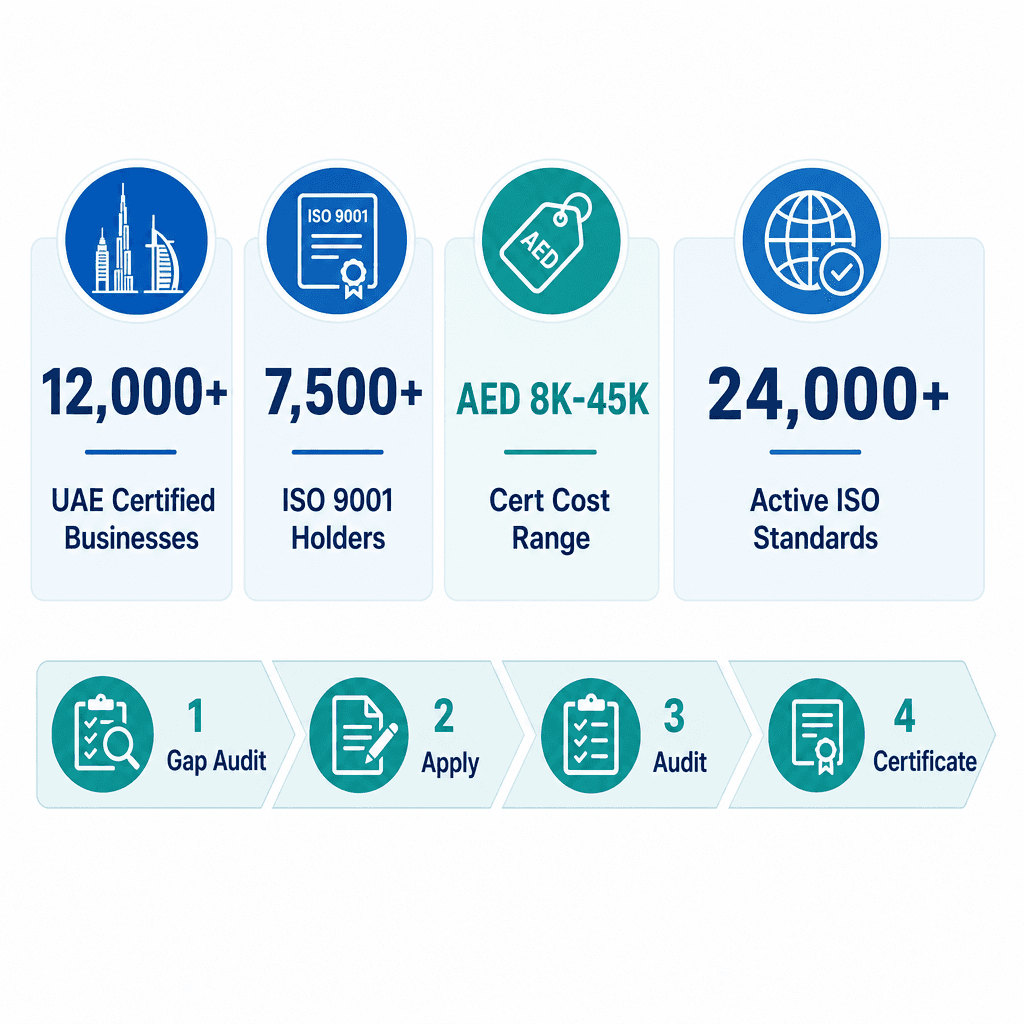
In 2026, over 12,000 UAE businesses hold active ISO certifications (Dubai Accreditation Centre, 2026). ISO 9001 alone accounts for more than 7,500 of those certificates. UAE government tenders in construction, healthcare, and defence list ISO certification as a baseline eligibility requirement (UAE Ministry of Economy, 2026). The International Organization for Standardization has more than 24,000 standards in active publication (ISO, 2026). Initial certification costs range from AED 8,000 to AED 45,000 depending on the standard and company size.
ISO certification UAE is a formal third-party audit process confirming your business meets internationally recognised standards for quality, safety, or information security. Certificates are issued by bodies accredited by the Dubai Accreditation Centre (DAC) or Abu Dhabi Accreditation Centre (ADAC) and are recognised by government entities, free zones, and trading partners in over 90 countries.
This guide covers the most common ISO standards for UAE businesses, the exact certification process step by step, accredited bodies, fees in AED, realistic timelines, and how Dubai South Business Hub Free Zone business support can accelerate your path to certification.
What Is ISO Certification
ISO certification is a formal declaration by an accredited third-party body that a business's processes, products, or systems meet a specific International Organization for Standardization standard. In the UAE, certificates are issued by DAC-accredited bodies and are recognised by government entities, free zones, and international trading partners.
The International Organization for Standardization Explained
ISO is a Geneva-based non-governmental body that publishes voluntary international standards across industries. Standards are developed by technical committees drawing on input from 167 national member bodies worldwide. With over 24,000 standards in active publication as of 2026 (ISO, 2026), the organisation covers everything from quality management to food safety to cybersecurity.
In the UAE, ESMA (Emirates Authority for Standardization and Metrology) is the ISO member body and national standards authority. ESMA has published more than 15,000 UAE national standards aligned with ISO frameworks (ESMA, 2026). That alignment matters: a Dubai-based logistics company holding ISO 9001 demonstrates to port authorities and freight clients that its quality management system meets the same benchmark as certified operators in Germany or Singapore.
Why UAE Businesses Pursue ISO Certification
The commercial case is straightforward. A mid-size Abu Dhabi construction subcontractor won its first ADNOC supply contract only after achieving ISO 9001 and ISO 45001, both were listed as non-negotiable in the tender specification. That story repeats across sectors. Here's why UAE businesses actively pursue iso certification uae:
Government tender eligibility: Federal and emirate-level RFPs routinely list ISO 9001 or ISO 45001 as mandatory. The UAE Ministry of Economy mandates ISO certification for suppliers in construction, healthcare, and defence (UAE Ministry of Economy, 2026).
Client and supply chain requirements: Multinationals operating in the UAE require certified suppliers as standard practice.
Free zone and trade license renewals: Premium service categories increasingly reference ISO status.
Operational improvement: The gap analysis and audit process forces documented process discipline that reduces errors and rework.
Keep your ISO obligations alongside other regulatory deadlines using the company compliance calendar UAE.
Most Common ISO Standards for UAE Businesses
The four ISO standards most relevant to UAE businesses are ISO 9001 (quality management), ISO 14001 (environmental management), ISO 27001 (information security), and ISO 45001 (occupational health and safety). ISO 9001 is the most widely held, with over 7,500 UAE certificates active in 2026 (DAC, 2026).
ISO 9001 - Quality Management System
ISO 9001:2015 is the world's most widely adopted management system standard. It applies to any sector: manufacturing, professional services, healthcare, logistics, retail. The standard requires documented quality objectives, risk-based thinking, and continual improvement cycles. Most UAE government tenders reference ISO 9001 as the baseline quality credential.
A Dubai-based facilities management company used ISO 9001 certification to qualify for the DEWA contractor list, directly generating AED 2 million in new annual contracts. That's the commercial reality of iso 9001 uae: it's not a certificate on the wall, it's a revenue-enabling credential.
Applicable to businesses of any size or sector
Requires a documented quality manual and measurable quality objectives
Mandates management reviews at planned intervals
Recognised by virtually every UAE government procurement authority
ISO 14001, ISO 27001, and ISO 45001 - Sector-Specific Standards
Beyond ISO 9001, three other standards dominate UAE certification activity. An Abu Dhabi IT services firm achieved ISO 27001 certification in 2025, directly satisfying a UAE Central Bank vendor compliance requirement that had blocked a major banking client contract for over six months. The right standard opens the right doors.
ISO 14001:2015, Environmental Management System
Required for businesses with environmental impact obligations, particularly in manufacturing, oil and gas, and construction. Aligns with UAE sustainability mandates under the UAE Net Zero 2050 strategy.
ISO 27001:2022, Information Security Management System
Mandatory for fintech, healthtech, and government contractors handling sensitive data. Aligns directly with the UAE Personal Data Protection Law (Federal Decree-Law No. 45 of 2021), making it increasingly relevant for any data-handling business (UAE Government, 2026).
ISO 45001:2018, Occupational Health and Safety Management System
Required for high-risk industries including construction, manufacturing, and facilities management. This standard replaces OHSAS 18001, which is no longer valid, businesses still holding OHSAS 18001 certificates need to transition immediately.
Many UAE businesses pursue integrated certification covering two or three standards simultaneously to reduce audit duplication and overall cost. Explore the full standards catalogue at ISO.org.
ISO Certification Process in UAE - Step by Step
The ISO certification process in UAE follows six steps: selecting the right standard, conducting a gap analysis, implementing required changes, completing internal audits, undergoing a Stage 1 and Stage 2 external audit, and receiving your certificate. The full process takes 3 to 12 months depending on company size and readiness.
Steps 1 to 3 - Selection, Gap Analysis, and Implementation
Select the correct ISO standard. Base your choice on industry, client requirements, and tender obligations. ISO 9001 for quality, ISO 45001 for safety, ISO 27001 for data security, ISO 14001 for environmental management. Getting this wrong wastes months.
Commission a formal gap analysis. An accredited consultant or certification body reviews your existing processes against the standard's requirements and identifies deficiencies. Budget AED 3,000 to AED 8,000 for this stage. A Sharjah-based food manufacturing company discovered during its ISO 22000 gap analysis that it lacked documented supplier verification procedures, a finding that, if caught during a client audit instead, could have cost a major retail contract.
Implement the required changes. Document processes, assign responsibilities, create a quality or safety manual, train staff, and run the management system for a minimum of three months before the Stage 1 audit. Most certification bodies will not accept a Stage 1 audit booking until this three-month operation period is confirmed.
Steps 4 to 6 - Internal Audit, External Audit, and Certification
Conduct internal audits. Cover all relevant departments to identify nonconformities before the external auditor arrives. Internal auditors must be trained and independent of the area they audit, you can't audit your own work.
Stage 1 Audit (Document Review). The certification body reviews your documented system for completeness. Typically conducted off-site or virtually. Duration: 1 to 2 days. Gaps identified here must be addressed before Stage 2 is scheduled.
Stage 2 Audit (On-Site Assessment). The certification body's lead auditor visits your premises, interviews staff, and verifies that the documented system is actually operating. Nonconformities raised must be closed before the certificate is issued. Certificates are valid for three years, with mandatory annual surveillance audits in Years 1 and 2, and a full recertification audit in Year 3 (DAC, 2026).
Accredited ISO Certification Bodies in UAE
ISO certificates in the UAE must be issued by bodies accredited by the Dubai Accreditation Centre (DAC), Abu Dhabi Accreditation Centre (ADAC), or an IAF-recognised overseas accreditation body. Certificates from non-accredited bodies are not accepted for UAE government tenders or regulatory submissions.
DAC and ADAC - UAE's Accreditation Authorities
The Dubai Accreditation Centre (DAC) is the UAE's primary accreditation body, operating under Dubai Economy and Tourism. The Abu Dhabi Accreditation Centre (ADAC) performs the same function for Abu Dhabi-registered certification bodies. Both are signatories to the International Accreditation Forum (IAF) Multilateral Recognition Arrangement, meaning certificates from their accredited bodies are recognised in over 90 countries (IAF, 2026).
Always verify a certification body's accreditation status at dac.gov.ae before signing an engagement contract. A certificate issued by a non-accredited body is commercially worthless in the UAE government procurement context, it won't satisfy a tender pre-qualification requirement regardless of how thorough the audit was.
Which ISO certifying bodies are accredited in UAE?
Bureau Veritas, SGS, TÜV Rheinland, DNV, and Lloyd's Register all operate UAE offices with DAC or ADAC accreditation and cover the main management system standards. Bureau Veritas and TÜV Rheinland appear most frequently in UAE government tender pre-qualification documents. Smaller UAE-registered certification bodies also hold DAC accreditation, always confirm their scope covers your specific standard before engaging. ESMA maintains a national register of accredited conformity assessment bodies at esma.gov.ae. Request quotes from at least three accredited bodies to benchmark cost before committing.
ISO Certification Cost in UAE - 2026 Fee Guide by Standard and Company Size
ISO Standard | Small Business (1–30 staff) | Medium Business (31–150 staff) | Annual Surveillance Audit |
|---|---|---|---|
ISO 9001 (Quality) | AED 8,000 – AED 15,000 | AED 15,000 – AED 28,000 | AED 4,000 – AED 10,000 |
ISO 14001 (Environment) | AED 9,000 – AED 16,000 | AED 16,000 – AED 30,000 | AED 5,000 – AED 11,000 |
ISO 27001 (Information Security) | AED 12,000 – AED 20,000 | AED 20,000 – AED 38,000 | AED 6,000 – AED 14,000 |
ISO 45001 (Health & Safety) | AED 10,000 – AED 18,000 | AED 18,000 – AED 32,000 | AED 5,000 – AED 12,000 |
Consultant / Implementation Fee | AED 5,000 – AED 10,000 | AED 10,000 – AED 20,000 | N/A |
Internal Auditor Training | AED 1,500 – AED 3,500 | AED 3,500 – AED 7,000 | N/A |
Fees are indicative 2026 market rates from DAC-accredited bodies. Multi-site and integrated management system audits are priced separately. Source: DAC, 2026.
Costs in AED
ISO certification costs in the UAE range from AED 8,000 to AED 45,000 for the initial certification cycle. Costs vary by standard, company size, number of employees, and site count. Annual surveillance audits cost AED 4,000 to AED 15,000. Consultant fees are separate and typically range from AED 5,000 to AED 20,000.
ISO Certification Cost Breakdown by Standard and Company Size
Certification body fees are the primary cost driver, calculated based on employee headcount and site complexity. Consultant or implementation partner fees are a separate line item, often necessary for first-time applicants who don't have an existing documented management system. Training costs for internal auditors and top management awareness sessions should be budgeted separately. Government fees for ESMA registration or MOHRE-related documentation are typically below AED 1,500.
Here's a real example: a 25-person Dubai trading company paid AED 12,500 to Bureau Veritas for ISO 9001 certification covering Stage 1 and Stage 2 audits, plus AED 8,000 to a local consultant for gap analysis and documentation. Total first-year cost: AED 20,500. Annual surveillance audits for that same business run AED 4,000 to AED 10,000 depending on the certification body's annual rate schedule (DAC, 2026).
Important Considerations on ISO Certification Cost UAE
Get three quotes. Certification body fees vary by up to 40% for the same standard and company size. Always benchmark before signing.
Budget for Year 2 and Year 3. The initial certification fee covers Stage 1 and Stage 2 only. Annual surveillance audits in Years 1 and 2, plus a recertification audit in Year 3, add AED 8,000 to AED 30,000 over the full three-year cycle.
Integrated audits save money. If you're pursuing ISO 9001 and ISO 45001 simultaneously, most certification bodies offer combined audit days at a reduced day rate compared to running them separately.
Consultant fees are negotiable. A business with existing documented procedures will need fewer consultant days, the gap analysis will confirm this. Don't pay for implementation support you don't need.
Track your ISO certification costs alongside UAE corporate tax compliance obligations to manage your annual regulatory budget effectively.
Timeline
ISO certification in the UAE takes 3 to 12 months from project kick-off to certificate issuance. Small businesses with straightforward processes typically achieve certification in 3 to 5 months. Larger organisations or those starting from a low baseline require 9 to 12 months. The minimum pre-audit system operation period is three months.
Realistic Certification Timelines by Business Type
Timeline depends almost entirely on your starting point. A small business under 30 staff, operating from a single site and pursuing ISO 9001, can realistically achieve certification in 3 to 5 months from gap analysis to certificate. A medium business with 31 to 150 staff and multiple process streams typically needs 5 to 8 months. Large or complex organisations with 150-plus staff, multi-site operations, or an integrated ISO 27001 system should plan for 9 to 12 months.
Accelerated timelines are possible if a business already operates a documented management system. The gap analysis will confirm readiness and often surprises clients, many businesses are closer to certification than they think.
What Delays ISO Certification in the UAE
Undocumented processes: Procedures that exist only in people's heads take longer to document than the implementation itself.
Management bandwidth: ISO projects stall when senior leadership delegates without allocating actual staff time. This is the most common cause of timeline overrun.
Nonconformity closure: Major nonconformities raised at Stage 2 can add 4 to 8 weeks while corrective actions are implemented and verified by the certification body.
Audit scheduling: Peak periods, particularly Q4, can mean 4 to 6 week waits for certification body audit slots. Book early.
Use the company compliance calendar UAE to schedule your ISO milestones alongside trade license renewals and other regulatory deadlines.
References
ISO.org (iso.org)