A Dubai South Business Hub free zone entity lets an existing mainland company access 0% qualifying income treatment and 100% foreign ownership while keeping its mainland presence. Licences start from AED 12,500 per year. Over 60% of UAE mainland business owners who set up a second entity choose a free zone rather than another mainland licence.
In 2026, over 60% of UAE mainland business owners who set up a second entity chose a free zone structure to access international markets and optimise their tax position (UAE Ministry of Economy, 2026). Dubai South Business Hub Free Zone is emerging as the top choice for that expansion move. Dubai South Business Hub licenses start from AED 12,500 per year. Registration takes 3-5 business days. The 0% corporate tax rate applies to qualifying free zone income (Federal Tax Authority, 2023). Dubai South itself spans 145 sq km adjacent to Al Maktoum International Airport (Dubai South Official Portal, 2024). And 100% foreign ownership is permitted across all Dubai South Business Hub license types.
If you already have a UAE mainland company and want to expand your operations, access international markets more efficiently, or add a 100% foreign-owned entity to your corporate structure, this guide is for you. You'll learn exactly why mainland business owners choose to expand mainland business Dubai South-style, how the two-entity model works in practice, what it costs, and how to manage both companies without the compliance headaches.
What Is a Dubai South Business Hub Free Zone Entity and Why Mainland Business Owners Add One
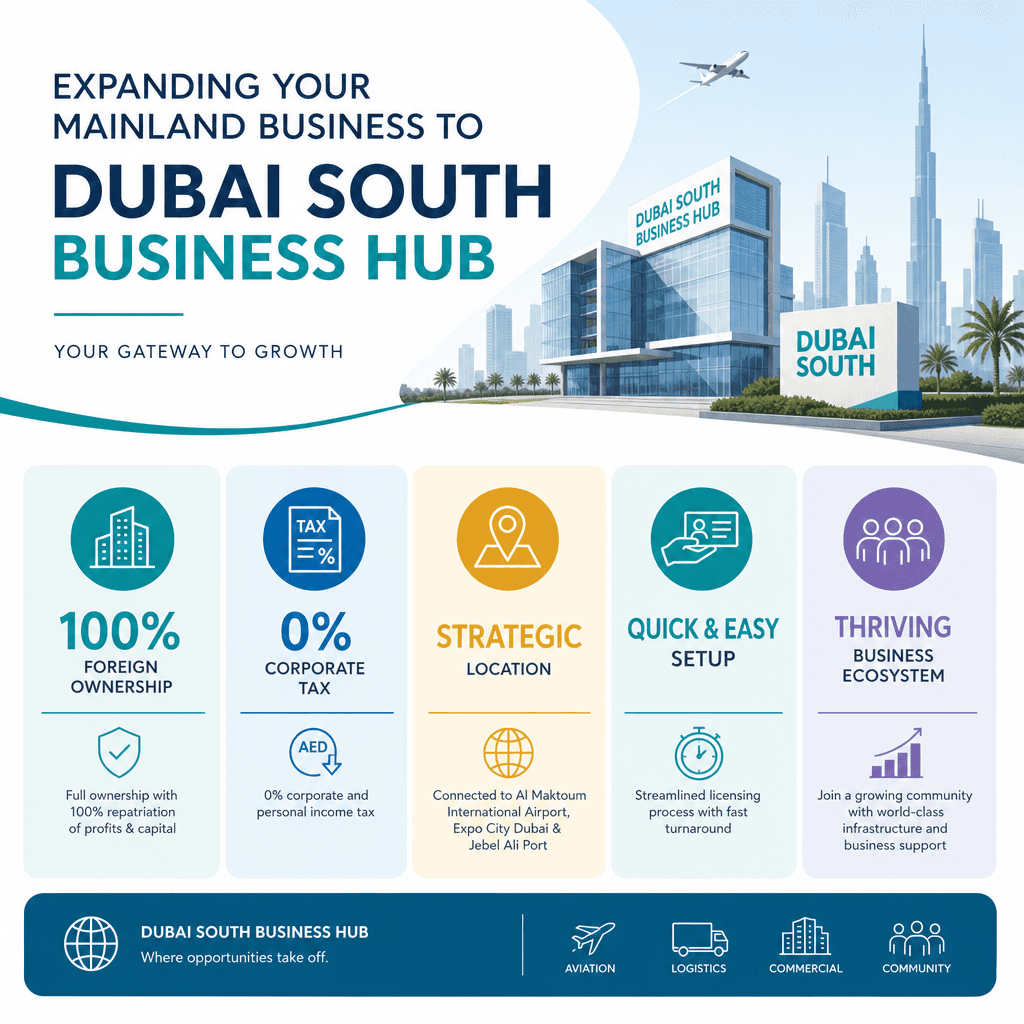
A Dubai South Business Hub Free Zone entity is a separate, independently licensed company registered within the Dubai South Business Hub free zone jurisdiction. Mainland business owners add one to handle international invoicing, hold intellectual property, access 0% corporate tax on qualifying income, and operate closer to Al Maktoum International Airport's logistics corridor. It's not a replacement for your mainland license. It's a second company that sits alongside it, doing the work your mainland entity can't do as efficiently.
The Two-Entity Model Explained
A mainland company and a Dubai South Business Hub free zone company are legally separate entities. Different trade licenses, different bank accounts, different Memoranda of Association. Your mainland entity keeps doing what it does best: UAE local contracts, government tenders, retail operations. The Dubai South Business Hub entity sits alongside it, purpose-built for international clients, cross-border consulting, IP licensing, or Dubai South logistics operations.
Take a Dubai-based construction consultancy with a mainland trade license. It sets up a Dubai South Business Hub free zone entity specifically to invoice European and US clients, keeping the two revenue streams legally separate and tax-optimised. Same shareholders. Two distinct legal persons. That's the model. If you want the foundational breakdown, read our guide on free zone vs mainland business setup.
Dubai South Business Hub sits within the 145 sq km Dubai South master-planned city adjacent to Al Maktoum International Airport (Dubai South Official Portal, 2024). That physical location is a concrete differentiator over inland free zones like DMCC or DIFC for any mainland business with supply chain or import/export operations.
Who Should Consider This Structure
Not every mainland business owner needs a second entity. But here's who should seriously consider it:
Mainland owners billing overseas clients who want a credible international entity rather than invoicing from a mainland license
Business owners needing additional visa allocation without restructuring their mainland company's headcount
Entrepreneurs building a holding structure where Dubai South Business Hub becomes the parent over the mainland operating company
Any mainland company involved in import/export who benefits from proximity to DWC and Al Maktoum International Airport
A UAE-based e-commerce operator with a mainland retail license, for example, adds a Dubai South Business Hub entity to handle supplier contracts from China and fulfilment coordination through Dubai South's logistics zone, keeping the international supply chain structurally separate from local retail operations. Dubai South Business Hub free zone licenses start from approximately AED 12,500 per year (Dubai South Business Hub Official Pricing, 2026).
Five Reasons Mainland Businesses Add a Dubai South Business Hub Free Zone Entity
Mainland businesses add a the free zone entity for five key reasons: to invoice international clients from a credible free zone structure, access 0% corporate tax on qualifying income, gain additional visa capacity, create a holding structure over the mainland company, and use Dubai South's logistics position near Al Maktoum International Airport. Each reason is specific. Each maps to a real operational need. Here's how Dubai South Business Hub for mainland businesses stacks up in practice.
Reasons One Through Three: Revenue, Tax, and Visas
International invoicing. Billing overseas clients from a Dubai South Business Hub free zone entity carries clear international credibility. Free zone invoices are standard in cross-border B2B transactions and accepted by most foreign accounting systems without the questions that sometimes accompany mainland invoices.
Tax efficiency. Qualifying international income earned through a Dubai South Business Hub entity can attract 0% corporate tax, compared to the 9% rate that applies to taxable mainland income above AED 375,000 (Federal Tax Authority, 2023). CT treatment depends on qualifying free zone person status, so get professional tax advice. For full detail, see our Dubai South Business Hub banking and taxation services page.
Staff visa flexibility. A Dubai South Business Hub entity has its own visa quota. You can sponsor additional employees under the free zone license without affecting your mainland company's headcount or existing visa allocation.
A mainland IT services firm with 10 mainland visas already allocated adds a Dubai South Business Hub entity to sponsor three overseas specialists working exclusively on international projects, keeping those roles entirely off the mainland headcount. That's a practical, immediate benefit of mainland expansion Dubai South Business Hub style.
Reasons Four and Five: Holding Structures and Logistics
Holding structure. Dubai South Business Hub can function as a parent entity holding shares in your mainland operating company. This separates asset ownership from operational risk, a common structure for business owners planning future investment rounds or an eventual exit. See our guide on corporate structuring in Dubai for the full breakdown.
Logistics advantage. Dubai South Business Hub is physically located within Dubai South, the 145 sq km master city built around Al Maktoum International Airport (DWC) (Dubai South Official Portal, 2024). For mainland businesses moving goods, managing freight, or running supply chain operations, a Dubai South Business Hub entity puts your corporate address inside the logistics corridor. No other inland free zone offers that.
A mainland trading company dealing in industrial equipment establishes a Dubai South Business Hub free zone entity as its regional holding company. The Dubai South Business Hub entity holds the mainland trade license shares and all IP assets, while the mainland company handles day-to-day UAE sales. Clean, structured, and built for scale. That's the mainland expansion Dubai South Business Hub model working exactly as intended.
Dubai South Business Hub Expansion: Key Numbers (2026) AED 12,500 License fee from Dubai South Business Hub, 2026 0% CT on qualifying free zone income Federal Tax Authority 3-5 days Registration timeline Dubai South Business Hub, 2026 145 sq km Dubai South master city Dubai South Portal, 2024
Dubai South Business Hub free zone key figures for mainland business owners considering expansion, as of 2026. Sources: Dubai South Business Hub Official Pricing, Federal Tax Authority, Dubai South Official Portal.
How a Dubai South Business Hub Entity Complements Your Mainland Company
A Dubai South Business Hub Free Zone entity complements a UAE mainland company by handling international clients, IP, and logistics operations while the mainland company retains UAE local contracts and government work. The two entities operate independently but can be owned by the same shareholders, creating a clean, purpose-driven corporate structure. To grow mainland company Dubai South-style, you need to understand what each entity does, and what it can't do.
What Each Entity Handles
Your mainland company handles UAE local contracts, government tenders, and retail operations. Only a mainland license permits direct trading within the UAE domestic market without a local distributor or service agent (UAE Ministry of Economy). That's a hard regulatory boundary, and it's why your mainland license stays essential.
Your Dubai South Business Hub entity handles international client invoicing, cross-border consulting, IP and brand licensing, import/export coordination through Dubai South, and holding of overseas assets or subsidiaries. Free zone entities must use a mainland distributor or service agent for direct UAE local market sales, so the two roles are genuinely complementary rather than overlapping.
A Dubai mainland marketing agency invoices all UAE-based clients through its mainland license and all GCC and European clients through its Dubai South Business Hub free zone entity, keeping domestic and international revenue streams structurally separate. Clear activity segregation reduces audit risk and simplifies both VAT reporting and CT compliance.
Mainland Company vs Dubai South Business Hub Free Zone Entity: Who Does What
Feature | UAE Mainland Company | Dubai South Business Hub Free Zone Entity |
|---|---|---|
UAE Local Market Sales | ‚úÖ Direct trading permitted | ‚ùå Requires mainland distributor |
International Client Invoicing | ‚ùå Less credible internationally | ‚úÖ Free zone invoice standard globally |
Government Tenders | ‚úÖ Eligible to bid | ‚ùå Generally excluded |
Corporate Tax Rate | 9% on income above AED 375,000 | 0% on qualifying free zone income |
Visa Quota | Separate allocation | ‚úÖ Own independent allocation |
Ownership Structure | 100% foreign ownership permitted | ‚úÖ 100% foreign ownership permitted |
Logistics / Import-Export Access | Standard UAE access | ‚úÖ Inside Dubai South logistics corridor |
Important Considerations Before You Structure
The Dubai South Business Hub entity does not replace your mainland license. It augments it. That's the key message. Here's what to keep in mind before you set up:
Intercompany transactions must be arm's length. If your mainland company pays a management fee to your Dubai South Business Hub entity, that fee must reflect what unrelated parties would charge. UAE CT transfer pricing rules apply (Federal Tax Authority, 2023).
Each entity needs its own bank account. You can't share banking infrastructure between the two companies.
Activity scopes must not overlap without proper documentation. If both entities are performing similar services, you need clear contractual delineation to satisfy CT and VAT audits.
Reverse ownership is worth considering. A Dubai South Business Hub entity holding shares in your mainland company (rather than the other way around) may suit certain exit or investment structures better. Review our guide on corporate structuring in Dubai for detail.
Mainland vs Dubai South Business Hub Entity: Revenue Split Illustration
A visual showing how a dual-entity structure divides revenue streams between a UAE mainland company and a Dubai South Business Hub free zone entity.
UAE local revenue routed through mainland: 100% of domestic sales
International revenue routed through Dubai South Business Hub: GCC, Europe, US clients
CT rate on mainland taxable income: 9% above AED 375,000
CT rate on qualifying Dubai South Business Hub income: 0%
Dubai South Business Hub license cost from: AED 12,500/year
Registration timeline: 3-5 business days
Setting Up Your Dubai South Business Hub Expansion Entity: The Process Step by Step
Setting up a Dubai South Business Hub expansion entity follows the same process as a new company registration at Dubai South Business Hub Free Zone. Existing mainland shareholders can own the Dubai South Business Hub company directly. The entity is fully independent, with a separate trade license, bank account, and Memoranda of Association. Corporate tax group relief may also be available for related-party entities. Here's how to add free zone company Dubai South to your corporate structure.
A process timeline showing the four steps to expand a UAE mainland business by adding a Dubai South Business Hub Free Zone entity, from activity selection to first invoice. Adding a Dubai South Business Hub Entity: 4-Step Process 1 Choose Activity and License Type 2 Submit Documents and Register Entity 3 Open Separate Bank Account 4 Issue First International Invoice
Four steps to set up a Dubai South Business Hub expansion entity alongside an existing UAE mainland company. Registration typically completes in 3-5 business days (Dubai South Business Hub, 2026).
Step 1: Choose Your Activity and License Type
Dubai South Business Hub offers a broad range of licensed activities spanning professional services, trading, consulting, logistics, and technology. Align the Dubai South Business Hub activity with the international-facing work you intend to route through the new entity. Don't duplicate your mainland activity scope without a clear contractual reason.
Existing mainland shareholders, whether individual or corporate, can be listed as shareholders of the Dubai South Business Hub company. There's no requirement to use different ownership. A mainland shareholder who owns a Dubai general trading company can register a Dubai South Business Hub consulting entity under their own name as a 100% shareholder. Same owner. Second license. Distinct activity scope. 100% foreign ownership is permitted across all Dubai South Business Hub license types.
If your mainland company will own the Dubai South Business Hub entity rather than the same individual shareholders, this creates a parent-subsidiary structure. See our guide on corporate structuring in Dubai for detail on whether that or reverse ownership suits your goals better.
Step 2: Register the Entity and Open a Separate Bank Account
The Dubai South Business Hub entity is legally independent. It requires its own Memorandum of Association, trade license, and corporate bank account. It can't share any of these with your mainland company. That independence is what makes the structure work from both a CT and VAT compliance perspective.
Corporate tax group relief may be available if both the mainland company and the Dubai South Business Hub entity are qualifying related parties under UAE CT law. This allows losses in one entity to offset profits in the other within the same tax group. Eligibility requires at least 95% common ownership between both UAE resident persons (Federal Tax Authority, 2023). Consult a tax adviser to confirm before filing.
A mainland logistics company that registers a Dubai South Business Hub entity within the Dubai South free zone, opens a UAE business bank account under the Dubai South Business Hub license, and begins invoicing its freight-forwarding clients through the free zone entity can realistically complete the full process within two weeks of initiating registration. Dubai South Business Hub's supported ecosystem includes banking and taxation services to help you get operational faster. Ready to start? Launch your Dubai South Business Hub expansion entity today.