

Last updated: June 2026 By Editorial Team , UAE business setup and compliance specialists with hands-on experience supporting free zone companies at Dubai South.
Last updated: June 2026
By Editorial Team, UAE business setup and compliance specialists with hands-on experience supporting free zone companies at Dubai South. Full bio →
Table of Contents
What Running a Small Business in Dubai Actually Means Day to Day
Financial Management: Keeping the Numbers Clean Every Month
7 Operational Areas You Must Manage to Run a Small Business in Dubai
Staying Compliant: Licenses, Visas, and Deadlines That Cannot Slip
Banking, Payroll, and Client Invoicing in the UAE
Growth Decisions: When to Hire, Outsource, or Expand Your Business
Technology Tools That Make Running a Small Business in Dubai More Efficient
Running a Small Business in Dubai Requires Systems, Not Just Ambition
References
In 2026, over 94% of businesses registered in Dubai's free zones are classified as small or medium enterprises (Dubai Department of Economy and Tourism, 2025). Yet a significant share face compliance penalties or operational disruption within their first three years, not because they failed to launch, but because they underestimated what running a small business in Dubai actually demands once the trade license arrives. The Federal Tax Authority (FTA) sets a minimum AED 1,000 fine per late VAT return filing (FTA, 2023). UAE corporate tax at 9% applies above AED 375,000 net profit, effective June 2023 (UAE Ministry of Finance, 2023). WPS salary delays beyond 10 days trigger automatic MoHRE alerts that can freeze new work permit applications (MoHRE, 2022). And health insurance is mandatory for every employee in Dubai, with the cost falling entirely on the employer (Dubai Health Authority, 2023). These aren't edge cases. They're the operational baseline.
This guide covers the day-to-day reality of managing a small business in Dubai: financial discipline, compliance deadlines, banking, staff, client management, growth decisions, and the tools that make it all operationally sustainable, so you spend less time firefighting and more time building.
What Running a Small Business in Dubai Actually Means Day to Day
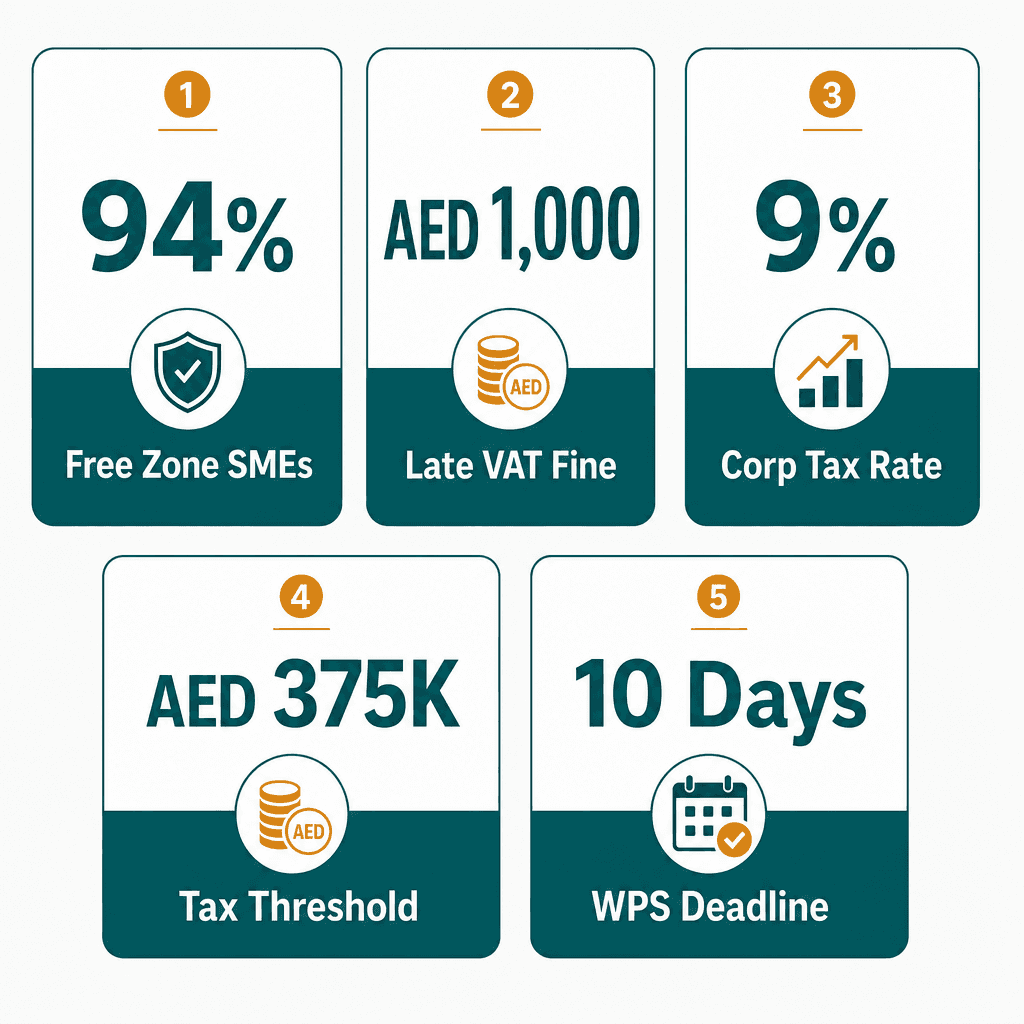
Running a small business in Dubai means managing an active compliance calendar, UAE-specific payroll rules, VAT filing obligations, corporate banking requirements, and client contracts, all simultaneously. The trade license is your starting point, not your finish line. Operational success depends on systems, not just registration.
The Gap Between Getting Licensed and Operating Smoothly
Trade license approval is step one. Operations, compliance, and people management begin immediately after, and the pace doesn't slow down. Most first-year disruptions stem from missed renewal dates, incomplete payroll setup, or VAT registration delays. Dubai's regulatory environment is efficient, but it's also unforgiving.
Think of your business as a system with four active layers, each requiring ongoing attention:
Financial: bookkeeping, VAT filing, bank reconciliation, cash flow
Compliance: license renewal, visa tracking, contract updates
HR: WPS payroll, leave management, health insurance renewals
Client: invoicing, contracts, payment terms
One Dubai South free zone consultancy that launched in Q1 missed its 30-day WPS registration window after hiring its first employee. The result: a Ministry of Human Resources and Emiratisation (MoHRE) block on new visa applications, resolved only after a compliance audit and penalty payment. That's a preventable disruption, and a common one.
Why Small Business Operations UAE Differ from Other Markets
If you're coming from the US or UK, a few things about small business operations in the UAE will catch you off guard. There's no corporate income tax on profits below AED 375,000, but VAT at 5% still applies to most taxable supplies, and excise obligations apply to specific product categories. Above the threshold, the 9% corporate tax rate (effective June 2023) applies (UAE Ministry of Finance, 2023).
Visa-linked residency is the bigger operational difference. Your staff's legal right to live and work in the UAE ties directly to your company's compliance health. A blocked license or unpaid fine doesn't just affect your operations, it affects your employees' residency status. Free zone vs. mainland rules also diverge on client scope, office requirements, and banking access. For a full overhead breakdown, see the cost of running a business in Dubai.
A mainland trading company in Dubai with three staff members, for example, may face both a DET (Dubai Economy and Tourism) trade license renewal and three simultaneous employee visa renewals in the same month, a cash flow and admin crunch that catches many owners unprepared.
Financial Management: Keeping the Numbers Clean Every Month
Effective financial management for a small Dubai business means monthly bank reconciliation, up-to-date bookkeeping, quarterly VAT filing with the FTA, and a rolling cash flow forecast. Gaps in any of these create compounding risk, from audit exposure to blocked banking services.
Monthly Bookkeeping and Bank Reconciliation
Clean books aren't optional in the UAE. Here's what your monthly financial routine should include:
Reconcile your corporate account monthly, unreconciled accounts are a red flag in FTA audits
Categorise every transaction at source: separate operating costs, VAT-applicable expenses, and owner drawings
Use cloud accounting tools like Zoho Books or QuickBooks, both of which integrate with UAE bank feeds
Retain all financial records for a minimum of five years, as required by UAE tax law (FTA, 2023)
A Dubai South e-commerce business using Zoho Books with automated bank feed reconciliation reduced its month-end close from three days to four hours. That's not a small efficiency gain, it's time that goes back into running the business. Zoho business solutions for Dubai South companies are available through the DSBH partner programme at preferential rates.
VAT Compliance and Cash Flow Forecasting
VAT-registered businesses must file quarterly returns via the FTA EmaraTax portal, with deadlines set 28 days after the end of each tax period (FTA, 2023). The standard rate is 5% on most taxable supplies. Late payment carries an immediate 2% penalty on unpaid tax, rising to 4% monthly if it remains outstanding (FTA Administrative Penalties Schedule, 2023).
The most common cash flow mistake in managing a small business in Dubai? Treating VAT collected as operating income. It isn't. It's a liability. A Dubai-based marketing agency mixed VAT-collected funds with its operating cash and faced an AED 18,000 VAT liability at quarter-end with insufficient reserves, requiring an emergency director loan to file on time.
Warning: Always hold VAT collected in a separate sub-account or clearly tagged reserve. Project cash flow 90 days ahead, with VAT payable listed as a firm liability, not discretionary. Cross-reference your VAT deadlines against license and visa renewal costs using the company compliance calendar UAE.
VAT Filing: Compliant vs. Non-Compliant Approach
Area | Compliant Approach | Common Mistake |
|---|---|---|
VAT funds handling | ✅ Held in separate reserve account | ❌ Mixed with operating cash |
Filing deadline | ✅ 28 days after tax period end | ❌ Filed late, AED 1,000+ fine |
Cash flow forecast | ✅ 90-day rolling, VAT as payable | ❌ No forecast, reactive only |
Record retention | ✅ 5 years, cloud-stored | ❌ Incomplete or paper-only |
Late payment penalty | ✅ AED 0, filed on time | ❌ 2% immediate + 4% monthly |
Accounting tool | ✅ FTA-ready output (Zoho Books) | ❌ Manual Excel, reformatted |
7 Operational Areas You Must Manage to Run a Small Business in Dubai
To run a small business in Dubai effectively, you must actively manage seven operational areas: financial records and VAT, license and visa compliance, corporate banking, staff and payroll, client contracts and invoicing, business growth decisions, and automation through UAE-compatible technology tools.
The Seven Pillars of Day-to-Day Business Management UAE
Here's how the seven pillars break down in practice:
Financial management: bookkeeping, reconciliation, VAT filing, cash flow forecasting
Compliance: trade license renewal, visa tracking, employee contract updates
Banking: corporate account health, minimum balance monitoring, payment gateways
Staff management: WPS payroll, leave tracking, visa and health insurance renewals
Client management: UAE-compliant invoicing, contract documentation
Growth decisions: activity additions, office upgrades, hire vs. outsource
Technology: tools that reduce overhead and support compliance
A three-person Dubai South logistics consultancy mapped all seven pillars into a shared Google Sheet dashboard, assigning owners and due dates to each task. Missed deadlines dropped from four per year to zero. That's the operational discipline that separates businesses that scale from those that stall. DSBH business support services covers compliance, HR, and financial management support for free zone companies that want this structure without building it from scratch.
Prioritising What Gets Your Attention First
Not all seven pillars demand equal attention every week. Here's the priority order:
Compliance deadlines are non-negotiable, fines and visa blocks happen fast
Financial hygiene compounds: one month behind becomes three quickly
Staff issues (WPS failure, unpaid leave) create legal exposure under UAE Labour Law
Client contracts and invoicing protect cash flow, UAE courts uphold written contracts
Critical WPS note: Under UAE Labour Law Federal Decree-Law No. 33 of 2021, failure to pay salaries via WPS within 10 days of the due date triggers an automatic complaint mechanism at MoHRE. That mechanism can freeze new work permit applications for your entire company, not just the affected employee. One payroll delay can stall your next hire.
Staying Compliant: Licenses, Visas, and Deadlines That Cannot Slip
Compliance for a small Dubai business means tracking trade license renewal (annual), employee visa renewals (every 2-3 years), health insurance renewals (annual), and labour contract updates. Missing any of these triggers fines, visa blocks, or banking restrictions. A compliance calendar is essential.
Trade License and Visa Renewal Tracking
Your trade license renewal is annual, and while most free zones and DET send reminders, the legal responsibility sits with you. Start the renewal process 30-45 days before expiry to avoid grace period fees, which typically run AED 250-500 per month depending on the issuing authority. Employee residence visas carry a 2-year validity in most cases, and renewal should start no later than 30 days before expiry. An expired visa costs AED 25 per day in overstay fines (ICP, 2023).
A Dubai South free zone company with five employees used a shared calendar with 45-day advance alerts to manage staggered visa renewals across different hire dates. The goal was simple: avoid any month where license renewal costs and multiple visa renewals coincided. It worked. Use the company compliance calendar UAE template to build the same structure for your business.
Health Insurance and Employee Contract Obligations
Health insurance is mandatory for all employees in Dubai. The Dubai Health Authority (DHA) places the full cost on the employer, and coverage must remain active throughout the employee's visa period. Letting insurance lapse, even briefly, creates both regulatory and HR exposure.
Contract update requirement: Following UAE Labour Law Federal Decree-Law No. 33 of 2021, unlimited employment contracts were phased out across the UAE. Businesses that had not updated employee contracts to fixed-term formats by early 2023 faced legal ambiguity in any employment dispute. If your contracts predate 2022, they need reviewing now. HR and employee benefits management at Dubai South through Bayzat simplifies both insurance renewals and contract compliance for free zone companies.
Banking, Payroll, and Client Invoicing in the UAE
UAE corporate banking requires maintaining minimum balances, often AED 25,000-50,000 depending on the bank and account type. WPS payroll must be processed through an approved provider. Client invoices must include your trade license number, VAT registration number, and comply with FTA tax invoice format requirements.
Managing Your Corporate Account and Payment Gateways
Corporate banking in the UAE has specific requirements that catch many first-time business owners off guard:
Most UAE banks require a minimum monthly balance of AED 25,000-50,000, falling below triggers fees that compound quickly
Keep a separate sub-account or clearly tagged reserve for VAT collected, practical discipline that prevents the cash flow crisis described earlier
PayTabs, Telr, and Network International are all Central Bank of UAE-licensed payment service providers widely used by SMEs
For SME digital banking functionality, Emirates NBD, Mashreq Neo, and ADCB lead the field in online tools and integrations
A Dubai-based SaaS reseller integrated Telr directly with their Zoho Books accounting instance. Invoice matching became automatic, and reconciliation time dropped significantly. That kind of integration is worth prioritising when you're choosing both a payment gateway and an accounting tool.
WPS Payroll and UAE-Compliant Invoicing
WPS requirements for running a business in Dubai:
Salary must be paid via an approved bank or exchange house, cash payments do not qualify
WPS submission must occur within the defined salary cycle, delays trigger automatic MoHRE alerts
WPS covers all private sector employers regardless of company size
FTA tax invoice requirements for every B2B transaction above AED 10,000:
Supplier name and address
Tax Registration Number (TRN)
Invoice date and sequential number
Description, quantity, and unit price
VAT amount and total payable
Simplified tax invoices are permitted for transactions under AED 10,000 (FTA, 2023). A five-person Dubai consultancy using Bayzat HR software to generate WPS payroll files through Emirates NBD's business banking portal cut payroll processing from half a day to under 30 minutes. See HR and employee benefits management at Dubai South for how Bayzat integrates with free zone workflows.
Growth Decisions: When to Hire, Outsource, or Expand Your Business
Small Dubai businesses should hire when recurring work exceeds what outsourcing can cover cost-effectively and when client relationships require dedicated staff. Outsource for specialist functions. Expand business activities when you're consistently turning down work outside your licensed scope.
Adding Business Activities and Upgrading Your Setup
Growth in the UAE often starts with a trade license amendment, not a new hire. Consider these options before committing to headcount:
Adding a business activity costs AED 500-1,500 depending on the authority, worth doing before you lose a contract for scope reasons
Upgrading from a flexi-desk to a private office triggers additional visa allocation, plan this against your growth headcount
Free zone expansion: some zones allow in-place upgrades; others require a new application
Review the cost of running a business in Dubai before committing to any physical office upgrade
A Dubai South technology company added 'IT Consultancy' as a secondary activity to their existing trade license for AED 750. That single amendment opened two new client contracts that had previously required a separate legal entity. Flexi-desk arrangements typically support 1-3 visa allocations, so office upgrades and headcount growth need to be planned together.
Hire vs. Outsource: A Framework for Small UAE Businesses
Hire when:
Work is recurring, client-facing, and volume justifies the full employment cost
Full UAE employment cost: salary + visa (AED 5,000-8,000) + health insurance (AED 1,500-4,000/year) + end-of-service gratuity accrual
Outsource when:
Work is periodic, specialist, or when the visa overhead outweighs the task value
References
Editorial sources available on request. Full citation list is being compiled.