
Table of Contents Types of Healthcare Businesses in Dubai Healthcare License Requirements DHA and MOH Approvals for Medical Businesses Free Zone vs Mainland for Healthcare Costs in AED Setup Process, Step by Step What…
Table of Contents
Types of Healthcare Businesses in Dubai
Healthcare License Requirements
DHA and MOH Approvals for Medical Businesses
Free Zone vs Mainland for Healthcare
Costs in AED
Setup Process, Step by Step
What Healthcare Activities Are Allowed in Free Zones
How Dubai South Business Hub Free Zone Helps
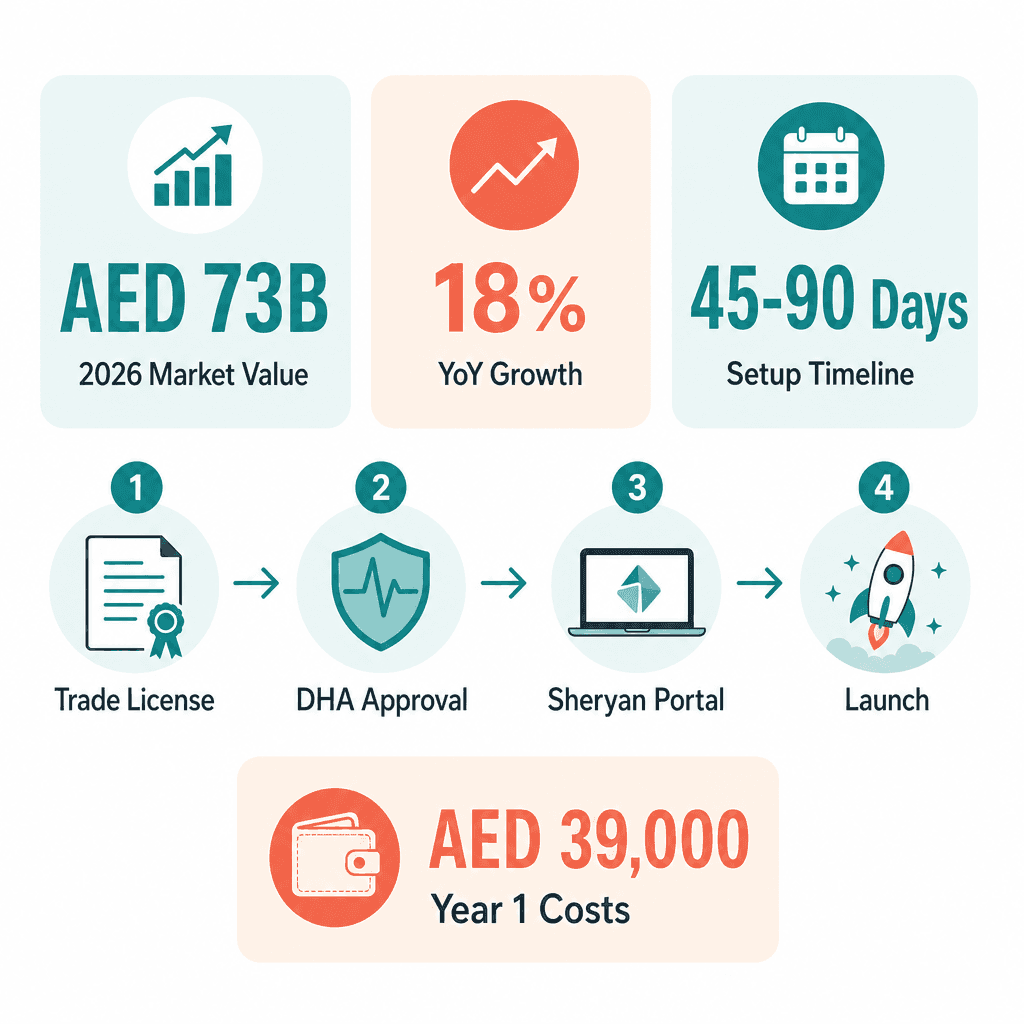
In 2026, Dubai's healthcare sector is valued at over AED 73 billion, with the government targeting AED 110 billion by 2030 under the Dubai Health Strategy (Dubai Health Authority, 2026). Healthcare business registrations in the UAE rose 18% year-on-year in 2025 (UAE Ministry of Economy, 2025). Foreign-owned medical businesses now account for 34% of all licensed healthcare facilities in Dubai (DHA, 2026). The UAE pharmaceutical market alone reached AED 16.2 billion in 2026 (UAE Ministry of Economy, 2026). Wellness centre registrations grew 27% in 2025 (DHA, 2025).
If you want to know how to start a healthcare business in Dubai, the short answer is this: you need two parallel approvals running simultaneously, a trade license from the Dubai Department of Economy and Tourism (DET) or a free zone authority, and a facility license from the Dubai Health Authority (DHA) issued via the Sheryan portal at dha.gov.ae. First-year regulatory costs for a standard clinic start at AED 39,000, and the full setup process takes 45 to 90 working days.
This guide covers every stage of the process, from choosing your business type and understanding DHA approvals to comparing free zone and mainland options and calculating your costs in AED, so you can launch with confidence.
Types of Healthcare Businesses in Dubai
Healthcare businesses in Dubai include medical clinics, pharmacies, wellness and physiotherapy centres, medical consultancies, diagnostic laboratories, home healthcare providers, and health technology companies. Each type requires a specific activity classification under the Dubai Health Authority or Ministry of Health and Prevention before a trade license is issued. Knowing which category your business falls into before you apply is not optional, it's the foundation of the entire setup process.
Clinical and Diagnostic Facilities
If you want to start a healthcare business in Dubai that sees patients directly, you're working with clinical facilities. General practice clinics, specialist clinics, dental clinics, and polyclinics each carry distinct DHA activity codes, and using the wrong one triggers an automatic rejection. Dubai has over 4,700 licensed private healthcare facilities as of 2026 (DHA, 2026), and specialist clinics account for 41% of new healthcare license applications in 2025 (DHA, 2025).
Diagnostic laboratories and radiology centres require separate facility licensing from DHA, on top of the trade license. A general medical clinic license on Dubai mainland costs from AED 15,000 to AED 25,000 in DHA facility fees alone. Take a specialist dermatology clinic in Jumeirah as a practical example: it needs both a DET trade license and a DHA facility approval, with annual renewal via the Sheryan portal. Miss the renewal deadline and you're looking at a fine of AED 500 per month.
Pharmacy, Wellness, and Health Technology Businesses
Pharmacies sit in their own category. They require a DHA facility license plus a pharmacist-of-record who holds a valid DHA professional license, you can't open the doors without both in place. Wellness centres (physiotherapy, nutrition counselling, medical fitness) are classified separately from clinical facilities and carry lower licensing fees, which is one reason wellness centre registrations in Dubai grew 27% in 2025 (DHA, 2025).
Health technology companies sit in a different regulatory lane entirely. A telemedicine startup, for instance, is typically classified under ISIC Section J (Information and Communication), specifically ISIC Division 62 (Computer Programming and Consultancy), if its principal activity is software delivery. It can partner with DHA-licensed clinics to facilitate remote consultations without needing its own facility approval. Medical consultancies providing advisory services without direct patient contact fall under ISIC Section M (Professional, Scientific and Technical Activities) and don't require DHA facility approval at all. The UAE health technology market is projected to reach AED 8.4 billion by 2027 (UAE Ministry of Economy, 2026). Check the full list of business activities in Dubai to confirm your classification before you apply.
Healthcare License Requirements
To obtain a healthcare business license in Dubai, you need a DET trade license with the correct healthcare activity code, a DHA facility approval for any patient-facing premises, and individual professional licenses for all licensed healthcare practitioners. Additional MOHAP registration applies for pharmaceutical and medical device businesses. Getting any one of these wrong delays all the others.
Trade License and Activity Classification
The Dubai Department of Economy and Tourism (DET) issues the trade license, but the activity code on that license must exactly match the DHA-approved facility type. This is where most applications go wrong. Activity code mismatches caused 23% of delayed healthcare license applications in 2024 (DHA, 2024), and DET processed 6,200 new healthcare trade licenses in 2025 (DET, 2025), so the volume of errors is significant.
Here's a concrete example of the risk: a medical consultancy applying under DET activity code 8621010 (General Medical Practice) instead of 7490010 (Other Professional Services) will find its DHA facility approval blocked, because the activity type doesn't match the intended facility function. Confirm your ISIC-aligned code with DHA before submitting to DET. A mainland trade license for a healthcare activity costs AED 12,000 to AED 20,000 per year. Free zone entities use their own authority's license rather than a DET license, but the DHA approval process remains identical.
Professional Licensing for Healthcare Practitioners
Every healthcare professional working in a Dubai facility must hold a valid DHA professional license. That means doctors, nurses, pharmacists, physiotherapists, and all allied health staff. There are no exceptions. DHA professional license applications go through the Sheryan portal at dha.gov.ae, with processing taking 15 to 30 working days. DHA issued 14,800 new professional licenses in 2025 (DHA, 2025), with fees ranging from AED 1,000 to AED 5,000 depending on category (DHA, 2026).
One point that catches international practitioners off guard: a GP relocating from Abu Dhabi with a valid HAAD (Health Authority Abu Dhabi) license cannot practise in Dubai until a separate DHA application is submitted and approved via Sheryan. UAE-wide mutual recognition does not apply across all practitioner categories. The licensed facility is legally responsible for verifying that every staff member holds a current DHA professional license before they see a single patient. To launch your company at Dubai South Business Hub Free Zone, the team can guide you through professional licensing requirements from day one.
DHA and MOH Approvals for Medical Businesses
Medical businesses in Dubai require DHA facility approval before opening, issued via the Sheryan portal. MOHAP approval is mandatory for pharmaceutical companies, medical device distributors, and businesses operating across multiple emirates. Each licensed practitioner on staff also needs an individual DHA professional license tied to the facility. These are not sequential, you'll be managing DHA and MOHAP processes in parallel if your business spans both.
DHA Facility Approval Process
DHA facility approval is mandatory for any premises where healthcare services are delivered to patients. It's entirely separate from, and additional to, the DET trade license. Submit via the Sheryan portal at dha.gov.ae; required documents include floor plans, tenancy contract, equipment list, and proof of qualified staff. Processing takes 20 to 45 working days (DHA, 2026), and facility license fees range from AED 5,000 to AED 30,000 depending on facility type (DHA, 2026).
DHA conducts a physical inspection before issuing the facility license, and your fit-out must comply with the DHA Healthcare Facility Guidelines (2023 edition). A physiotherapy centre in Business Bay, for instance, must submit floor plans showing treatment rooms of minimum 12 sqm each to pass inspection. Facility license renewal is annual. Late renewal incurs a fine of AED 500 per month, a cost that's easy to avoid with a calendar reminder but surprisingly common among first-year operators.
MOHAP and HAAD Requirements for Multi-Emirate Operations
MOHAP (Ministry of Health and Prevention) approval is required for pharmaceutical manufacturers, medical device importers and distributors, and any business operating across UAE emirates. HAAD governs healthcare businesses in Abu Dhabi specifically, a DHA license does not permit practice in Abu Dhabi, and vice versa. If you're planning multi-emirate operations, build the separate emirate-level approval costs into your budget from the start.
MOHAP registration for medical device distribution is submitted via mohap.gov.ae and costs AED 3,000 to AED 10,000 per product registration. MOHAP registered 2,100 new medical device lines in 2025 (MOHAP, 2025). A medical device distributor importing diagnostic equipment must register each device with MOHAP before any sale, regardless of which emirate the buyer is in. Skip this step and you're looking at product seizures and significant penalties.
What approvals does a medical business need in Dubai?
A medical business in Dubai needs three approvals to operate: a DET trade license (or free zone equivalent) with the correct activity code, a DHA facility license for any patient-facing premises issued via the Sheryan portal, and individual DHA professional licenses for every licensed practitioner on staff. Pharmaceutical and medical device businesses also need MOHAP registration via mohap.gov.ae.
Free Zone vs Mainland for Healthcare
Mainland healthcare businesses in Dubai can operate patient-facing clinics anywhere in the emirate and are regulated directly by DHA. Free zone healthcare companies are suited to consultancy, health technology, medical education, and trading activities, but cannot operate patient-facing clinical facilities within the free zone premises. The choice between the two isn't just about cost, it's about what your business actually does.
Mainland Healthcare Setup, Who It Suits
Mainland is the only option for businesses operating patient-facing clinical facilities. DHA will not approve a clinic operating from within a free zone. That's a hard rule, not a grey area. 72% of Dubai's private healthcare facilities operate under mainland DET licenses (DHA, 2026), and 100% foreign ownership has been permitted on mainland for most healthcare activities since 2021 under the UAE Commercial Companies Law (UAE Ministry of Economy, 2021).
A mainland DET setup allows direct contracting with Dubai Government and semi-government health entities including Dubai Health, Rashid Hospital, and Dubai Hospital. Mainland companies can also open multiple clinic branches across Dubai under a single trade license, with each branch requiring its own DHA facility approval. A German-owned specialist orthopaedic clinic group, for example, can set up three Dubai mainland branches under a single DET license, each holding its own DHA facility approval, a structure that's both legally clean and operationally scalable.
Free Zone Healthcare Setup, Who It Suits
Free zones are the right base for medical consultancies, health technology firms, telemedicine platforms, medical education providers, pharmaceutical trading companies, and medical device distributors. Free zone companies benefit from 0% corporate tax on qualifying income under UAE Corporate Tax Law (Federal Decree-Law No. 47 of 2022), 100% foreign ownership, and full profit repatriation. Free zone healthcare and wellness company registrations grew 31% in 2025 (UAE Free Zone Authority data, 2025).
A UK-based health tech company establishing its Middle East hub at Dubai South Business Hub Free Zone to distribute a telemedicine SaaS platform across GCC markets is a typical use case, no DHA facility approval needed, because the company isn't seeing patients. Worth flagging: if that same company later wants to add in-person services, it must establish a separate mainland branch with DHA facility approval. You can't retrofit clinical activity onto a free zone license.
Healthcare Business Setup Costs in Dubai, 2026 Fee Guide
Cost Item | Fee in AED (2026) |
|---|---|
DET Mainland Trade License (healthcare activity) | AED 12,000 to AED 20,000/year |
DHA Facility License (wellness centre) | AED 5,000/year |
DHA Facility License (specialist clinic) | AED 18,000 to AED 30,000/year |
DHA Professional License (per practitioner) | AED 1,000 to AED 5,000 |
MOHAP Medical Device Registration (per product line) | AED 3,000 to AED 10,000 |
Dubai South Business Hub Free Zone Trade License | From AED 12,900/year |
Medical Liability Insurance (mandatory for DHA facilities) | AED 4,000 to AED 20,000/year |
Costs in AED
Starting a healthcare business in Dubai costs between AED 25,000 and AED 120,000 in the first year, depending on the business type, location, and number of licensed practitioners. Costs include the trade license, DHA facility approval, professional licenses, and mandatory medical liability insurance. Most first-time applicants underestimate the total by 30% because they budget only for the headline license fees.
License and Approval Fee Breakdown
A two-doctor general practice clinic on mainland Dubai illustrates the real numbers clearly: AED 15,000 for the DET trade license, plus AED 18,000 for the DHA facility license, plus two DHA professional licenses at AED 3,000 each, that's AED 39,000 in annual regulatory fees before a single dirham is spent on fit-out or rent. Add mandatory medical liability insurance (AED 4,000 to AED 20,000 per year) and initial fit-out starting at AED 80,000 for a two-room facility (market estimate, 2026), and the first-year outlay for a modest clinic is comfortably above AED 120,000.
For non-clinical businesses, the picture is different. A healthcare consultancy or health tech company at Dubai South Business Hub Free Zone starts from AED 12,900 per year, no DHA facility license required, no fit-out to DHA standards, and no mandatory medical waste contract. That's a meaningful cost difference for businesses that don't see patients.
Hidden Costs to Budget For
The fees that catch operators off guard are the smaller ones that add up fast. Name reservation at DET costs AED 620. Initial DET approval fees run AED 200 to AED 350. The DHA pre-approval inspection fee is AED 1,000 to AED 3,000. A mandatory medical waste disposal contract for clinical facilities adds AED 3,000 to AED 8,000 per year, a cost one pharmacy owner I've seen overlook entirely, alongside the pharmacist-of-record professional license renewal at AED 3,000 per year.
Staff costs add another layer. Emirates ID and visa processing for each practitioner runs AED 3,500 to AED 5,000 per person, including ICP fees at icp.gov.ae, specifically AED 3,175 for a two-year residency visa (ICP, 2026). Mainland businesses also need to account for the MOHRE Emiratisation levy: AED 800 per month per unfilled Emirati quota position (MOHRE, 2026). Use the calculate your setup cost tool to model your specific scenario before committing.
Setup Process, Step by Step
Setting up a healthcare business in Dubai follows seven sequential steps: confirm your business activity and legal structure, reserve your trade name, obtain initial DHA pre-approval, register with DET or your chosen free zone, secure premises and complete fit-out, pass the DHA facility inspection, and then trade. The full process takes 45 to 90 working days. The single biggest time-saver is getting DHA pre-approval before you sign a lease.
Steps 1 to 4, Pre-Registration and Authority Approvals
Define your healthcare activity type. Confirm the correct DHA activity code and ISIC classification before anything else. This determines every subsequent step, the wrong code at this stage creates a chain of errors that can take months to unwind.
Reserve your trade name. Submit via the DET portal at dubai.gov.ae or your chosen free zone authority. Healthcare trade names cannot include terms like "hospital" or "medical centre" unless the facility type qualifies, DET will reject the reservation if it doesn't match. Name reservation costs AED 620.
Obtain DHA initial approval (pre-approval). Submit via the Sheryan portal at dha.gov.ae. This is DHA's in-principle agreement to your proposed activity. Processing takes 5 to 10 working days (DHA, 2026). A physiotherapy entrepreneur who secured DHA pre-approval in Week 2, then signed a lease in Week 3, saved roughly three months compared to operators who commit to premises first.
Submit your trade license application. Send to DET (mainland) or your free zone authority, attaching the DHA pre-approval letter, shareholder passport copies, and Memorandum of Association. DET initial approval takes 3 to 7 working days (DET, 2026).
Steps 5 to 7, Fit-Out, Inspection, and Launch
Secure premises and complete fit-out. All fit-out must comply with DHA Healthcare Facility Guidelines (2023 edition). Once complete, submit a fit-out completion notice to DHA to schedule the physical inspection. Don't sign a long lease before confirming the space meets DHA's minimum room dimension requirements.
Pass the DHA physical inspection. Inspectors check room dimensions, equipment, sterilisation facilities, signage, and staff licensing documentation. Failed inspections require re-inspection at AED 1,000 per visit. A dental clinic that failed its first DHA inspection because its sterilisation room was 0.5 sqm below the minimum requirement needed an AED 8,000 fit-out adjustment before re-inspection, a costly but entirely avoidable problem. DHA schedules inspections 7 to 14 working days after fit-out notification (DHA, 2026).
Receive your DHA facility license and activate your trade license. Register with MOHRE at tasheel.mohre.gov.ae (mainland only), open your business bank account, and you're cleared to operate. Total timeline from name reservation to operational: 45 to 90 working days (DHA, 2026).
A process timeline showing the seven sequential steps from activity confirmation to launch for a Dubai healthcare business setup. Healthcare Business Setup, 7 Steps to Launch 1ConfirmActivity Code 2ReserveTrade Name References
dha.gov.ae (dha.gov.ae)
mohap.gov.ae (mohap.gov.ae)
icp.gov.ae (icp.gov.ae)
dubai.gov.ae (dubai.gov.ae)
tasheel.mohre.gov.ae (tasheel.mohre.gov.ae)