

Topic Summary
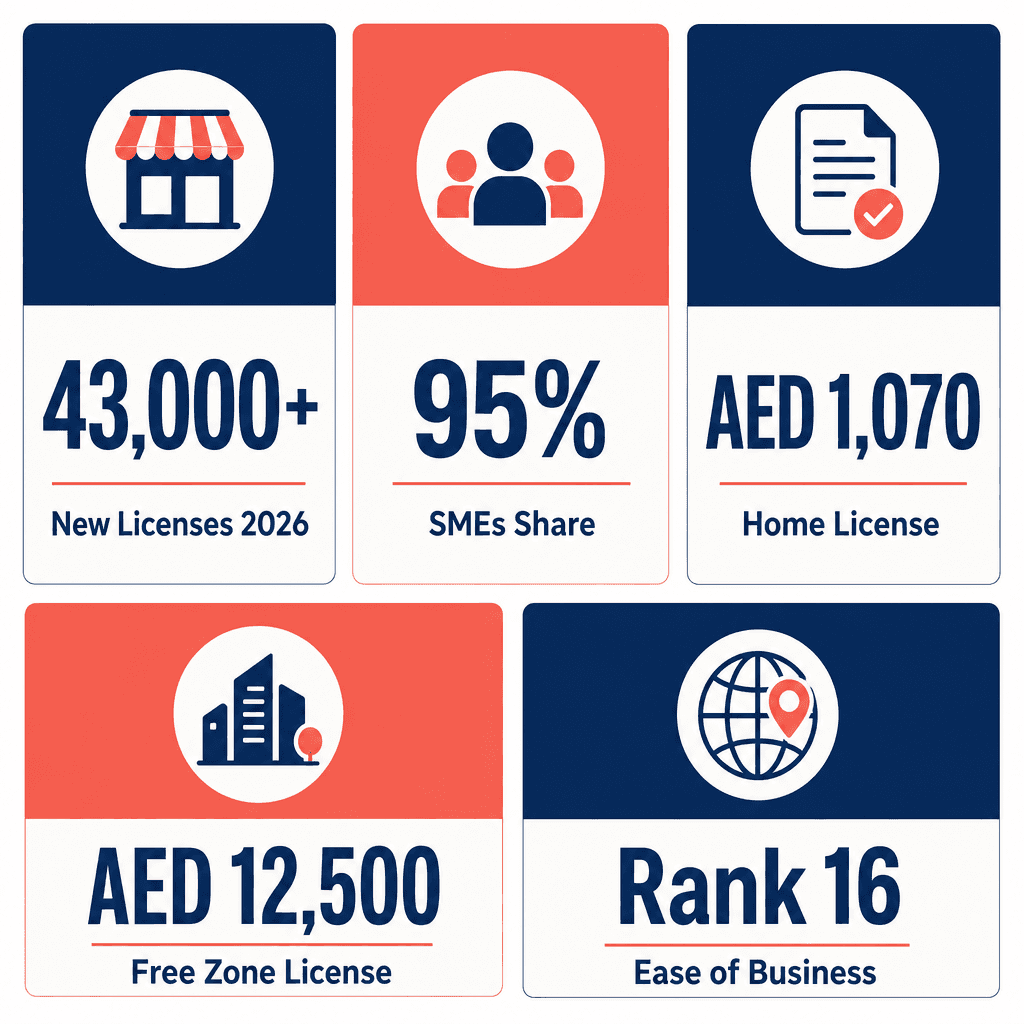
In 2026, over 43,000 new business licenses were issued in Dubai in a single year (UAE Ministry of Economy, 2026). SMEs now account for 95% of all registered companies and contribute 40% of the emirate's GDP (UAE…
In 2026, over 43,000 new business licenses were issued in Dubai in a single year (UAE Ministry of Economy, 2026). SMEs now account for 95% of all registered companies and contribute 40% of the emirate's GDP (UAE Ministry of Economy, 2026). The average free zone license starts from AED 12,500, and a home-based DED Trader license costs just AED 1,070 per year (DED, 2026). The UAE ranks 16th globally for ease of doing business (World Bank, 2026). Zero personal income tax applies to all individual business owners regardless of earnings.
Knowing how to start a small business in Dubai is simpler than most people assume. The cheapest legal path costs AED 1,070 for a home-based license, and a full free zone setup with a residency visa runs AED 17,000–22,000 all-in. This guide gives you every cost, every step, and every license option you need to go from idea to licensed company in 2026.
Want to skip ahead and price your specific setup? Calculate your setup cost using the Dubai South Business Hub Free Zone cost calculator.
Why Small Businesses Succeed in Dubai
Small businesses thrive in Dubai because of zero personal income tax, a 9% corporate tax threshold exempting companies earning under AED 375,000, a digitised licensing system, and access to over 3 million consumers in the UAE, making it one of the most entrepreneur-friendly markets in the world.
Tax Advantages and Market Access
Zero personal income tax is the headline benefit when you learn how to start a small business in Dubai. There is no tax on salary, dividends, or business profits drawn by individual owners. The UAE's corporate tax, introduced under Federal Decree-Law No. 47 of 2022, applies a 9% rate only on net profits above AED 375,000 per year (UAE Federal Tax Authority, 2026). A freelance graphic designer earning AED 200,000 per year pays zero corporate tax under the current threshold, keeping every dirham to reinvest.
Dubai's geography compounds the advantage. You're sitting within a 4-hour flight radius of 2.5 billion consumers across South Asia, East Africa, and the Middle East. Free zone businesses also enjoy 100% repatriation of capital and profits, meaning you can move money out of the UAE without restriction. That's a combination very few jurisdictions can match.
Government Support for SMEs
Dubai SME, the Mohammed Bin Rashid Establishment for SME Development, offers financing programmes, mentorship access, and preferential government procurement for registered small businesses. The UAE ranks 16th globally for ease of doing business (World Bank, 2026), and that ranking reflects real infrastructure: digital portals, fast approvals, and transparent fee schedules.
Over 40 free zones across the UAE actively compete for SME registrations, which drives license costs down year on year. The DED Trader platform allows home-based business licensing in under 48 hours for residents already on a UAE visa. A home-baker in Dubai used the DED Trader license to legalise her apartment-based operation for AED 1,070, with no commercial lease required.
10 Small Business Ideas for Dubai in 2026
The ten most viable small business ideas in Dubai for 2026 include freelance consulting, e-commerce, social media management, home-based food production, tutoring, cleaning services, personal fitness training, content creation, dropshipping, and virtual assistant services, all startable for under AED 25,000 in total setup costs.
Small Business License Options in Dubai - Cost and Eligibility Comparison 2026
License Type | Annual Cost | Eligibility and Key Restrictions |
|---|---|---|
DED Trader License | AED 1,070/year | UAE residents only. No visa included. Home-based and online activities only (e-commerce, handmade goods, consulting). |
DED Professional License | From AED 15,000/year | UAE residents and expats. Local service agent required. Physical address needed. Covers service-based professions. |
Free Zone License (e.g., Dubai South Business Hub Free Zone) | From AED 12,500/year | 100% foreign ownership. Visa eligible from day one. Flexi-desk included in most packages. Cannot trade directly on UAE mainland without a distributor. |
Free Zone Freelance Permit | From AED 7,500/year | Individual only. Single-activity permit. Visa eligible. Ideal for solo consultants, designers, and media professionals. |
Mainland Commercial License | From AED 20,000/year | Expats with local partner or under 2021 FDI reforms for eligible sectors. Full UAE market access. Physical office required. |
Service-Based Ideas With Low Overhead
These five small business Dubai ideas require no warehouse, no inventory, and minimal equipment:
Freelance Consulting (marketing, HR, finance): License from AED 12,500 at a free zone. No office required. Billable rates run AED 300–1,200 per hour depending on specialism.
Social Media Management: A freelance permit from AED 7,500 at Dubai Media City or IFZA covers this. A laptop and phone are sufficient to operate.
Virtual Assistant Services: Operate under a professional services license. Total startup cost is AED 13,000–18,000 including a residency visa.
Tutoring and Online Courses: KHDA (Knowledge and Human Development Authority) approval is needed for in-person tutoring in Dubai. Online-only delivery avoids that requirement entirely. License from AED 12,500.
Personal Fitness Training: A personal trainer license via DED starts from AED 15,000, or you can operate through a gym-partnership arrangement to reduce upfront cost.
A Dubai-based HR consultant registered a free zone freelance permit in 5 days for AED 14,200 all-in and billed AED 180,000 in her first year working entirely remotely. That's the realistic upside of getting licensed quickly.
Product and Digital Business Ideas
E-Commerce Store: The DED e-trader license costs AED 1,070 for UAE residents. A free zone e-commerce license starts from AED 12,500. Selling platforms include Noon, Amazon.ae, and Shopify.
Dropshipping: No warehouse needed. Under ISIC Revision 4, dropshipping falls under Division 47 (retail trade). A free zone license covers international supplier relationships with no local stock required.
Home-Based Food Production: Requires Dubai Municipality food safety approval plus a DED home trade license. Total cost: AED 8,000–14,000.
Content Creation and Influencer Marketing: The UAE National Media Council (NMC) influencer license costs AED 15,000 (NMC, 2026) and covers paid brand partnerships and sponsored posts.
Cleaning Services: DED or free zone license from AED 15,000. Dubai Municipality approval is required for commercial premises cleaning.
An expat entrepreneur launched a dropshipping business for AED 13,500 through a free zone e-commerce license, sourcing from Turkish suppliers and selling across the GCC via Amazon.ae. He had his first order within 30 days of license issuance. Launch your company at Dubai South Business Hub Free Zone to access the same e-commerce activity category.
Cheapest License Options for Small Businesses
The cheapest small business license in Dubai starts at AED 1,070 for the DED e-trader home license, available to UAE nationals and residents only. Free zone licenses begin at AED 12,500 per year and include 100% foreign ownership. Free zone options are the most affordable route for expat entrepreneurs who also need a residency visa.
DED Home-Based and Freelance Licenses
The DED Trader license at AED 1,070 per year is the entry point for small business Dubai setup. It covers e-commerce, handmade goods, and home-based consulting for UAE residents. You don't need to rent commercial space, and the application completes online via the DED portal (dubaided.gov.ae) in 1–2 working days.
If your business requires a physical address or involves client-facing services, the DED Professional license starts from AED 15,000 per year. Trading, retail, and import/export activities fall under the DED Commercial license from AED 20,000. Worth flagging: none of these DED home-based licenses include a residency visa. If you're already on a spousal visa, employer visa, or Golden Visa, that's not a problem. A stay-at-home parent in Jumeirah used the AED 1,070 DED Trader license to sell handmade candles on Instagram and Noon.com, fully legal with no office and no visa application needed.
Free Zone Licenses for Expat Entrepreneurs
Free zone licenses start from AED 12,500 and give you 100% foreign ownership with no local sponsor required. Most packages include a flexi-desk (a registered virtual office address), which satisfies bank KYC requirements when opening a business account. A free zone license also makes you eligible to apply for a UAE residency visa, at an additional cost of AED 3,500–5,000 including the medical test and Emirates ID.
In 2026, the most competitively priced options for first-time founders include IFZA, Dubai South Business Hub Free Zone, Meydan Free Zone, and SHAMS. One practical limitation: free zone companies cannot sell directly to UAE mainland customers without appointing a mainland distributor or registering a DED branch. For service businesses billing internationally, this restriction rarely matters.
Total Startup Costs in AED - Realistic Breakdown
Realistic total startup costs for a small business in Dubai range from AED 13,000 for a home-based DED setup to AED 30,000–40,000 for a free zone license with one residency visa, Emirates ID, and a basic business bank account, including all government fees and medical tests.
Line-by-Line Cost Breakdown
Free zone trade license: AED 12,500–18,000 depending on activity and free zone chosen
Residency visa fees: AED 3,500–5,000 including medical test and Emirates ID (ICP, 2026)
Emirates ID: AED 370 (icp.gov.ae, 2026)
Business bank account: AED 0 opening fee at most banks, but minimum balance of AED 10,000–50,000 is required to avoid monthly charges
MOHRE registration (if hiring staff): AED 300 per employee
A freelance digital marketer registered at Dubai South Business Hub Free Zone for AED 12,500 (license) + AED 4,200 (visa) + AED 370 (Emirates ID) = AED 17,070 total in year one. That's the realistic floor for a fully compliant solo setup with a visa.
Hidden Costs First-Time Founders Miss
Medical insurance is mandatory for all UAE visa holders. A basic plan starts from AED 650 per year (DHA, 2026), with more comprehensive plans reaching AED 2,500. Budget this from day one. Accounting software or a bookkeeper costs AED 2,000–8,000 per year for VAT-registered businesses.
VAT registration is mandatory once annual turnover crosses AED 375,000. There's no fee to register with the Federal Tax Authority, but quarterly filing is required and errors carry penalties. Document notarisation and attestation, if required by your free zone, runs AED 150–500 per document. And annual license renewal costs the same as your year-one license fee, every 12 months without exception. Many first-time founders budget for the license but miss the insurance entirely, adding AED 650–2,500 to year-one costs.
Use the setup cost calculator to build a complete year-one budget before you commit.
Free Zone vs Home-Based Business in Dubai
A free zone license gives expat entrepreneurs 100% ownership, a residency visa, and a UAE business address from AED 12,500. A home-based DED license costs from AED 1,070 but does not include a visa and restricts trading to online or home-delivered services. Choose based on whether you need a visa and mainland access.
When a Free Zone License Makes Sense
Choose a free zone if you're an expat who needs a UAE residency visa tied to your own business rather than an employer. Free zone companies face no restrictions on invoicing international clients, which makes them ideal for consultants, digital agencies, and service exporters. You get 100% ownership without a local sponsor, and a UAE business address that satisfies bank KYC requirements.
A British entrepreneur consulting for European clients chose a Dubai South Business Hub Free Zone license. She invoices in EUR, pays zero income tax on those earnings, and her UAE residency visa is tied to her own company rather than an employer. That independence is the core advantage of the free zone model for affordable business ideas Dubai-based expats can actually use.
When a Home-Based License Is Enough
If you already hold a UAE residency visa through a spouse, employer, or Golden Visa, you don't need to pay for a visa-linked free zone license. The DED Trader license at AED 1,070 covers purely online activities: e-commerce, content creation, and freelancing without physical client meetings. It's also a sensible way to test a business idea before committing to a full free zone setup.
A resident on a spousal visa launched an online tutoring business under the AED 1,070 DED Trader license. No visa needed, no office, fully operational within 48 hours of applying online. That's the cleanest and cheapest path when you already have your residency sorted. Launch your company at Dubai South Business Hub Free Zone if you need the visa pathway alongside your license.
Setup Timeline
A free zone small business in Dubai can be fully licensed and operational in 5–10 working days. The process runs: choose activity and free zone, submit documents, receive initial approval, pay fees, receive license, then apply for your visa through ICP and GDRFA. A home-based DED license completes in 1–2 working days online.
Step-by-Step Free Zone Setup Process
Choose your business activity and confirm it appears on your chosen free zone's permitted activity list. Takes 1 day. Cross-reference with ISIC activity codes if you're in a regulated sector.
Submit your documents: passport copy, UAE visa page (or entry stamp), and the free zone application form. Takes 1 day. Many free zones accept fully digital submissions.
Receive initial approval (an in-principle approval letter from the free zone authority). Typically 1–3 working days.
Pay license and flexi-desk fees. License is issued within 1–2 working days of payment clearing.
Apply for UAE residency visa via GDRFA (gdrfad.gov.ae) or ICP (icp.gov.ae). Medical test, Emirates ID processing, and visa stamping take 5–7 working days.
A Pakistani national completed Steps 1–4 at Dubai South Business Hub Free Zone in 4 working days and had her visa stamped 6 days later, for a total elapsed time of 10 working days from first enquiry to stamped visa.
Month-by-Month Realistic Timeline
Month 1: Research free zones, select your activity, submit documents, receive license, begin visa application.
Month 2: Visa stamped, Emirates ID received, business bank account opened. Bank account activation typically takes 2–4 weeks after license issuance.
Month 3: First client invoiced, accounting system configured, VAT registration assessed if you're projecting over AED 375,000 in annual turnover.
Month 6: Review your license activity list. Adding secondary activities costs AED 1,000–3,000 each, so it's worth reviewing as the business grows.
Most solo founders are fully operational, licensed, visa stamped, and bank account active, within 6–8 weeks of starting the application process.
Common Small Business Mistakes in Dubai
The most common small business mistakes in Dubai are choosing the wrong license activity, underestimating total costs by ignoring visa and insurance fees, opening a bank account before the license is issued, and operating without a valid license, which carries fines of AED 10,000–50,000 from DED or the relevant free zone authority.
Licensing and Activity Errors
Choosing the wrong business activity code is one of the most expensive mistakes a first-time founder makes. Under UAE commercial law, you can only legally invoice for activities listed on your trade license. Adding activities later costs AED 1,000–3,000 per addition. Operating without a small business license Dubai authorities recognise is a criminal offence: fines start at AED 10,000 (DED, 2026) and can reach AED 50,000 for repeat violations.
Freelancing under an employment visa without a separate freelance permit violates UAE immigration law. Both GDRFA and MOHRE enforce this actively. A consultant operating under an employment visa without a freelance permit was fined AED 50,000 and had her employment contract terminated, a risk entirely avoidable with a AED 12,500 free zone permit. Also worth checking: ISIC activity codes
References
UAE Federal Tax Authority (tax.gov.ae)
World Bank (worldbank.org)
Dubai Municipality (dm.gov.ae)
dubaided.gov.ae (dubaided.gov.ae)
icp.gov.ae (icp.gov.ae)
DHA (dha.gov.ae)
gdrfad.gov.ae (gdrfad.gov.ae)