

Table of Contents What Makes an E-Commerce Platform Different from an Online Store License Required for E-Commerce Platform in Dubai Technical Infrastructure Options Payment Gateway Integration for UAE Platforms…
Table of Contents
What Makes an E-Commerce Platform Different from an Online Store
License Required for E-Commerce Platform in Dubai
Technical Infrastructure Options
Payment Gateway Integration for UAE Platforms
Logistics and Delivery Partner Setup
UAE Consumer Protection Laws for Online Platforms
E-Commerce Platform Startup Costs in AED
How Dubai South Business Hub Free Zone Helps
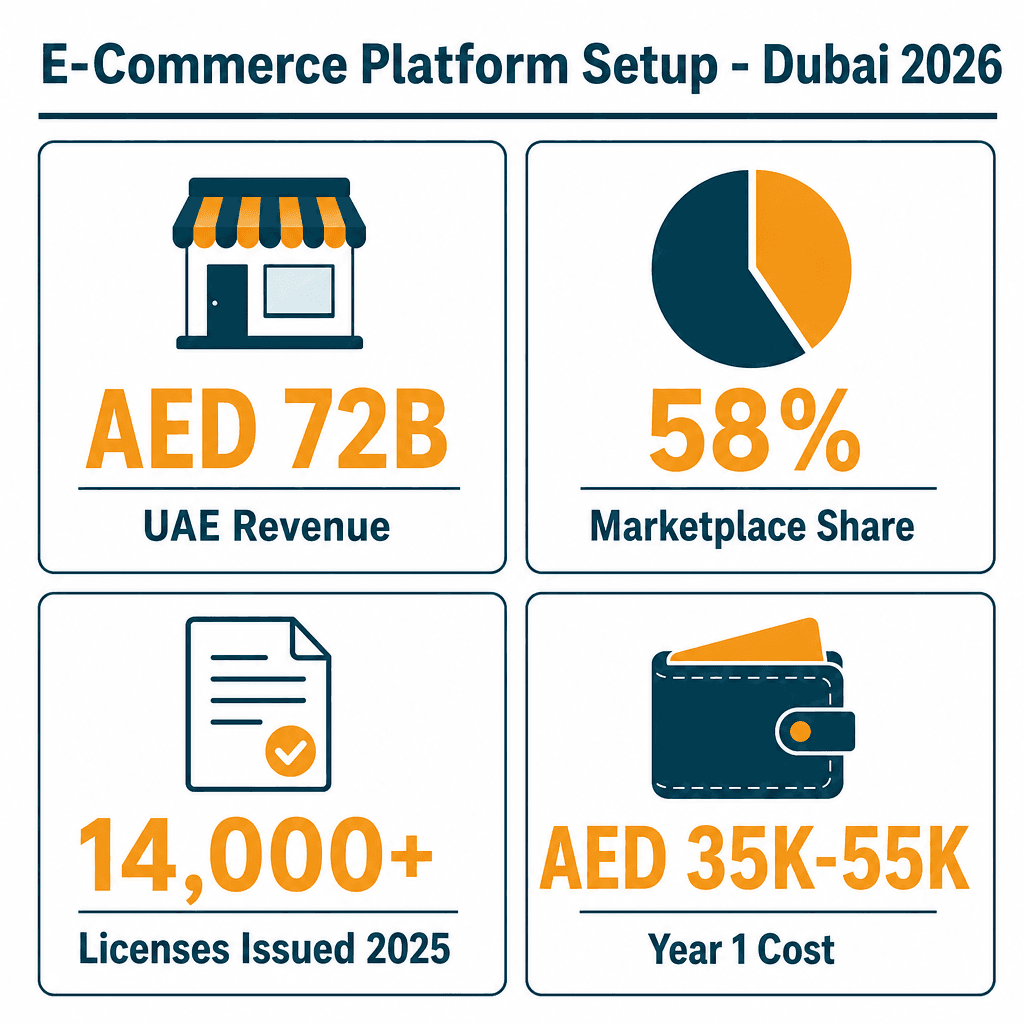
In 2026, UAE e-commerce revenue has reached AED 72 billion, with marketplace platforms capturing 58% of all online transactions (UAE Ministry of Economy, 2026). Dubai Economy and Tourism issued over 14,000 new e-commerce licenses in 2025 alone (Dubai Economy and Tourism, 2026). The minimum viable setup for starting an e-commerce platform in Dubai, free zone license, SaaS marketplace software, and one payment gateway, costs AED 35,000 to AED 55,000 in year one (Dubai South Business Hub Free Zone, 2026).
Starting an e-commerce platform in Dubai requires a DED or free zone trade license, a minimum setup cost of AED 35,000, and full compliance with UAE consumer protection law. This guide walks you through every step: licensing, technical infrastructure, payment gateways, logistics partners, and realistic startup costs in AED. Read the full e-commerce licensing in Dubai guide for deeper licensing detail.
What Makes an E-Commerce Platform Different from an Online Store
An e-commerce platform is a multi-vendor marketplace that hosts third-party sellers and processes transactions between buyers and sellers. Unlike a single-brand online store that sells only its own products, platforms require a marketplace license, escrow-compatible payment gateways, and UAE consumer protection compliance for all listed vendors. The distinction isn't just commercial, it's legal, and getting it wrong at registration creates compounding problems.
Platform vs. Store: The Legal and Commercial Distinction
A marketplace platform hosts multiple independent sellers and earns revenue from commissions, listing fees, or subscription charges. A store sells one brand's own inventory. That difference determines your license activity code, your VAT obligations, and your liability under UAE law.
Under ISIC Rev.4, platforms are classified either under Section G (Wholesale and Retail Trade) or Section J (Information and Communication), depending on where the majority of your value added comes from. If your primary income is commission on third-party sales, Section J applies. If you're primarily a reseller who also hosts other vendors, Section G is the correct classification.
UAE law treats marketplace operators as intermediaries with distinct liability obligations under Federal Law No. 15 of 2020 on Consumer Protection. DED classifies marketplace activity separately from direct retail, and your license activity code must reflect this from day one. Noon.com is the clearest local example: it hosts third-party UAE sellers, manages payments, and is regulated as a marketplace operator, not a retailer, even though consumers buy products through its interface.
Why the Distinction Matters for Your License and Tax Structure
Marketplace operators are subject to 5% VAT on commission income under Federal Tax Authority rules, not just on product sales. That's a different VAT treatment from a standard retailer, and it affects how you issue tax invoices to vendors and consumers alike.
Here's a scenario that plays out more often than you'd think: a Dubai founder registers as a "retail trader" but earns 80% of revenue from seller commissions. Under UAE commercial and tax law, that's a misclassification. The Federal Tax Authority uses the ISIC top-down method to determine principal activity, value added from commissions, not gross merchandise value, defines your category. Incorrect activity codes are among the top three reasons DED suspends e-commerce licenses (Dubai Economy and Tourism, 2026). Choose the right code at setup, not after your first audit.
License Required for E-Commerce Platform in Dubai
To operate an e-commerce platform in Dubai, you need a trade license with an e-commerce or marketplace activity code issued by Dubai Economy and Tourism (DED) for mainland or a free zone authority. Free zone licenses for starting an e-commerce platform in Dubai start at AED 5,750 and are issued in 3–7 business days.
Mainland License via Dubai Economy and Tourism
The DED mainland route suits founders who want to sell directly to UAE residents and government entities without a distribution intermediary. Apply through the DED portal at dubai.ae and select activity code 4791 (Retail Sale via Internet) or 6312 (Web Portals), depending on your revenue model. A grocery marketplace selling to mainland consumers, for instance, must hold a DED mainland license to deliver to residential addresses without a distributor in the chain.
The application process runs as follows:
Reserve your trade name on the DED portal at dubai.ae.
Select your activity code, 4791 or 6312 based on your primary revenue source.
Submit an Ejari-registered tenancy contract for your registered office address.
Pay the license fee, starting at AED 12,500 annually, up to AED 18,000 with additional activity codes.
Receive your trade license within 5–10 business days.
DED issued 14,000+ e-commerce licenses in 2025 (Dubai Economy and Tourism, 2026), so the process is well-established. The main constraint is the mandatory physical office requirement, which adds rental costs on top of the license fee.
Free Zone License for Marketplace Operators
Free zones like Dubai South Business Hub Free Zone offer e-commerce and marketplace license packages from AED 5,750, with 100% foreign ownership, zero corporate tax on qualifying income, and no currency restrictions. An international founder launching a UAE fashion marketplace can incorporate at Dubai South Business Hub Free Zone for AED 5,750, gain full ownership, and operate the platform digitally from day one, no physical office needed.
The trade-off is direct mainland access. Free zone operators selling to UAE mainland consumers must appoint a mainland distributor or use a dual-license structure. For most digital marketplace founders, that's a manageable constraint, especially in the early stages when the platform is building vendor and consumer base.
Dubai E-Commerce Platform License Comparison: Mainland vs. Free Zone (2026) | ||
Feature | DED Mainland License | Dubai South Business Hub Free Zone License |
|---|---|---|
Starting annual fee | AED 12,500 | AED 5,750 |
Processing time | 5–10 business days | 3–7 business days |
Foreign ownership | Up to 100% (post-2021 reform) | 100% |
Physical office required | Yes (Ejari-registered) | No (flexi-desk available) |
Direct mainland B2C sales | Yes | Via distributor or dual license |
Corporate tax | 9% on taxable income above AED 375,000 | 0% on qualifying free zone income |
Technical Infrastructure Options
When you build an e-commerce platform in UAE, you choose from three infrastructure paths: SaaS platforms like Shopify or Marketplacer for speed, open-source solutions like Magento or WooCommerce for control, or fully custom development for scale. Each carries different upfront costs in AED, maintenance obligations, and UAE payment gateway compatibility. Your ecommerce platform business in Dubai will be shaped by this decision more than almost any other.
SaaS Marketplace Platforms: Shopify, Marketplacer, and CS-Cart
SaaS options are the fastest route to market. Shopify Markets supports AED pricing and integrates natively with UAE payment gateways including Telr, PayTabs, and Checkout.com. Marketplacer is purpose-built for multi-vendor marketplaces, it handles vendor onboarding, commission splits, and payout automation out of the box. CS-Cart Multi-Vendor starts at USD 1,500 (approximately AED 5,500) as a one-time license, making it popular with UAE fashion and electronics marketplace founders who want ownership without a monthly SaaS fee.
A Dubai electronics marketplace launched on CS-Cart Multi-Vendor, onboarding 40 UAE vendors in 6 weeks at a total setup cost under AED 30,000. SaaS solutions reduce development time to 4–8 weeks versus 6–12 months for custom builds, a 60% reduction in time-to-launch (Gartner, 2025). For most first-time marketplace founders, SaaS is the right starting point.
Open-Source and Custom Development for UAE Marketplaces
Magento Open Source (Adobe Commerce) supports Arabic RTL layouts, AED currency, and UAE VAT invoice generation natively, making it the most compliance-ready open-source option for UAE marketplace operators. A Dubai healthcare marketplace chose Magento with custom vendor verification workflows specifically to meet DHA (Dubai Health Authority) supplier compliance requirements, something no off-the-shelf SaaS product could handle.
Custom development gives full control over data residency, which matters under Federal Decree-Law No. 45 of 2021, UAE user data must be stored on UAE or approved servers. The cost range is wide: AED 80,000 to AED 300,000 depending on vendor management complexity, API integrations, and mobile app requirements. UAE-based development agencies charge AED 150–AED 350 per hour; offshore teams run AED 50–AED 120 per hour. Custom is the right choice when regulatory or vertical-specific requirements can't be met by SaaS.
Payment Gateway Integration for UAE Platforms
UAE e-commerce platforms must integrate a Central Bank of UAE-approved payment gateway to process AED transactions legally. Top options to build your e-commerce platform in UAE include Telr, PayTabs, Network International, and Checkout.com, each charging 2.5%–3.5% per transaction. Marketplace platforms also need escrow or split-payment functionality to pay vendors separately from consumer receipts. Read our full payment gateway UAE guide for a complete comparison.
Approved Payment Gateways and Transaction Fees
The Central Bank of UAE had licensed 47 payment service providers as of Q1 2026 (CBUAE, 2026). For most UAE marketplace founders, the practical shortlist is four gateways:
Telr: AED 349/month plus 2.65% per transaction. Supports 120+ currencies. Widely used by UAE SME marketplaces.
PayTabs: No monthly fee plus 2.85% per transaction. Strong Arabic-language checkout flows.
Network International: Enterprise pricing from AED 1,500/month. Preferred by large UAE marketplaces processing AED 1M+ monthly.
Checkout.com: 2.9% plus AED 1.10 per transaction. Best international payment coverage for cross-border UAE platforms.
A Dubai food delivery marketplace integrated Telr for AED consumer payments and Checkout.com for international vendor payouts, reducing cross-border fee leakage by 1.2%. That kind of dual-gateway architecture is worth considering if your vendor base spans multiple countries.
Split Payments and Vendor Payout Architecture
Standard payment gateways don't automatically split transactions between platform commission and vendor net amount, you need a marketplace-specific module. PayTabs MarketPay, Telr's marketplace module, and Checkout.com's partnership with Stripe Connect all handle automated splits. A UAE handmade goods marketplace used PayTabs MarketPay to automate vendor splits, reducing manual reconciliation from 8 hours per week to under 30 minutes (PayTabs, 2025).
Worth flagging: escrow functionality is legally required for platforms holding consumer funds for more than 24 hours under UAE Payment Systems Regulation (Cabinet Decision No. 10 of 2023). Vendor payout cycles of weekly are standard in UAE; daily payouts require specific Central Bank approval. Build your payout architecture around these constraints from day one.
What payment gateway is best for a UAE marketplace platform?
For most UAE marketplace founders starting out, Telr offers the best balance of cost, Arabic checkout support, and marketplace module availability. PayTabs is the stronger choice if you need zero monthly fees while transaction volumes are low. Switch to Network International once monthly GMV exceeds AED 1 million, where enterprise pricing becomes cost-effective.
Logistics and Delivery Partner Setup
Dubai e-commerce platforms integrate with third-party logistics providers including Aramex, Fetchr, Quik, and Emirates Post for last-mile delivery. Marketplace operators who negotiate API-based delivery rate cards rather than per-shipment pricing cut fulfilment costs by 15%–30% at scale. This is one of the most overlooked cost levers in an ecommerce platform business in Dubai.
Top Logistics Partners for UAE Marketplaces
Aramex: Nationwide UAE coverage, API integration, same-day Dubai delivery from AED 15 per shipment at volume.
Fetchr: GPS pin-based delivery with no formal address required, critical for UAE, where residential addressing is inconsistent.
Quik: Hyperlocal same-hour delivery in Dubai, suited for grocery and pharmacy marketplace verticals.
Emirates Post: Government-backed, lowest cost for light parcels under 500g at AED 8–AED 12 per shipment.
A UAE pet supplies marketplace integrated Aramex and Fetchr APIs simultaneously, offering same-day delivery in Dubai via Fetchr and next-day UAE-wide via Aramex. Checkout conversion increased by 22% after launch. Same-day delivery availability increases UAE e-commerce conversion rates by 18%–25% (Dubai Chamber, 2025), it's not a nice-to-have at this point. For cross-border shipments, register with Dubai Customs at dubai.customs.gov.ae before going live.
Setting Up Logistics API Integrations on Your Platform
Register a business account with each logistics provider and request API credentials.
Integrate the provider's RESTful API into your platform's checkout module for real-time rate calculation.
Configure webhook callbacks to update order status automatically when shipment milestones are reached.
Set up a returns management workflow, UAE consumer law mandates 14-day return rights on most product categories under Federal Law No. 15 of 2020.
Test with live orders in a sandbox environment before processing vendor shipments at scale.
A Dubai fashion marketplace completed Aramex API integration in 3 days using Aramex's open developer portal at developer.aramex.com, enabling automated label generation for 200+ daily vendor shipments. The developer documentation is genuinely accessible, you don't need a senior engineer to get it done.
UAE Consumer Protection Laws for Online Platforms
UAE e-commerce platforms are governed by Federal Law No. 15 of 2020 on Consumer Protection and Cabinet Decision No. 31 of 2021. When you start an online marketplace in Dubai, you're liable for ensuring all listed vendors comply with disclosure, returns, and warranty obligations. Non-compliance carries fines up to AED 2 million, this isn't a back-office concern.
Mandatory Disclosures and Vendor Compliance Requirements
Every product listing on your platform must display the vendor's trade name, country of origin, product specifications, and total price in AED including VAT. Arabic language support is mandatory for product listings targeting UAE consumers under Cabinet Decision No. 31 of 2021. You must verify that all listed vendors hold valid UAE trade licenses before activating their accounts.
The UAE Ministry of Economy issued AED 500,000 in fines to three Dubai marketplace operators in 2025 for hosting unlicensed vendors without conducting license verification (UAE Ministry of Economy, 2026). Misrepresentation penalties range from AED 50,000 to AED 2,000,000 under Federal Law No. 15 of 2020. Build vendor license verification into your onboarding workflow, not as an afterthought.
Returns, Refunds, and Dispute Resolution Obligations
Consumers have 14 days to return goods purchased online. The platform operator is jointly liable with the vendor, you can't disclaim responsibility by pointing to the seller. Refunds must be processed within 14 business days of return receipt. A Dubai electronics marketplace that failed to meet this deadline received a formal DET compliance notice and a 30-day remediation order in Q3 2025.
Your platform must provide a visible, functional dispute resolution mechanism. Email-only contact is insufficient under current Dubai Economy and Tourism guidance, you need an in-platform dispute workflow. For marketplace models using gig-economy delivery staff, MOHRE (Ministry of Human Resources and Emiratisation) also governs employment disputes with platform delivery workers. Factor this into your operational and legal setup.
E-Commerce Platform Startup Costs in AED
Starting an e-commerce platform in Dubai costs between AED 35,000 and AED 380,000 in year one, depending on license type, technical infrastructure, and marketing spend. The minimum viable setup for building an e-commerce platform in UAE, free zone license, SaaS platform, and one payment gateway, runs AED 35,000–AED 55,000 all-in. See our full e-commerce licensing in Dubai guide for a detailed cost breakdown by license type.
Year-One Cost Breakdown for a Dubai Marketplace
Free zone license (Dubai South Business Hub Free Zone): AED 5,750
SaaS marketplace platform (CS-Cart Multi-Vendor or Shopify Plus): AED 5,500–AED 22,000/year
Payment gateway setup and monthly fees: AED 4,188–AED 18,000/year
Logistics API integration (developer time): AED 3,000–AED 8,000 one-time
Arabic localisation and UI development: AED 5,000–AED 15,000 one-time
Legal setup (T&Cs, vendor agreements): AED 3,500–AED 8,000 one-time
Digital marketing (first 6 months): AED 12,000–AED 60,000
A Dubai-based B2B tools marketplace launched with a Dubai South Business Hub Free Zone license, CS-Cart Multi-Vendor, and Telr gateway for a total year-one cost of AED 48,500, profitable by month 9. A custom-built marketplace with a mobile app runs AED 200,000–AED 380,000 in year one.
E-Commerce Platform Startup Cost Ranges in AED (Dubai, 2026) | |
Cost Item | AED Range |
|---|---|
Free zone trade license (Dubai South Business Hub Free Zone) | AED 5,750/year |
SaaS marketplace platform (CS-Cart / Shopify Plus) | AED 5,500–AED 22,000/year |
Payment gateway setup + monthly fees | AED 4,188–AED 18,000/year |
Arabic localisation and UI development | AED 5,000–AED 15,000 one-time |
Legal setup (T&Cs, vendor agreements) | AED 3,500–AED 8,000 one-time |
Logistics API integration | AED 3,000–AED 8,000 one-time |
Digital marketing (first 6 months) | AED 12,000–AED 60,000 |
TOTAL, Minimum Viable Setup | AED 35,000–AED 55,000 |
Ongoing Annual Operating Costs to Budget For
License renewal: AED 5,750–AED 18,000/year depending on jurisdiction.
Platform hosting and maintenance: AED 6,000–AED 24,000/year.
Payment gateway transaction fees: 2.5%–3.5% of GMV, budget this as a percentage of revenue, not a fixed cost.
Customer support staff: AED 36,000–AED 72,000/year per full-time agent.
VAT compliance and annual audit: AED 4,000–AED 10,000/year.
A mid-size UAE fashion marketplace processing AED 2M monthly GMV pays approximately AED 600,000/year in gateway fees at 2.5%. Founders who underestimate this erode margin faster than any other cost line. UAE VAT registration is mandatory above AED 375,000 in annual taxable supplies (Federal Tax Authority, 2026), budget AED 4,000–AED 10,000/year for compliance and audit support from the moment you cross that threshold.
Do I need a physical office to start an online marketplace in Dubai?
No, if you incorporate through a free zone like Dubai South Business Hub Free Zone. Free zone e-commerce licenses from AED 5,750 include a flexi-desk business address with no physical office lease required. DED mainland licenses do require an Ejari-registered tenancy contract, which adds AED 15,000–AED 40,000/year in rental costs depending on location.
How Dubai South Business Hub Free Zone Helps
Dubai South Business