

Table of Contents Overview of UAE Tax Environment VAT Compliance Timeline and Deadlines Corporate Tax Compliance Timeline Economic Substance Regulations Filing Other Compliance Obligations: WPS, UBO, Trade License…
Table of Contents
Overview of UAE Tax Environment
VAT Compliance Timeline and Deadlines
Corporate Tax Compliance Timeline
Economic Substance Regulations Filing
Other Compliance Obligations: WPS, UBO, Trade License
Annual Tax Compliance Calendar for UAE Businesses
Penalties for Missed Deadlines in UAE
How Dubai South Business Hub Free Zone Helps
References
In 2026, the Federal Tax Authority (FTA) has issued over AED 1.2 billion in administrative penalties for late VAT filings and non-registration across the UAE (Federal Tax Authority, 2026). Over 350,000 businesses have now registered for corporate tax (Federal Tax Authority, 2026). Cabinet Decision No. 58 of 2020 sets UBO non-compliance penalties at up to AED 100,000 per violation. UAE tax compliance is no longer a year-end task, it's a 12-month operational discipline that every licensed business must manage actively.
This guide walks UAE business owners through every tax obligation on the 2026 calendar: VAT registration and quarterly filing, corporate tax registration and annual return, Economic Substance Regulations (ESR) reporting, UBO register updates, WPS payroll cycles, and trade license renewal, with exact deadlines, AED penalty figures, and a month-by-month compliance calendar. Read our UAE corporate tax explained guide for a deeper breakdown of the corporate tax framework.
Overview of UAE Tax Environment
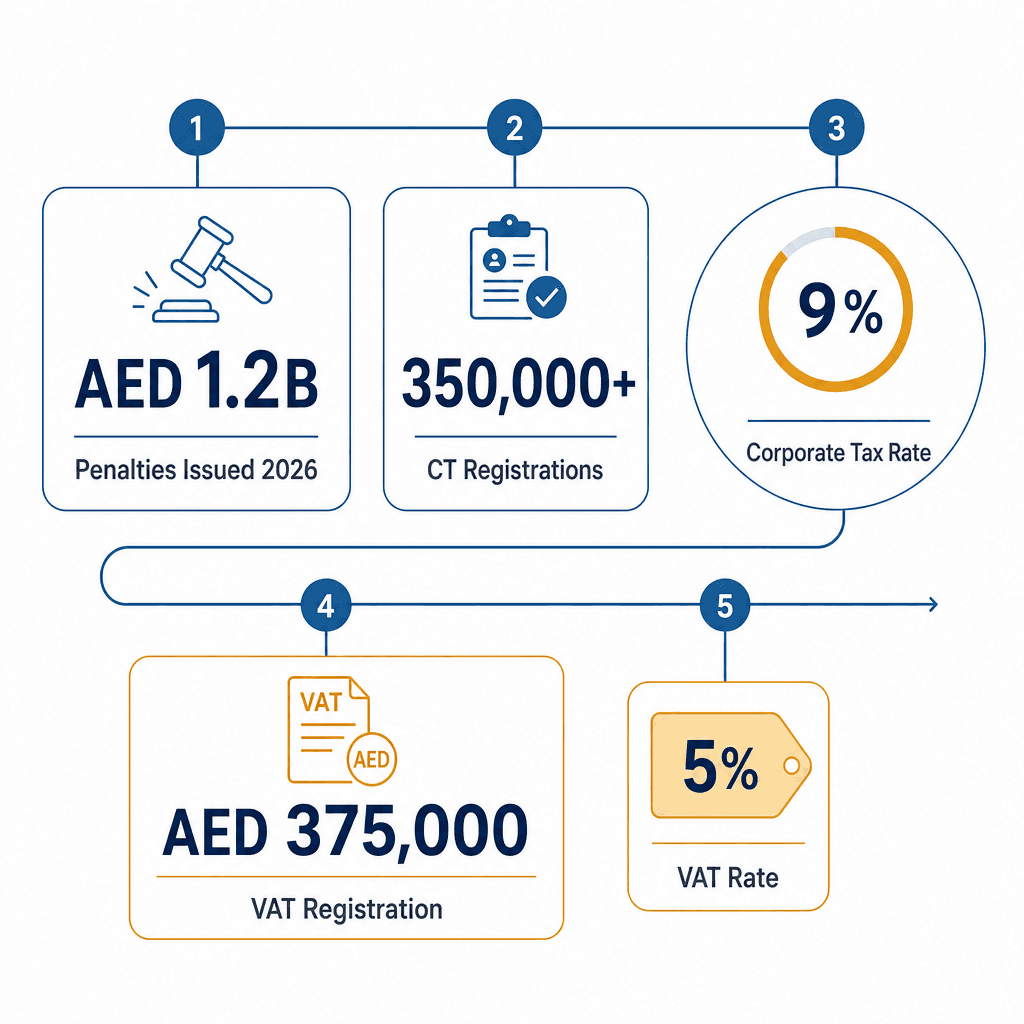
UAE tax compliance covers VAT (mandatory above AED 375,000 taxable turnover), corporate tax (9% on profits above AED 375,000 from June 2023), Economic Substance Regulations, UBO register obligations, and WPS payroll cycles. Every UAE-licensed business, mainland or free zone, carries at least one active filing obligation in 2026.
What UAE Tax Compliance Means for Your Business
The UAE shifted from a near-zero-tax environment to a structured multi-obligation framework in two phases: VAT at 5% launched in January 2018, and Federal Decree-Law No. 47 of 2022 introduced corporate tax for financial years starting on or after 1 June 2023. Both apply to mainland and free zone companies. Free zone qualifying income rules under corporate tax do not eliminate registration requirements, they only affect the rate applied.
Your uae tax obligations as a business now span at least five distinct tracks simultaneously. A Dubai South free zone trading company with AED 500,000 annual revenue must register for VAT, register for corporate tax, file quarterly VAT returns, submit an annual corporate tax return, and update its UBO register. All five run in parallel, each with its own deadline, portal, and penalty regime. The FTA portal at tax.gov.ae handles VAT and corporate tax registrations and filings centrally.
By Q1 2026, over 350,000 businesses had registered for corporate tax (Federal Tax Authority, 2026). The mandatory VAT registration threshold sits at AED 375,000 in taxable supplies, with voluntary registration available at AED 187,500, useful for B2B businesses that want to recover input tax from day one.
How ISIC Classifications Affect Your Tax Category
The FTA and Ministry of Finance reference ISIC Revision 4 activity codes when registering businesses. Your ISIC class determines ESR sector applicability, eligible reliefs, and VAT treatment, getting it wrong at registration creates downstream compliance problems. ISIC Rev.4 was approved by the UN Statistical Commission in March 2006 and covers 21 top-level economic sections (UN Statistics Division, 2008).
Free zone businesses must declare their principal economic activity using the top-down ISIC method: the activity generating the largest share of value added determines classification. Ancillary activities, internal accounting, transport, facilities management, are absorbed into that principal classification and don't trigger separate tax registrations. A Dubai South free zone company providing IT consulting (ISIC 6202) and also reselling hardware must apply this method: if consulting generates the larger share of value added, the entire business is classified under ISIC 6202 and assessed for ESR under the intellectual property or holding business category accordingly.
Worth flagging: e-commerce businesses are classified by the nature of goods or services sold, not the digital channel. A free zone e-retailer falls under ISIC Section G (wholesale and retail trade), not Section J (information and communication), a distinction that affects VAT treatment on cross-border supplies.
VAT Compliance Timeline and Deadlines
UAE VAT compliance requires registration above AED 375,000 taxable turnover, quarterly or monthly return filing via the FTA portal at tax.gov.ae, and payment within 28 days of the tax period end. Late registration carries an AED 20,000 penalty. Late filing carries a minimum AED 1,000 penalty per return (Federal Tax Authority, 2026).
VAT Registration stepsh2>
Follow these four steps to complete VAT registration correctly:
Confirm your threshold. Check whether taxable turnover exceeded AED 375,000 in the preceding 12 months, or is projected to exceed it within the next 30 days. Mandatory registration applies the moment either condition is met.
Gather your documents. You'll need your trade license, Emirates ID of the authorised signatory, bank account details, and 12 months of revenue records.
Submit via tax.gov.ae. The FTA issues a Tax Registration Number (TRN) within 20 business days of a complete application.
Display your TRN. It must appear on every tax invoice, omitting it is a separate administrative violation with its own penalty.
A consultancy launching in Dubai South in January 2026 that projects AED 400,000 in fees by June must register before the 30-day projection window closes. Missing that window triggers the AED 20,000 late registration penalty immediately. Voluntary registration at the AED 187,500 threshold is worth considering for any B2B business, input tax recovery from day one reduces your effective cost base.
For a full walkthrough of the registration process, see our UAE VAT registration guide.
Quarterly VAT Return Filing Calendar 2026
Most UAE businesses file quarterly. The 2026 VAT return schedule for a January–December financial year is: Q1 (January–March) due 28 April; Q2 (April–June) due 28 July; Q3 (July–September) due 28 October; Q4 (October–December) due 28 January 2027. High-turnover businesses above AED 150 million annual revenue may be assigned monthly filing cycles by the FTA.
Payment must clear the FTA's bank account by the due date, not just be initiated. Allow at least two business days for bank processing. A free zone manufacturer importing AED 200,000 of raw materials in Q1 2026 can offset that input VAT against output VAT in the 28 April return, reducing net VAT payable directly. There's no separate refund form for routine credits, it all runs through the same quarterly return. The late filing minimum penalty is AED 1,000 for a first offence and AED 2,000 for a repeat within 24 months (Federal Tax Authority, 2026).
Corporate Tax Compliance Timeline
UAE corporate tax compliance requires every UAE-licensed business to register with the FTA, file an annual corporate tax return within 9 months of the financial year end, and pay any tax due by the same deadline. The rate is 9% on taxable income above AED 375,000, with 0% on the first AED 375,000. Small Business Relief applies to businesses with revenue below AED 3 million.
Corporate Tax Registration Deadlines
Every juridical person, company, free zone entity, branch, must register for corporate tax. There is no revenue threshold that exempts you from registration. The FTA issued staggered deadlines based on trade license issuance month; check your specific deadline at tax.gov.ae. Failure to register carries an AED 10,000 administrative penalty (Federal Tax Authority, 2026). Natural persons (sole traders) earning above AED 1 million from business activity in a calendar year must also register.
A Dubai South free zone company incorporated in March 2023 with a financial year ending 31 December 2024 was required to file its first corporate tax return by 30 September 2025 and pay any tax due by that date. Small Business Relief, available for tax periods ending on or before 31 December 2026, allows businesses below AED 3 million revenue to treat taxable income as nil, but the return must still be filed and the relief election made explicitly.
Annual Corporate Tax Return Filing Process
Close your accounts. Prepare audited or management accounts for the tax period.
Calculate taxable income. Add back disallowable expenses, apply transfer pricing adjustments if applicable, and claim available exemptions.
Apply Small Business Relief if revenue is below AED 3 million and the election has been made for the relevant period.
Submit via EmaraTax at tax.gov.ae within 9 months of financial year end.
Pay the tax liability by the return due date. Instalment arrangements are not standard; late payment accrues monthly surcharges from day one.
For a company with a 31 December 2025 year-end, the corporate tax return and payment are due by 30 September 2026. That's the single most consequential date in your 2026 uae business tax lifecycle, plan your cash flow around it from Q2 onwards. Qualifying Free Zone Persons (QFZPs) pay 0% on qualifying income and 9% on non-qualifying income, but QFZP eligibility must be documented and confirmed before the return is filed.
Economic Substance Regulations Filing
UAE Economic Substance Regulations (ESR) require businesses in relevant sectors, banking, insurance, investment fund management, lease-finance, headquarters, shipping, holding companies, intellectual property, and distribution/service centres, to demonstrate genuine economic activity in the UAE and file an annual ESR notification and report. Deadlines fall 6 and 12 months after the financial year end respectively.
Which Businesses Must File ESR Notifications
Any UAE-licensed entity conducting a Relevant Activity must file an annual ESR notification, regardless of whether it passed or failed the substance test. This is a common oversight: you can't skip the notification just because you believe you're compliant. The 9 ESR sectors align with ISIC Rev.4 classifications, so your declared principal activity determines whether ESR applies. Notifications are filed through the Ministry of Economy portal at moec.gov.ae, with a deadline of 6 months after financial year end. The ESR annual report follows 12 months after year end.
Holding companies are a particular blind spot. A Dubai South free zone holding company that owns shares in three subsidiaries and receives only dividends must file an ESR notification as a "Holding Business", even with no employees and no active operations. Non-filing carries an AED 50,000 penalty in the first year, rising to AED 400,000 for subsequent failure (UAE Ministry of Finance, 2026). If your ISIC principal activity falls under intellectual property (ISIC 7210 or 7220), ESR applies, confirm using the top-down classification method.
ESR Substance Test Requirements
The substance test has three components: adequate employees in the UAE, adequate operating expenditure in the UAE, and adequate physical assets or premises in the UAE. The "directed and managed" test requires board meetings to occur in the UAE with a quorum physically present, and minutes must be retained as evidence. Core income-generating activities (CIGAs) must be performed in the UAE; outsourcing CIGAs to a group entity inside the UAE is permitted but must be formally documented.
An IP holding company at Dubai South that licenses software to overseas affiliates must ensure IP development decisions, R&D oversight, and key personnel are based in the UAE, not just the legal entity registration. Failing the substance test (separate from non-filing) triggers an AED 50,000 penalty in the first year, and second-year failure triggers automatic information exchange with foreign tax authorities (UAE Ministry of Finance, 2026).
Do all UAE businesses need to file ESR notifications?
No. ESR notifications are only required if your business conducts a Relevant Activity across the 9 defined sectors. However, if you're unsure whether your ISIC principal activity falls within scope, file the notification anyway, the penalty for non-filing (AED 50,000) far exceeds the administrative cost of filing when not required.
Other Compliance Obligations: WPS, UBO, Trade License
Beyond VAT and corporate tax, UAE businesses must maintain WPS payroll compliance through MOHRE, update the UBO (Ultimate Beneficial Owner) register annually, renew their trade license before expiry, and ensure ILOE (Involuntary Loss of Employment) insurance is active for all employees. Each obligation carries separate AED penalties and affects your ability to issue visas and labour cards.
WPS Payroll Compliance Through MOHRE
The Wage Protection System (WPS), administered by the Ministry of Human Resources and Emiratisation (MOHRE) at mohre.gov.ae, requires all private sector employers to pay salaries through an approved bank or exchange house within the contracted payment cycle. Salary must be paid within 10 days of the agreed pay date. A one-month delay triggers a WPS violation and blocks new work permit applications immediately.
ILOE premiums of AED 5 per employee per month must be deducted and remitted, non-compliance blocks visa renewals. A Dubai South company with 12 employees that misses WPS submission for two consecutive months will find its labour card issuance blocked at MOHRE, halting all new hires until the violation is cleared and an AED 1,000 fine per affected employee per month is paid (MOHRE, 2026).
UAE Tax Compliance Fee and Deadline Reference Table, 2026
Compliance Obligation | Key Deadline / Trigger | Fee or Penalty (AED) |
|---|---|---|
VAT registration threshold and penalty | Within 30 days of exceeding AED 375,000 taxable turnover | AED 20,000 late registration penalty (FTA, 2026) |
Corporate tax rate and filing window | Return and payment due 9 months after financial year end | 9% on taxable income above AED 375,000; AED 10,000 registration penalty (FTA, 2026) |
ESR notification and report deadlines | Notification: 6 months after year end; Report: 12 months after year end | AED 50,000 (first year non-filing); AED 400,000 (subsequent failure) (MoF, 2026) |
UBO update obligation and penalty | Within 15 days of any ownership change; confirmed at annual license renewal | Up to AED 100,000 (Cabinet Decision No. 58, 2020) |
WPS violation fine per employee | Within 10 days of agreed pay date | AED 1,000 per employee per month delayed (MOHRE, 2026) |
Trade license renewal at Dubai South Business Hub Free Zone | Before license expiry date each year | From AED 5,750 per year depending on activity category |
UBO Register and Trade License Renewal Deadlines
Follow these four steps to stay compliant on UBO and trade license obligations:
Identify all Ultimate Beneficial Owners. These are individuals holding 25% or more of shares, voting rights, or effective control of the company.
File or update UBO information with your licensing authority within 15 days of any ownership change, not at the next annual renewal.
Confirm UBO data at trade license renewal. The renewal form now requires UBO confirmation before issuance; it's built into the process.
Renew your trade license before expiry. A lapsed license renders all associated permits, visas, and bank accounts non-compliant immediately.
A shareholder restructuring at a Dubai South free zone company in March 2026 must trigger a UBO register update within 15 days, or face an AED 100,000 administrative penalty under Cabinet Decision No. 58 of 2020. Trade license renewal fees at Dubai South Business Hub Free Zone start from AED 5,750 per year. Free zone companies file UBO information with their respective free zone authority rather than the DED, at Dubai South Business Hub Free Zone, UBO confirmation is integrated into the annual license renewal workflow. See our company compliance calendar UAE for a full year-round checklist.
Annual Tax Compliance Calendar for UAE Businesses
A UAE business with a January–December financial year faces VAT returns due in April, July, October, and January; a corporate tax return due in September; ESR notification due in June; ESR report due in December; and trade license renewal, WPS monthly cycles, and UBO updates running throughout the year. Missing any single deadline triggers AED penalties that compound quickly.
Month-by-Month 2026 Compliance Deadlines
January 2026: Q4 2025 VAT return and payment due 28 January via tax.gov.ae; WPS January payroll cycle due within 10 days of pay date.
March 2026: Corporate tax registration confirmation for newly licensed entities; ILOE premium Q1 remittance to MOHRE.
April 2026: Q1 2026 VAT return due 28 April; review trade license expiry dates for Q2 renewals.
June 2026: ESR notification due for December year-end entities, file at moec.gov.ae.
July 2026: Q2 2026 VAT return due 28 July; mid-year WPS audit recommended.
September 2026: Corporate tax return and payment due 30 September for December 2025 year-end entities, the most cash-intensive month of the year.
October 2026: Q3 2026 VAT return due 28 October.
December 2026: ESR annual report due; UBO register annual confirmation required at license renewal.
January 2027: Q4 2026 VAT return due 28 January 2027.
For a Dubai South free zone trading company with a 31 December year-end, September 2026 is the most cash-intensive month: corporate tax payment is due alongside normal operational costs. Forecast this in your Q2 cash flow plan, don't wait until August to model the liability.
2026 UAE Business Tax Compliance Calendar
A month-by-month visual timeline showing every major UAE tax and regulatory deadline for businesses with a January–December financial year.
28 April: Q1 2026 VAT return and payment due (FTA, tax.gov.ae)
30 June: ESR notification deadline for December year-end entities (moec.gov.ae)
28 July: Q2 2026 VAT return and payment due
References
tax.gov.ae (tax.gov.ae)
moec.gov.ae (moec.gov.ae)
mohre.gov.ae (mohre.gov.ae)