
Last updated: June 2026 By Editorial Team , Business setup specialists covering UAE free zone formation, mainland licensing, and corporate structuring since 2018.
Last updated: June 2026
By Editorial Team, Business setup specialists covering UAE free zone formation, mainland licensing, and corporate structuring since 2018. Full bio →
Table of Contents
What Is a Business License in Dubai and Why Choosing the Right One Matters
The Three Main Business License Types in Dubai Explained
Mainland vs. Free Zone: How Your Jurisdiction Shapes Your License
6 Steps to Match Your Business Activity to the Right License in Dubai
Regulated Activities That Require Special Approvals in Dubai
How to Check Whether Your Activity Is Available in a Given Free Zone
Decision Flowchart: Which Business License Do You Need in Dubai?
Your Next Steps
References
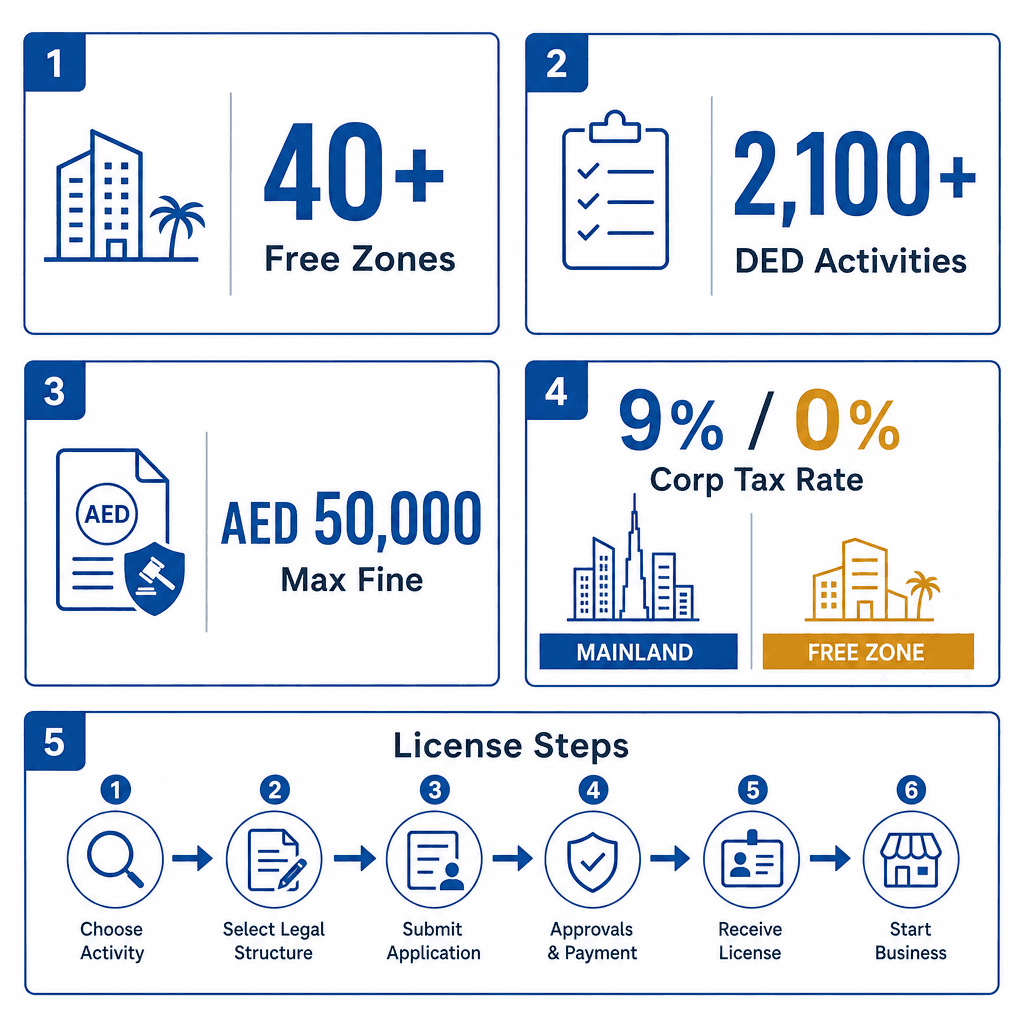
In 2026, Dubai hosts more than 40 free zones, over 2,100 approved business activities on the Dubai DED list alone (DED, 2024), and three distinct license categories, yet most founders still pick a license based on price alone, not fit. That single misstep can cost between AED 3,000 and AED 15,000 to correct through re-licensing or activity amendments. The UAE introduced a 9% corporate tax in June 2023, but free zone qualifying income retains a 0% rate under specific conditions (UAE Federal Tax Authority, 2023). Over 1,000 commercial and industrial activities were opened to 100% foreign ownership on the mainland as of 2021 (UAE Ministry of Economy, 2021). And fines for operating outside your licensed activities can reach AED 50,000 per violation.
There is no single right business license in Dubai. There are dozens of license types, hundreds of activity codes, and multiple jurisdictions to choose from. The right combination depends entirely on what you do, who you serve, and how you plan to grow. This guide gives you a practical framework for selecting the correct license, covering the three main UAE license types, the mainland vs. free zone decision, activity mapping, regulated sectors, and exactly what to do when your activity does not appear on any list. For a deeper look at the fundamentals, start with understanding business licenses in Dubai.
What Is a Business License in Dubai and Why Choosing the Right One Matters
A business license in Dubai is the official government permit that authorises a company to conduct specific economic activities within a defined jurisdiction. Choosing the wrong type can restrict your market access, trigger compliance penalties, or require a costly restructure, making the right selection critical from day one.
The Legal Role a License Plays in Your UAE Business
A license is not simply a registration document. It defines exactly which activities your company is legally permitted to perform, and UAE authorities enforce this boundary seriously. The Dubai DED lists over 2,100 approved business activities across its classification system (DED, 2024), each mapped to a specific license category. Your license type also determines your visa quota, the bank account tier you qualify for, and your minimum office space requirement.
Operating outside your licensed activities exposes you to enforcement action. Fines for unlicensed activity in Dubai can reach AED 50,000 per violation. Consider this real-world scenario: a logistics company holding only a commercial trading license cannot legally offer freight forwarding consultancy without adding that activity as a separate line item. In the UAE system, those are two distinct approved activities, not one broad description.
License type determines visa allocation per company size
Bank compliance teams verify activity codes against actual transactions
Office requirements (flexi-desk vs. dedicated unit) vary by license category
Why the Decision Is More Complex Than It Looks
Most founders face three simultaneous decisions: license type, business activity code, and jurisdiction (mainland vs. free zone). Each choice narrows the next. Some activities are only available in specific zones. Some license types are not available on the mainland for foreign-owned companies without additional conditions. Getting the combination wrong at setup stage means re-licensing, activity amendments, or full restructuring, costs that run from AED 3,000 to AED 15,000 or more.
Take a US-based founder wanting to run an e-commerce business selling physical goods into the UAE market. They need a commercial license, a trading activity code, and a jurisdiction that permits direct-to-consumer delivery. Not all free zones offer all three. Dubai has 40-plus free zones, each with its own approved activity list, and activity amendments post-licensing typically take 5–10 working days with government fees attached. Choosing the right combination upfront is always cheaper than correcting it later.
The Three Main Business License Types in Dubai Explained
Dubai issues three primary license types: commercial (for trading and selling goods or services), professional (for skill-based service providers and consultants), and industrial (for manufacturing and processing). Each maps to a distinct category of economic activity, and choosing the wrong one can limit what your company is legally permitted to do.
Free Zone License vs. Mainland DED License: Key Differences
Feature | Free Zone License | Mainland DED License |
|---|---|---|
Foreign Ownership | ✅ 100% foreign ownership, always | ✅ 100% for most activities post-2021 reforms; some sectors still restricted |
Direct UAE Market Access | ❌ Requires local distributor or branch to sell directly on the mainland | ✅ Full direct access to UAE consumers and businesses |
Setup Timeline | ✅ 3–5 working days at most free zones | ⏱ 2–4 weeks via DED portal and approvals |
Typical Starting Cost | From AED 12,500 at competitive free zones | From AED 15,000–AED 25,000+ depending on activity and office type |
Corporate Tax on Qualifying Income | ✅ 0% on qualifying income under specific conditions (FTA, 2023) | 9% corporate tax applies above AED 375,000 net profit threshold |
Office Requirement | ✅ Flexi-desk or virtual office accepted at most free zones | Physical tenancy agreement typically required; Ejari registration mandatory |
Government Tender Eligibility | ❌ Most federal and emirate tenders require a mainland DED license | ✅ Eligible for UAE government and semi-government contracts |
Commercial License: Trading, Retail, and General Business
The commercial license covers buying and selling goods, import and export, retail, e-commerce, and most B2B trading activities. It also applies to service-based businesses that are not classified as professional practices, real estate brokerage, travel agencies, and general contracting all fall here. Most free zone licenses default to the commercial category, making it the most common license type issued in Dubai each year (DED, 2024).
Import, export, and wholesale trading of physical goods
E-commerce and online retail operations
Real estate brokerage and property management
Travel and tourism agency services
An American consumer electronics brand opening a regional distribution hub in Dubai South would hold a commercial license with import, export, and wholesale trading activities listed. For more on mapping activities to the right license, see choosing the right business activity in Dubai.
Professional License: Consultants, Creatives, and Skilled Practitioners
The professional license is designed for individuals and firms whose output is expertise, advice, or a skill, management consultants, architects, lawyers, designers, and IT specialists. UAE Federal Decree-Law No. 32 of 2021 on Commercial Companies expanded 100% foreign ownership to most professional activity categories on the mainland, removing the historic requirement for an Emirati service agent in many cases.
Free zones issue an equivalent under various names (often called a "service license") but the underlying classification aligns with the professional category. A New York-based marketing agency opening a Dubai office to serve regional clients would apply for a professional license listing "marketing consultancy" and "advertising services" as approved activities, two distinct line items, not one broad description.
Industrial License: Manufacturing, Processing, and Production
An industrial license is required for any business that physically transforms raw materials into finished goods, food processing, garment manufacturing, and electronics assembly all qualify. Industrial licenses typically require a physical factory or production facility, so they are less common in free zones without dedicated industrial land.
Dubai South's logistics and industrial zones are specifically designed to accommodate industrial license holders near Al Maktoum International Airport. A packaging company setting up a production line there would hold an industrial license covering "manufacture of corrugated paper and paperboard containers", a specific ISIC-aligned activity code, not a generic description. Industrial license applicants must meet minimum factory space requirements set by the relevant authority.
Mainland vs. Free Zone: How Your Jurisdiction Shapes Your License
Mainland licenses are issued by the Dubai DED and permit trading anywhere in the UAE and internationally. Free zone licenses are issued by individual zone authorities, offering 100% foreign ownership and tax benefits, but traditionally restrict direct trading within the UAE mainland market without a local distributor or branch.
When a Mainland License Is the Right Call
Choose a mainland DED license when your business model requires direct contact with UAE consumers or businesses. Key signals:
You need to trade directly with UAE-based customers without an intermediary
Your activity requires a physical retail presence in a Dubai shopping mall or commercial district
Your sector requires a government contract, most federal and emirate tenders require a mainland DED license
Post-2021 reforms mean most activities no longer require an Emirati local sponsor, removing the historic cost barrier
A US restaurant franchise opening outlets across Dubai malls needs a mainland commercial license. Free zone licenses do not permit direct retail food service on the mainland. As of 2021, over 1,000 commercial and industrial activities were opened to 100% foreign ownership on the mainland (UAE Ministry of Economy, 2021).
When a Free Zone License Is the Smarter Choice
A free zone license works best when your business is export-oriented, digital, or B2B with international clients. You do not need to physically sell into the UAE retail market. Key advantages:
100% foreign ownership with no local partner requirement
0% corporate tax on qualifying income under specific conditions (UAE Federal Tax Authority, 2023)
Setup timelines of 3–5 working days vs. 2–4 weeks for mainland DED applications
No currency restrictions on profit repatriation
A California SaaS company serving Middle East enterprise clients sets up in a Dubai free zone, invoices clients internationally, and repatriates profits freely, it never needs to touch the UAE retail market. Launch your company at Dubai South Business Hub Free Zone if logistics, aviation, e-commerce, or professional services are your focus, the zone sits directly adjacent to Al Maktoum International Airport.
6 Steps to Match Your Business Activity to the Right License in Dubai
To match your business activity to the correct Dubai license: define your core revenue-generating activity, identify whether it is commercial, professional, or industrial, choose mainland or free zone jurisdiction, verify the activity exists on your chosen authority's approved list, check for regulatory approvals, then apply with the correct activity codes on your application.
Step 1: Define Your Principal Activity by Revenue, Not Job Title
List every revenue stream your business will generate in year one, then rank them by expected income contribution. Your principal activity, the one generating the most value, determines your license type. Secondary activities are added as separate line items on the same license in most cases.
Avoid broad or vague descriptions. UAE authorities match applications to exact approved activity codes, and "general trading" is a specific license category with its own requirements and higher fees. A founder who plans to sell skincare products and offer beauty consultancy has two distinct activities: retail trading (commercial) and beauty consultancy (professional). Depending on jurisdiction, that may require two separate licenses or a dual-activity license.
Step 2: Map Activities to License Type and Jurisdiction
Cross-reference your activity against the DED mainland list or your target free zone's approved activity catalogue. Note whether the activity falls under a regulated sector before committing to a jurisdiction. Some free zones list 1,500-plus approved activities; others are highly niche with fewer than 200.
Use the DSBH business activities list if logistics, e-commerce, or professional services are your focus. A supply chain consultancy checking Dubai South's activity list would find "logistics consultancy" and "supply chain management consultancy" as distinct approved activities, both compatible with a service license at the zone.
Steps 3–6: Verify, Apply, and Add Activities as You Grow
Step 3: Confirm your activity is not reserved for mainland-only or requires a local partner, check the DED's restricted activity list before committing to a free zone.
Step 4: Calculate total license cost including activity fees, office requirements, and visa allocation. Use the DSBH cost calculator for free zone estimates before you commit.
Step 5: Submit your application with exact activity codes. Errors at this stage cause rejections and delay timelines by days or weeks.
Step 6: Once licensed, add secondary activities through an amendment. Budget for government fees of AED 1,000–AED 3,000 per addition, and allow 3–7 working days for processing at Dubai South Business Hub.
A Dubai South licensee starting with e-commerce trading can add "warehousing and storage services" as a secondary activity post-launch without re-licensing. That is a common growth path for product-based businesses in the zone, and the amendment is handled in-house by the free zone authority, faster than DED mainland amendments, which route through multiple government portals.
Regulated Activities That Require Special Approvals in Dubai
Certain Dubai business activities, including healthcare, education, financial services, and food production, require pre-approval from sector regulators before a license is issued. These approvals come from bodies like the Dubai Health Authority, KHDA, DFSA, or Dubai Municipality, and typically add 4–12 weeks to the setup timeline.
Four Sectors With Mandatory Pre-Licensing Approvals
Healthcare: Clinics, pharmacies, and health tech platforms require Dubai Health Authority (DHA) or Ministry of Health approval. DHA pre-approval for digital health platforms typically takes 6–10 weeks.
Education: Any training institute, school, or tutoring centre must register with the Knowledge and Human Development Authority (KHDA). KHDA approval requires curriculum review and facility inspection (KHDA, 2024).
Financial services: Fintech, investment advisories, and payment processors fall under the Dubai Financial Services Authority (DFSA) in DIFC, or the Securities and Commodities Authority (SCA) for mainland operations.
Food and beverage: Production, processing, and food retail require a Dubai Municipality food safety permit, this applies even to cloud kitchens and catering operations.
A US health tech startup offering telemedicine consultations in Dubai must obtain DHA approval for its platform before any free zone authority will issue a commercial license. Skipping this step is the most common cause of delayed healthcare sector setups, founders discover the requirement only after they have already paid initial registration fees.
How to Factor Regulatory Timelines Into Your Setup Plan
Apply for sector regulator approval before, not after, selecting your jurisdiction. Some regulators only approve entities in specific zones. DIFC is the only jurisdiction where DFSA-licensed financial firms can operate, a fintech company that sets up in a general-purpose free zone and later realises this will face a full relocation, not just an amendment.
Build a minimum of 8–12 weeks of regulatory buffer into your launch timeline for any of the four regulated sectors. Engaging a business setup consultant familiar with the relevant regulator significantly reduces rejection risk, self-filing complex healthcare or finance applications without prior experience is one of the most expensive mistakes founders make in the UAE.
Is a general trading license a good fallback if I can't find my exact activity?
A general trading license covers a broad range of goods but carries higher fees and stricter bank due diligence. It is not a substitute for a specific activity license. Use it only as a short-term interim measure while pursuing a custom activity approval, and ensure your actual operations stay within the licensed scope to avoid compliance exposure.
How to Check Whether Your Activity Is Available in a Given Free Zone
To verify activity availability in a Dubai free zone, search the zone's official online activity directory, cross-reference with your intended license type, and confirm with the zone's business development team. Not every free zone lists every activity, some are sector-specific, and unlisted activities may still be approvable on request.
Using a Free Zone Activity Directory Effectively
Most free zones publish searchable online activity lists. Start there before contacting any sales team. Search by keyword and by ISIC-aligned category code where available, activity names vary between zones even for identical business types. At Dubai South Business Hub, the DSBH business activities list is publicly accessible and organised by sector.
A founder searching for "cryptocurrency trading" may need to also search "virtual asset trading" or "digital asset exchange", terminology is not standardised across UAE free zones. Searching multiple synonyms before concluding an activity is unavailable saves significant time and avoids premature zone changes.
What to Do When Your Activity Is Not on the List
An unlisted activity does not always mean it is unavailable, free zones can submit activity addition requests to their governing authority.
Contact the free zone's business development team with a written description of your activity; they will confirm availability or suggest the closest approved equivalent.
If no equivalent exists, check whether the mainland DED license covers the activity, or whether a different free zone with a broader portfolio is a better fit.
Avoid using a "general services" license as a long-term workaround, it creates compliance risk if your actual operations diverge from the license scope.
A drone technology company requesting "unmanned aerial vehicle maintenance services" found the activity unlisted at its initial free zone choice but had it approved within two weeks after a formal activity addition request at Dubai South. That outcome is more common than founders expect. For additional guidance, see choosing the right business activity in Dubai.
Decision Flowchart: Which Business License Do You Need in Dubai?
Use this decision flowchart to identify which Dubai business license fits your situation: start with your primary activity type, determine whether it is commercial, professional, or industrial, then decide between mainland and free zone based on your target market, and finally verify activity availability and regulatory requirements for your chosen jurisdiction.
Text-Based Flowchart: From Business Idea to License Type
START: What does your business primarily do?
Sell physical goods → Commercial License
Provide expertise or services → Professional License
Manufacture or process products → Industrial License
NEXT: Who are your main customers?
UAE consumers or businesses directly → Consider Mainland DED
International clients or UAE B2B via intermediary → Consider Free Zone
References
Editorial sources available on request. Full citation list is being compiled.