Topic Summary
In 2026, the UAE operates more than 40 free zones across all seven emirates, making it one of the most free-zone-dense investment environments globally.
Quick Summary
The UAE operates 40+ free zones across all seven emirates as of 2026, with Dubai hosting more than 30 of them.
Free zone companies enjoy 100 percent foreign ownership, customs duty exemptions, and potential 0 percent corporate tax on qualifying income under Cabinet Decision No. 55 of 2023.
Free zone companies cannot sell directly to UAE mainland customers without a mainland distributor or dual license.
Dubai South Business Hub Free Zone offers a fully digital setup beside Al Maktoum International Airport, covering aviation, logistics, e-commerce, and trading licenses.
In 2026, the UAE operates more than 40 free zones across all seven emirates, making it one of the most free-zone-dense investment environments globally. The list of free zones in UAE spans sectors from financial services and technology to logistics, healthcare, and media, giving foreign investors a regulated, sector-specific entry point into the region without requiring a local partner.
This guide covers how many free zones exist in the UAE and Dubai, what a free zone company actually is, how free zones differ from mainland in structural terms, a full reference table of the UAE free zone list by emirate, and a detailed breakdown of Dubai South Business Hub Free Zone for entrepreneurs ready to start their application today.
What Is a UAE Free Zone and How Does It Differ from Mainland
A UAE free zone is a designated economic area where foreign investors can own 100 percent of their company without a local sponsor. Free zone companies operate under their own regulatory authority, benefit from tax exemptions, and are structured for international trade rather than direct UAE mainland sales. The list of free zones in UAE currently covers more than 40 such designated areas, each governed by an independent free zone authority rather than the federal Department of Economic Development (DED).
100 Percent Foreign Ownership Explained
Free zones have permitted full foreign ownership since their inception in the 1980s. Before the 2021 UAE Commercial Companies Law amendment (Federal Decree-Law No. 32 of 2021), mainland companies required a 51 percent UAE national shareholder in most sectors. Free zones offered a clear alternative: complete equity control from day one.
Full ownership means you retain all profits, all voting rights, and all decision-making authority with no local partner involved. A German logistics firm establishing a regional headquarters in a Dubai free zone, for example, can hold 100 percent equity without appointing a UAE national as a shareholder or director.
Worth flagging: the 2021 amendment now permits 100 percent foreign ownership in many mainland activities too, so the ownership gap between free zone and mainland has narrowed. Your choice between the two structures now depends more on trading geography and regulatory environment than ownership alone.
Free Zone vs Mainland: The Core Differences
Here are the structural differences that matter most when you're comparing free zone and mainland options:
Licensing authority: Free zone companies are licensed by their specific free zone authority, not the DED.
Mainland sales: A free zone company cannot sell directly to UAE mainland consumers without a mainland distributor or dual license.
Geographic freedom: Mainland companies trade freely across all seven emirates; free zone companies are restricted to their zone and international markets.
Customs duties: Free zones offer duty exemptions on goods imported and re-exported; mainland companies pay standard UAE customs duties.
Corporate tax: Both structures face UAE corporate tax at 9 percent on taxable income above AED 375,000, introduced June 2023. Qualifying free zone entities may access a 0 percent rate on qualifying income under Cabinet Decision No. 55 of 2023.
A software company based in a technology free zone can export services globally with potential tax efficiency, but it must appoint a mainland distributor to sell software licenses directly to a UAE government entity. That distinction is the practical reality of the free zone structure, and it's worth building into your business model before you choose a jurisdiction. [UAE Federal Tax Authority, 2023]
How Many Free Zones Are in the UAE and Dubai
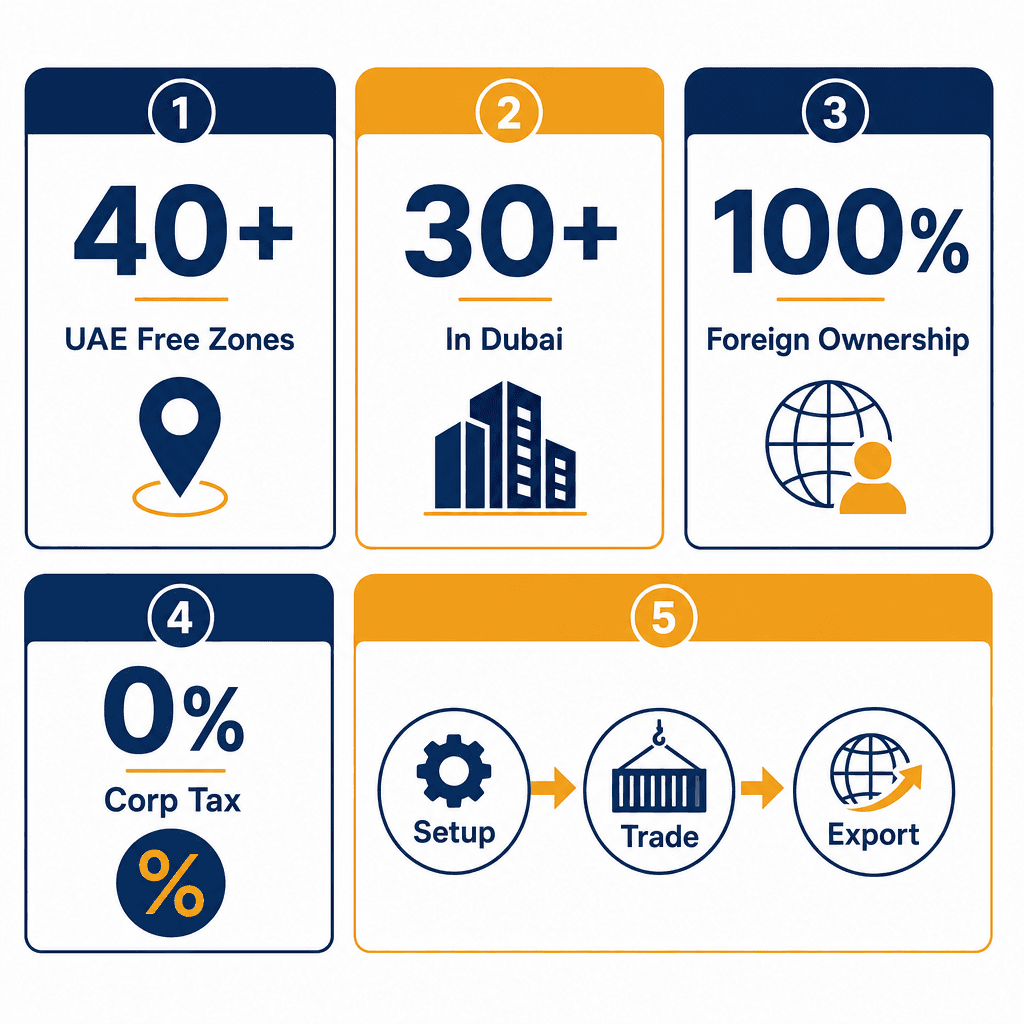
The UAE has more than 40 free zones across all seven emirates as of 2026. Dubai alone has over 30 free zones, making it the emirate with the highest concentration. Abu Dhabi, Sharjah, Ajman, Ras Al Khaimah, Fujairah, and Umm Al Quwain each operate additional free zones serving specific sectors. If you've been asking how many freezones in Dubai there are, the answer is 30-plus individual authorities, each with its own licensing scope and regulatory rules.
Free Zones by Emirate: A Quick Count
Dubai hosts the largest share of the list of free zones in UAE, covering technology, media, healthcare, logistics, gold and diamonds, financial services, and more. Abu Dhabi operates major zones including Abu Dhabi Global Market (ADGM) and Khalifa Industrial Zone Abu Dhabi (KIZAD), alongside sector-specific facilities. Sharjah, Ajman, Ras Al Khaimah, Fujairah, and Umm Al Quwain each operate at least one free zone, providing alternatives for businesses that need proximity to specific ports, airports, or lower-overhead locations.
An e-commerce company weighing setup locations can choose from more than 30 Dubai options or explore Ras Al Khaimah Economic Zone (RAKEZ) or Sharjah Airport International Free Zone (SAIF Zone) depending on their sector and operational footprint. The total count varies slightly depending on whether special economic zones and single-activity zones are included; the commonly cited figure is 40-plus active free zones nationally.
Why the UAE Has So Many Free Zones
Each free zone was created to attract investment into a specific sector or geographic corridor. The number reflects the breadth of the UAE's economic diversification strategy, not redundancy. Free zones operate as semi-autonomous regulatory jurisdictions, meaning each authority can tailor licensing, visa, and operational rules to its target industry.
Dubai Internet City was established in 1999 specifically to attract global technology companies, demonstrating how a single-sector free zone can anchor an entire industry cluster within a city. That model has been replicated across sectors ever since. UAE Vision 2031 targets AED 650 billion in annual foreign direct investment, and the proliferation of sector-specific free zones is one of the primary mechanisms for reaching that figure (UAE Government Portal, 2021).
UAE Free Zones by Emirate: Name and Sector Focus
Emirate | Free Zone Name | General Sector Focus |
|---|---|---|
Dubai | Dubai Multi Commodities Centre (DMCC) | Commodities and trade |
Dubai | Dubai Internet City (DIC) | Technology |
Dubai | Dubai Media City (DMC) | Media and communications |
Dubai | Dubai International Financial Centre (DIFC) | Financial services |
Dubai | Dubai Silicon Oasis (DSO) | Technology and semiconductors |
Dubai | Dubai Healthcare City (DHCC) | Healthcare and medical |
Dubai | Dubai Design District (d3) | Design and fashion |
Dubai | Dubai Airport Freezone (DAFZA) | Aviation and trade |
Dubai | Jebel Ali Free Zone (JAFZA) | Logistics and manufacturing |
Dubai | Dubai South Business Hub Free Zone | Aviation, logistics, and e-commerce |
Dubai | Dubai Knowledge Park (DKP) | Education and HR |
Dubai | Dubai International Academic City (DIAC) | Higher education |
Dubai | Dubai Production City (IMPZ) | Print and publishing |
Dubai | Dubai Studio City | Media production |
Dubai | Dubai Outsource City (DOC) | Business process outsourcing |
Dubai | International Humanitarian City (IHC) | Humanitarian and aid |
Dubai | Dubai Science Park | Life sciences |
Dubai | Dubai Industrial City | Manufacturing |
Dubai | Dubai Biotechnology and Research Park (DuBiotech) | Biotechnology |
Dubai | Gold and Diamond Park | Jewellery and precious metals |
Dubai | International Free Zone Authority (IFZA) | Multi-sector |
Dubai | Meydan Free Zone | Technology and services |
Sharjah | Sharjah Airport International Free Zone (SAIF Zone) | Multi-sector trade |
Sharjah | Hamriyah Free Zone | Manufacturing and heavy industry |
Sharjah | Sharjah Media City (Shams) | Media and creative |
Sharjah | Sharjah Publishing City | Publishing |
Abu Dhabi | Abu Dhabi Global Market (ADGM) | Financial services |
Abu Dhabi | Khalifa Industrial Zone Abu Dhabi (KIZAD) | Industrial and logistics |
Abu Dhabi | Abu Dhabi Airport Free Zone (ADAFZ) | Aviation and trade |
Abu Dhabi | twofour54 | Media and entertainment |
Ras Al Khaimah | Ras Al Khaimah Economic Zone (RAKEZ) | Multi-sector |
Ras Al Khaimah | Ras Al Khaimah Maritime City | Maritime and shipping |
Ajman | Ajman Free Zone | Multi-sector trade and light industry |
Fujairah | Fujairah Free Zone | Trade and logistics |
Fujairah | Fujairah Creative City | Media and services |
Umm Al Quwain | Umm Al Quwain Free Trade Zone | Manufacturing and trade |
Umm Al Quwain | Ahmed Bin Rashid Free Zone | Industrial |
For setup costs, license fees, visa quotas, document requirements, or application timelines at any free zone listed above, visit that free zone's official website directly. This table does not rank, score, or compare free zones on any metric.
Full List of Free Zones in UAE by Emirate
The UAE free zone list spans all seven emirates. Dubai holds the largest share with 30-plus zones. Abu Dhabi, Sharjah, Ajman, Ras Al Khaimah, Fujairah, and Umm Al Quwain each operate additional zones. The reference table above covers the free zone name, emirate, and general sector focus only. For any zone outside Dubai South Business Hub Free Zone, consult the official authority website for current requirements.
What Is an FZE Company in a UAE Free Zone
FZE stands for Free Zone Establishment, which is a single-shareholder limited liability company registered within a UAE free zone. It's the most common structure for solo founders and holding companies entering the UAE without a co-investor. An FZC (Free Zone Company) is the equivalent for two or more shareholders within the same framework.
Both FZE and FZC structures provide limited liability, meaning your personal assets remain separate from the company's obligations. A sole founder from India setting up a consulting business in a UAE free zone would typically register an FZE, giving them 100 percent ownership and limited liability within that free zone jurisdiction. The FZE structure is also widely used by international holding companies that want a UAE entity without bringing in additional equity partners.
DIFC operates under English common law with its own courts, making it the preferred location for financial institutions that need a familiar legal framework. For setup requirements at DIFC specifically, visit difc.ae directly. The same principle applies across the free zone list uae: each authority publishes its own official requirements, and those are the only figures you should rely on.
Dubai South Business Hub Free Zone: What You Can Set Up Here
Dubai South Business Hub Free Zone is located adjacent to Al Maktoum International Airport in Dubai South, the UAE's dedicated aviation and logistics city. It issues licenses across aviation, logistics, e-commerce, trading, and services, with a fully digital setup process that founders can complete from outside the UAE. As one of the newer entries on the list of free zones in UAE, it's positioned specifically for businesses that need airport proximity and operational flexibility.
Location and Strategic Advantage of Dubai South Business Hub Free Zone
Dubai South Business Hub Free Zone sits within the Dubai South master development, directly beside Al Maktoum International Airport. That airport is planned to become the world's largest at full build-out, with a projected capacity of 260 million passengers per year. The location places businesses inside one of the UAE's primary air cargo corridors, with direct connectivity to Jebel Ali Port and the Emirates Road highway network.
Dubai South itself covers 145 square kilometres, integrating residential, commercial, aviation, and logistics districts under one master plan. For businesses in aviation services, air freight, e-commerce fulfilment, and import-export trading, that proximity is a concrete operational advantage rather than a marketing claim. An e-commerce company licensed through Dubai South Business Hub Free Zone can position its fulfilment operations minutes from the cargo terminal, cutting last-mile air freight handling time in a measurable way.
License Activities Available at Dubai South Business Hub Free Zone
Dubai South Business Hub Free Zone issues licenses across the following categories:
Aviation and aerospace: MRO, ground handling support, aviation services
Logistics and freight: Air freight, sea freight, customs clearance, warehousing
E-commerce: Online retail, fulfilment, digital trade
General trading: Import, export, and re-export of goods
Consulting and professional services: Business advisory, management consulting
Technology: Software, IT services, digital solutions
Investors can hold a single license covering multiple related business activities, reducing the administrative overhead of running a multi-activity operation. A freight forwarding company can obtain a logistics license that covers air freight, sea freight, customs clearance, and warehousing under one document. List all intended activities at the time of application; adding activities after issuance typically incurs amendment fees.
Digital Setup Process at Dubai South Business Hub Free Zone
Dubai South Business Hub Free Zone operates a fully digital onboarding process. Founders outside the UAE can complete the initial application, document submission, and payment entirely online without travelling to Dubai. Here's how the process flows:
Name reservation: Reserve your company name online through the Dubai South Business Hub Free Zone portal.
Activity selection: Choose your license category and list all business activities.
Document upload: Submit passport copies and any required supporting documents digitally.
License issuance: Receive your license electronically once the authority completes its review.
Visa application initiation: Begin your UAE residency visa process online through the same portal.
Physical presence is required only at the Emirates ID biometrics stage, if you intend to obtain UAE residency through the free zone visa. A UK-based entrepreneur can reserve a company name, submit passport copies, and receive a license from Dubai South Business Hub Free Zone entirely online before booking a flight to the UAE. That digital-first approach makes Dubai South Business Hub Free Zone genuinely accessible to first-time UAE investors who want to test the market before committing to a physical relocation.
How to Choose the Right Free Zone in UAE: 6 Key Factors
Choosing the right UAE free zone depends on six factors: your business activity, target market, physical location needs, visa requirements, regulatory environment, and whether you need a specific industry cluster. Review each factor against your business model before contacting any free zone authority. The free zone list uae is broad enough that most businesses will find multiple viable options; the goal is to narrow down based on operational fit, not price.
Step 1: Match the Free Zone to Your Business Activity
Not every free zone permits every activity. A free zone built for media will not issue a manufacturing license, and a logistics zone may not permit financial advisory services. Start by listing every activity your business will perform, then filter the list of free zones in UAE to zones that explicitly license those activities on their official websites.
If your business spans multiple sectors, look for
References
UAE Federal Tax Authority (tax.gov.ae)