Topic Summary
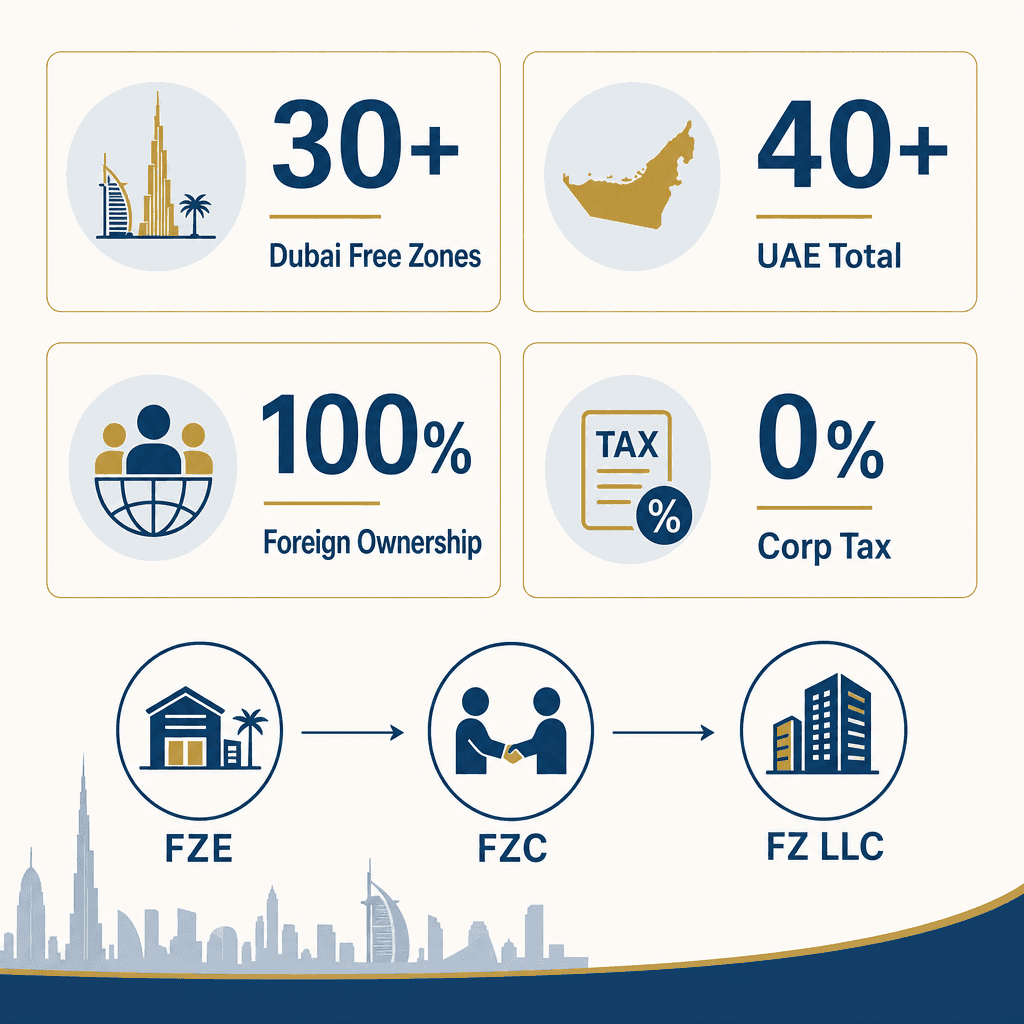
In 2026, Dubai operates more than 30 free zones, making it one of the most densely concentrated free zone ecosystems in the world (UAE Ministry of Economy, 2026).
Quick Summary
Dubai operates more than 30 active free zones as of 2026, each governed by its own authority and focused on a defined sector.
The three main company structures are FZE (single shareholder), FZC (two or more shareholders), and FZ LLC (available in select zones only).
Free zone companies get 100% foreign ownership and a 0% corporate tax rate on qualifying income under Federal Decree-Law No. 47 of 2022, but cannot sell directly on the UAE mainland without a licensed distributor.
Dubai South Business Hub Free Zone offers commercial, professional, and industrial licenses with on-site immigration services for SMEs and startups near Al Maktoum International Airport.
In 2026, Dubai operates more than 30 free zones, making it one of the most densely concentrated free zone ecosystems in the world (UAE Ministry of Economy, 2026). The list of freezone companies in Dubai spans sectors from commodities trading and logistics to technology, media, and financial services. Across all UAE emirates, the total number of free zones exceeds 40 (UAE Government Portal, 2025). Each zone issues its own licenses, sets its own rules, and serves a distinct business community. This guide explains how many free zones Dubai has, what a Dubai freezone license covers, how FZE and FZC structures differ, what free zone immigration means in practice, and where Dubai South Business Hub Free Zone sits in the landscape, so you can compare your options before committing to a jurisdiction.
What Is a Free Zone in Dubai and How Does It Work
A free zone in Dubai is a designated economic area governed by its own regulatory authority, where businesses can operate under a separate legal framework from the UAE mainland. Free zone companies benefit from full foreign ownership, simplified registration, and the ability to trade internationally without a local sponsor. The list of freezone companies in Dubai registered under this model now spans every major commercial sector, making the free zone structure one of the most widely used entry points for international investors in the UAE.
How Free Zones Differ from the UAE Mainland
Free zones operate under their own authority and legal framework, entirely separate from the Dubai Department of Economy and Tourism (DET). That means the rules governing your license, your office requirements, and your visa allocations are set by the free zone authority, not by DET.
Mainland companies can trade directly anywhere in the UAE. Free zone companies typically trade within the free zone or internationally, and need a registered mainland distributor or agent to sell directly into the UAE domestic market. That distinction matters a lot depending on where your customers are.
100% foreign ownership has been available in free zones since their inception. The mainland introduced broader foreign ownership reforms under Federal Decree-Law No. 26 of 2020 (UAE Ministry of Economy, 2020), but the free zone model still offers a simpler, faster path to full ownership for most international founders. The UAE has more than 40 free zones nationwide; Dubai alone accounts for more than 30 of those.
Take a logistics company in Jebel Ali Free Zone (JAFZA) as a practical illustration: it can export globally and manage international supply chains from Dubai, but it would need a mainland-licensed distributor to sell directly to a retail outlet in Dubai's Deira district.
What a Dubai Free Zone License Covers
A Dubai freezone license is a commercial permit issued by a specific free zone authority. It authorises the holder to conduct approved business activities from within that free zone's jurisdiction. The license specifies the permitted activities, the license category, and its validity period, which is typically one year in most Dubai free zones.
License types generally fall into three categories: commercial (trading), professional (service-based), and industrial (manufacturing or processing). The exact categories available, and the activities permitted under each, vary by free zone authority. Each free zone publishes its own approved activity list, and that list is updated periodically.
The license is tied to the issuing free zone's jurisdiction. It does not automatically extend trading rights to the UAE mainland. A technology consultancy licensed in Dubai Internet City, for example, holds a professional license permitting it to provide IT services to clients worldwide from its Dubai Internet City office, but not to open a retail branch in a Dubai shopping mall without a separate mainland entity.
Main Free Zones in Dubai: Location and Sector Focus
Free Zone Name | Location or District | General Sector Focus |
|---|---|---|
Jebel Ali Free Zone (JAFZA) | Jebel Ali | Logistics, trade, manufacturing |
Dubai Multi Commodities Centre (DMCC) | Jumeirah Lakes Towers | Commodities trading, gold, diamonds |
Dubai Internet City (DIC) | Sheikh Zayed Road corridor | Technology and IT services |
Dubai Airport Free Zone (DAFZA) | Dubai International Airport | Aviation, logistics, high-value trade |
Dubai Media City (DMC) | Sheikh Zayed Road corridor | Media, broadcasting, publishing |
Dubai Healthcare City (DHCC) | Oud Metha | Healthcare, medical education, life sciences |
Dubai International Financial Centre (DIFC) | Downtown Dubai | Financial services, legal, professional services |
Dubai South Business Hub Free Zone | Dubai South district | Multi-sector, SME and startup-focused |
Dubai Silicon Oasis (DSO) | Al Ain Road | Technology, electronics, innovation |
Dubai Design District (d3) | Al Quoz | Design, fashion, luxury goods |
Source: Respective free zone authority websites, 2026. For setup costs, license fees, visa quotas, and document requirements, visit each free zone's official website directly.
How Many Free Zones Does Dubai Have
Dubai has more than 30 active free zones as of 2026, each established by a separate authority and focused on a defined sector. The total number across all UAE emirates exceeds 40. Each free zone in Dubai operates independently, issues its own licenses, and sets its own regulatory framework. The list of freezone companies in Dubai registered across these jurisdictions reflects decades of deliberate, sector-by-sector expansion.
Why Dubai Has So Many Free Zones
Dubai's free zone model began with JAFZA in 1985, established specifically to attract foreign direct investment by offering full foreign ownership and tax advantages that were unavailable on the mainland at the time (JAFZA, 2025, still accurate as of 2026). That single decision created a template that Dubai's economic planners replicated across every major industry.
Each subsequent free zone was designed to serve a specific sector. Regulators could tailor licensing frameworks, physical infrastructure, and professional networks to that sector's precise needs. Dubai Internet City launched in 1999 as one of the first technology-focused free zones in the region, followed by Dubai Media City, Dubai Healthcare City, and eventually DIFC for financial services.
Dubai Healthcare City is a good illustration of how this model works in practice. It was established specifically to attract hospitals, clinics, and medical education providers, creating a regulated healthcare cluster with its own licensing authority, its own clinical governance framework, and a co-located community of sector peers. That concentration of like-minded businesses is something a general-purpose zone simply cannot replicate. Sectors covered across Dubai's free zones now range from logistics and aviation to media, technology, healthcare, and financial services.
What Are FZE, FZC, and FZ LLC Companies in Dubai
An FZE (Free Zone Establishment) is a free zone company with a single shareholder. An FZC (Free Zone Company) has two or more shareholders. An FZ LLC is a limited liability structure available in certain free zones. All three provide limited liability protection and 100% foreign ownership within the free zone. Understanding these structures is essential before you choose a Dubai freezone license, because the structure you select determines your shareholding options and governance framework from day one.
FZE vs FZC: Which Structure Suits Your Business
An FZE suits a solo founder or single corporate shareholder who wants full ownership and control without partners. It's the most common structure among FZE companies in Dubai precisely because so many international founders are setting up alone, particularly in consulting, trading, and professional services.
An FZC is the appropriate structure when two or more individuals or corporate entities are co-founding the business and want to hold shares collectively. Both structures provide limited liability, meaning a shareholder's personal assets are generally protected from company debts up to the value of their shareholding.
A UK-based entrepreneur setting up a consulting firm alone in a Dubai free zone would register an FZE, holding 100% of the shares as the sole shareholder. If that same founder later brought in a business partner, they'd need to either restructure to an FZC or register a new entity. Minimum share capital requirements for both structures vary by free zone authority, so check the relevant authority's current rules before incorporating.
What FZ LLC Means and Where It Applies
The FZ LLC (Free Zone Limited Liability Company) structure is offered by select free zones and is modelled broadly on the mainland LLC structure. It often permits a higher number of shareholders than a standard FZC, making it useful for larger founding teams or investment structures.
Not all Dubai free zones offer the FZ LLC. Availability depends entirely on the specific free zone authority's regulations. DIFC is a useful reference point here: it operates under English common law and offers its own distinct company structures, which differ structurally from the standard FZE and FZC models used across most other Dubai free zones (DIFC Authority, 2025). Some free zones also permit branch registrations of foreign companies as an alternative to any of the three structures above. For exact share capital thresholds, shareholder limits, and eligibility rules, always go directly to the relevant authority's official website.
How to Start a Business in a Dubai Free Zone: Key Steps
To start a business in a Dubai free zone, choose a free zone aligned with your sector, select a legal structure (FZE, FZC, or FZ LLC), reserve a trade name, submit incorporation documents, obtain your Dubai freezone license, and arrange office space. Requirements and timelines vary by free zone authority. Setting up a company in a Dubai free zone follows a broadly consistent sequence, even though the specific documents, fees, and processing times differ between jurisdictions.
Step 1: Choose the Right Free Zone for Your Activity
Your sector and intended business activities are the primary filter. Each free zone publishes an approved activity list, and not all activities are available in all zones. A commodities trader, for instance, would look first at DMCC because of its established commodities ecosystem, vault infrastructure, and sector-specific networking, rather than a media or technology-focused zone.
Physical proximity to your clients, suppliers, or key infrastructure (port, airport, financial district) should also factor into your decision. Some free zones restrict certain nationalities or business types by sector regulation, so confirm eligibility before investing time in an application. Activity lists are updated periodically, so always check the official website of each free zone you're considering for the current version.
Step 2: Register Your Company and Obtain Your License
Once you've chosen a free zone, you submit a trade name reservation, select your legal structure (FZE, FZC, or FZ LLC where available), and file your incorporation documents with the free zone authority. The authority then reviews your application and, if approved, issues your Dubai freezone license specifying your permitted activities, license category, and validity period.
Most free zone licenses are valid for one year and require annual renewal. Document requirements, application fees, and processing timelines differ between free zones. At Dubai South Business Hub Free Zone, applicants can submit registration documents and receive a license through a streamlined process designed for SMEs and startups. Full details are available via the official Dubai South Business Hub Free Zone website. For any other free zone, contact that authority directly for current requirements.
Step 3: Set Up Your Office and Arrange Visas
Most free zones require at least a registered address. Depending on the zone's regulations, that can be a physical office, a flexi-desk, or a business centre unit. Some free zones offer virtual office options as well, though the workspace type can affect how many visas you're entitled to apply for.
Once your license is issued, you can apply for UAE residency visas for yourself and your employees through the free zone's immigration services. The number of visas available under a given license is set by the individual free zone authority. Free zone immigration is handled by the free zone authority in coordination with the UAE General Directorate of Residency and Foreigners Affairs (GDRFA). Residency visas issued this way are standard UAE residency visas, valid across all seven emirates, not restricted to the free zone's territory.
What Is Free Zone Immigration in Dubai and How Does It Work
Free zone immigration in Dubai refers to the visa sponsorship services provided by each free zone authority, allowing companies to sponsor residency visas for owners, employees, and dependants. The free zone acts as the sponsoring entity, coordinating with the UAE GDRFA. Visa allocations and eligibility depend on the specific free zone's rules. Understanding how free zone immigration works is particularly important for founders who plan to relocate to Dubai, not just register a company here.
Who Can Be Sponsored Under a Free Zone Visa
A free zone company can typically sponsor visas for its shareholders, directors, employees, and their immediate family members as dependants. The specific categories eligible for sponsorship, and the documentation required, vary by free zone authority and UAE immigration regulations.
Residency visas issued through a free zone are full UAE residency visas, recognised across all seven emirates. They're not zone-restricted permits. An FZE owner registered at Dubai South Business Hub Free Zone can sponsor a residency visa for themselves as the company's sole shareholder and manager, and subsequently sponsor their spouse and children as dependants through the same free zone authority. UAE residency visas issued via free zones are processed by GDRFA Dubai, and most free zone immigration services are accessible through the authority's own customer service centre or online portal.
How Free Zone Visa Sponsorship Differs from Mainland Sponsorship
On the mainland, your company's trade license issued by the Department of Economy and Tourism (DET) serves as the sponsoring entity for visas, processed through GDRFA or Amer centres. In a free zone, the free zone authority itself acts as the regulated intermediary, processing applications through its own immigration services desk in coordination with GDRFA.
Both pathways result in a standard UAE residency visa. The administrative route differs, not the visa itself. UAE residency visas are governed by Federal Decree-Law No. 29 of 2021 on entry and residence of foreigners (UAE Federal Government, 2021). A founder with a mainland DET license renews their visa through an Amer centre; a founder with a Dubai South Business Hub Free Zone license renews through Dubai South Business Hub Free Zone's own immigration services. Free zone immigration desks typically handle both new applications and renewals in a single location.
Is a free zone visa valid outside the free zone?
Yes. A UAE residency visa sponsored by a Dubai free zone authority is a standard federal residency visa, valid for living, working, and travelling across all seven UAE emirates. It is not geographically restricted to the free zone that issued it. The visa is processed by GDRFA Dubai and carries the same legal status as a mainland-sponsored residency visa.
About Dubai South Business Hub Free Zone
Dubai South Business Hub Free Zone is a multi-sector free zone located in the Dubai South district, near Al Maktoum International Airport. It offers commercial, professional, and industrial license categories, FZE and FZC company structures, and on-site visa immigration services, making it a practical option for SMEs and startups entering the UAE market. Among the list of freezone companies in Dubai, Dubai South Business Hub Free Zone stands out for its multi-sector scope and strategic location in one of the UAE's fastest-growing economic districts.
Location and Sector Focus of Dubai South Business Hub Free Zone
Dubai South Business Hub Free Zone is situated in the Dubai South district, a 145-square-kilometre master-planned economic zone near Al Maktoum International Airport. The district is one of the UAE's largest single urban development projects, designed to integrate aviation, logistics, residential, and commercial functions within a single planned area.
The free zone welcomes businesses across trading, professional services, consulting, logistics support, and light industrial activities. Its proximity to Al Maktoum International Airport and Expo City Dubai makes it strategically positioned for companies with regional distribution requirements or operations linked to the area's growing event and exhibition economy. A regional trading company setting up a Gulf-facing hub, for example, can use Dubai South Business Hub Free Zone to access Al Maktoum International Airport's cargo infrastructure directly, without needing a separate logistics partner at the port.
License Types and Business Activities at Dubai South Business Hub Free Zone
Dubai South Business Hub Free Zone issues licenses in three categories: commercial licenses for trading activities, professional licenses for service-based businesses, and industrial licenses for manufacturing and processing operations. Both FZE and FZC structures are supported, so solo founders and multi-shareholder ventures can incorporate within the same jurisdiction.
Before initiating your registration, you can review the full approved activity list through the Dubai South Business Hub Free Zone official portal to confirm your specific activity is permitted. A management consultancy with two co-founders, for instance, would register as an FZC under a professional license, with both founders listed as shareholders in the founding documents. The FZE structure remains the right choice when a single individual or corporate entity holds 100% of the shares.
Visa and Immigration Services at Dubai South Business Hub Free Zone
Dubai South Business Hub Free Zone provides on-site immigration services, allowing license holders to apply for, renew, and manage UAE residency visas for shareholders, employees, and dependants through the free zone authority. The free zone coordinates directly with GDRFA Dubai for visa processing, so applicants don't need to engage a separate typing centre for standard visa applications.
A startup founder at Dubai South Business Hub Free Zone can complete their company registration and investor visa application through a single point of contact at the free zone authority, rather than managing multiple government entities independently. That consolidated process is particularly valuable for first-time UAE entrants who are unfamiliar with the local administrative landscape. Residency visas obtained via Dubai South Business Hub Free Zone are standard UAE residency visas, valid across all emirates. Full information on visa categories, required documents, and applicable government fees is available through the Dubai South Business Hub Free Zone official customer service centre.
Pros and Cons of Setting Up in a Dubai Free Zone
Dubai free zones offer 100% foreign ownership, no corporate tax on qualifying income, and streamlined registration. The trade-off is that free zone companies cannot sell directly on the UAE mainland without a licensed distributor, and each free zone restricts activities to its approved list, limiting operational flexibility for some business models. If you're setting up a company in a Dubai free zone, weigh these factors against your specific customer base and revenue model before choosing a structure.
Advantages of a Dubai Free Zone Company
100% foreign ownership without a UAE national partner. This has been available in free zones since JAFZA's establishment in 1985, and it remains the primary draw for international investors.
0% corporate tax on qualifying free zone income under the UAE Corporate Tax Law (Federal Decree-Law No. 47 of 2022, effective June 2023). The 9% standard rate applies to taxable income above AED 375,000, but Qualifying Free Zone Persons (QFZPs) can access the 0% rate on eligible income (UAE Federal Tax Authority, 2023).
Sector-specific ecosystems in many zones give you immediate access to industry networks, co-located clients, and tailored infrastructure. A fintech startup in DIFC, for instance, gains proximity to regional banks, venture funds, and DIFC's own courts system, all within a single jurisdiction.
Simplified registration compared to mainland incorporation in many cases, with free zone authorities acting as a one-stop shop for licensing, visas, and office space.
Full profit repatriation: free zone companies can transfer profits and capital outside the UAE without restriction.
Limitations to Consider Before Choosing a Free Zone
No direct mainland sales without a licensed distributor or agent. A food and beverage importer planning to supply supermarkets across Dubai would find a mainland license more operationally straightforward, because direct B2B sales to mainland retailers require a mainland trading entity.
Activity list restrictions: your license only covers the activities approved by that specific free zone authority. If your business pivots or expands into an unapproved activity, you may need a second license or a zone transfer, both of which add cost and time.
Distribution layer costs: if your primary customers are UAE-based mainland businesses or consumers, the additional distributor arrangement reduces your margin