
Last updated: June 2026 By Editorial Team , UAE business setup specialists with direct experience advising free zone companies on banking, licensing, and corporate structuring.
Last updated: June 2026
By Editorial Team, UAE business setup specialists with direct experience advising free zone companies on banking, licensing, and corporate structuring. Full bio →
Table of Contents
What Is Digital Banking in the UAE and Why It Is Reshaping Business Finance
Head-to-Head Comparison: Digital Banking vs Traditional Banking UAE Across Key Dimensions
Banking Relationship Value and Credit Access: Where Traditional Banks Still Win
How to Choose Between Digital Banking vs Traditional Banking UAE: Five Decision Factors
Which Types of Businesses Suit Digital Banking vs Traditional Banking in the UAE
How to Open a Business Bank Account in the UAE: Steps from Decision to Activation
The Practical Answer for UAE Businesses in 2026
References
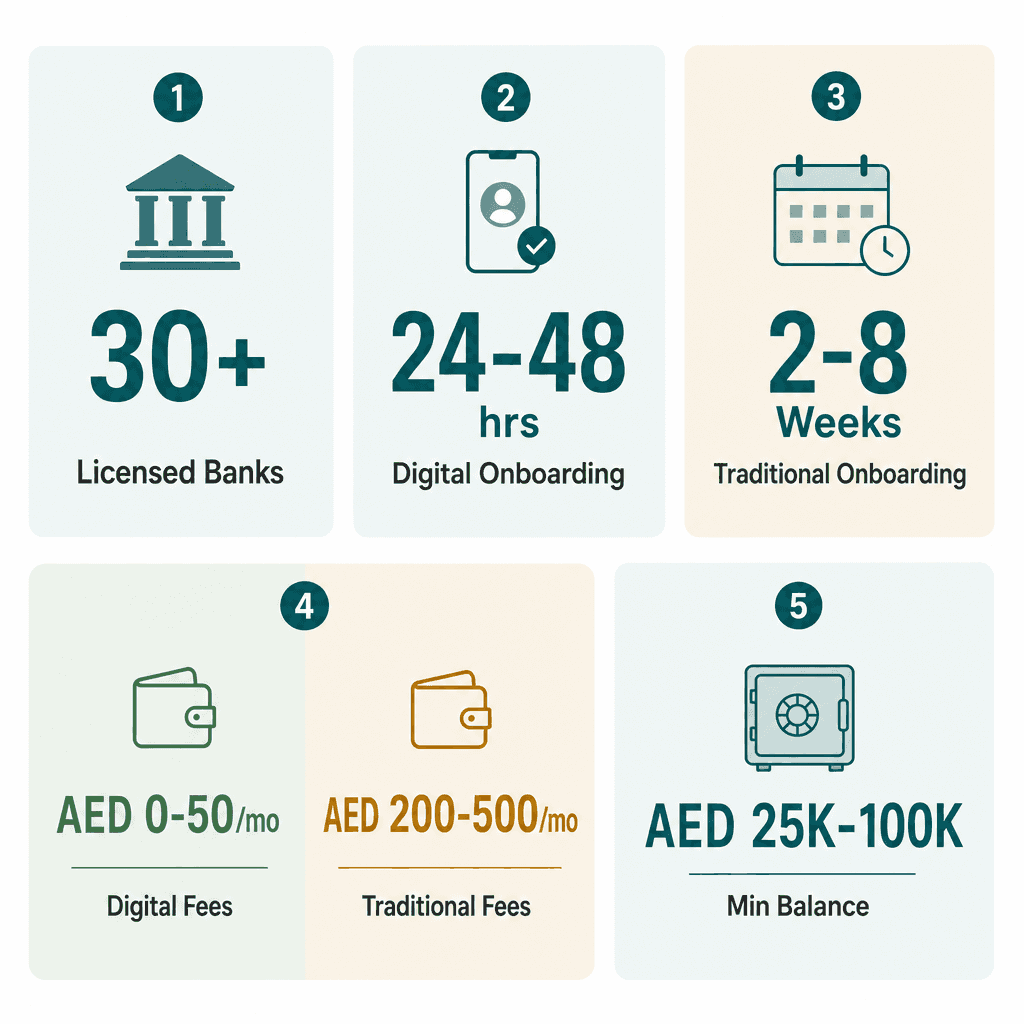
In 2026, the UAE is home to more than 30 licensed banks serving business accounts, and for the first time, digital-first institutions like Wio, Mashreq Neo, and Zand are processing new business account applications in as little as 24 to 48 hours. Traditional banks, by contrast, typically take 2–8 weeks and require AED 25,000–100,000 in minimum average balances (Central Bank of UAE, 2025). Digital banks charge AED 0–50 per month in standard fees. Traditional banks levy AED 200–500 or more in monthly penalties when balances fall short. WPS (Wage Protection System) compliance is mandatory for all UAE private sector employers under Ministry of Human Resources and Emiratisation (MOHRE) regulations, and most digital banks don't yet support it. These five numbers tell you most of what you need to know about the digital banking vs traditional banking UAE debate.
This guide walks you through the full digital banking vs traditional banking UAE comparison, account opening speed, fees, documentation, credit access, and regulatory standing, so you can choose the right banking structure for your business stage and goals, with links to DSBH banking and taxation services for hands-on support.
What Is Digital Banking in the UAE and Why It Is Reshaping Business Finance
Digital banking in the UAE refers to fully licensed banks, including Wio, Mashreq Neo, and Zand, that operate primarily through apps and APIs rather than branch networks. They hold Central Bank of UAE licenses, accept trade license and visa applications, and offer business accounts with faster onboarding and lower minimum balance requirements than conventional banks. This is not a fintech workaround. It's a structural shift in how the UAE banking sector delivers services to businesses.
How UAE Digital Banks Are Licensed and Regulated
Every digital bank operating in the UAE, Wio, Zand, Mashreq Neo, holds a full Central Bank of UAE banking license, not a fintech exemption or payment service provider registration. That distinction matters enormously. A neobank UAE account carries the same regulatory standing as an Emirates NBD or RAKBank account for trade license issuance, visa sponsorship, and corporate banking purposes.
Zand Bank launched in 2022 as the UAE's first purpose-built digital bank, holding a full commercial banking license from the Central Bank of UAE (Zand Bank, 2022). Wio Bank, backed by Abu Dhabi Holdings and Alpha Dhabi, reportedly processed over 50,000 business accounts in its first 18 months of operation.
Worth flagging: a neobank UAE is not the same as a payment app or e-wallet. Apps like PayBy or Payit are not deposit-taking institutions. They can't issue an IBAN for corporate purposes or satisfy a bank account requirement on a trade license application. If you're comparing options, make sure you're comparing like for like.
What Makes a Traditional Bank Different in the UAE Context
Traditional UAE banks, Emirates NBD, RAKBank, ADCB, Mashreq, operate physical branch networks, dedicated relationship managers, and full credit product suites. Their compliance infrastructure is deeper and more established, which is exactly why their onboarding timelines run longer. Manual UBO (Ultimate Beneficial Owner) verification, in-person KYC visits, and compliance committee reviews are standard.
The trade-off is access. Traditional banks offer trade finance instruments, letters of credit, bank guarantees, performance bonds, and WPS-compliant payroll that digital banks can't yet match. They also require AED 25,000–100,000 in minimum average monthly balances, with penalty fees of AED 200–500 or more per month if you fall short.
RAKBank has a dedicated business banking partnership with Dubai South Business Hub, offering on-site relationship manager access for free zone companies. That kind of structural access can reduce traditional bank onboarding from 8 weeks to closer to 2–3 weeks for RAKBank business banking at Dubai South members. For banking 101 for startups in the UAE, understanding this access advantage is one of the most practically useful things you can learn.
Head-to-Head Comparison: Digital Banking vs Traditional Banking UAE Across Key Dimensions
Digital banks in the UAE open business accounts in 24–48 hours with app-based KYC and zero or low minimum balances. Traditional banks take 2–8 weeks, require in-person documentation, and hold AED 25,000–100,000 minimums, but offer credit facilities, trade finance, and WPS salary transfer that digital banks cannot yet match. Here's how that plays out across the dimensions that matter most to a business owner.
Digital Banking vs Traditional Banking UAE: Side-by-Side Comparison
Feature | Digital Banks (Wio, Mashreq Neo, Zand) | Traditional Banks (RAKBank, Emirates NBD, ADCB) |
|---|---|---|
Account Opening Time | ✅ 24–48 hours | ❌ 2–8 weeks |
Documentation Process | ✅ App-based upload, no branch visit | ❌ In-person KYC, full UBO review |
Minimum Balance Requirement | ✅ AED 0 (most accounts) | ❌ AED 25,000–100,000 |
Monthly Fees (if below minimum) | ✅ AED 0–50 | ❌ AED 200–500+ |
API & Software Integration | ✅ Xero, QuickBooks, Zoho, bulk payments | ❌ Limited or fee-bearing |
Credit Facilities & Trade Finance | ❌ Limited or unavailable | ✅ Letters of credit, overdrafts, term loans |
WPS Salary Transfer | ❌ Not yet widely supported | ✅ Standard offering |
Account Opening Speed and Documentation Requirements
Wio Bank's business onboarding flow allows a sole-proprietor free zone company to submit all documents through the app, trade license, Emirates ID, passport copy, and receive account details within one business day. No branch visit. No compliance interview. That's a genuinely different experience from what UAE business banking looked like three years ago.
Traditional banks run a different process. Expect a 2–8 week timeline, an in-person KYC visit, and a full compliance review of your corporate structure including UBO declarations. This isn't bureaucracy for its own sake, Central Bank AML rules apply equally to digital and traditional banks. The difference is processing infrastructure, not regulatory rigour.
Fees, Minimum Balances, and Monthly Costs
Here's a scenario worth thinking through. A startup holding AED 30,000 in working capital would trigger monthly penalty fees at most traditional UAE banks, because most require AED 50,000–100,000 as a minimum average balance. A Wio or Zand account charges nothing in that situation. That's not a marginal difference for an early-stage business managing cash flow on a tight runway.
The opportunity cost matters too. AED 50,000 locked as a minimum balance is capital not deployed in operations, marketing, or hiring. Digital bank monthly fees sit in the AED 0–50 range for standard business accounts. Fee structures vary by bank and account tier, so check the specific product terms before you commit.
Business Features: API Access, Multi-Currency, and WPS vs Trade Finance
Mashreq Neo offers API-based payment automation for e-commerce businesses, while Mashreq corporate banking at Dubai South provides letters of credit for the same client's import operations. That dual setup is increasingly the default for growing UAE businesses, and it's a practical illustration of why the digital vs traditional question rarely has a single right answer.
Digital banks lead on developer-friendly infrastructure: open APIs, native integrations with Xero, QuickBooks, and Zoho Books, bulk payment uploads, and multi-currency wallets supporting 10–25 currencies depending on provider. Traditional banks lead on credit: overdraft facilities, term loans, letters of credit, bank guarantees, and WPS-compliant payroll, all regulatory requirements once your headcount grows.
Banking Relationship Value and Credit Access: Where Traditional Banks Still Win
Traditional UAE banks hold a decisive advantage for businesses needing credit. A multi-year banking relationship with Emirates NBD, RAKBank, or ADCB builds the credit history required for overdraft facilities, trade finance, and term loans. Digital banks currently offer limited or no lending products, making them insufficient as a sole banking solution for capital-intensive businesses.
How UAE Banks Evaluate Your Business for Credit
UAE banks assess credit eligibility based on minimum 12–24 months of audited financial statements, a consistent average balance history, and demonstrated revenue through account statements. That timeline is non-negotiable, and it's why starting your banking relationship early matters, even if you don't need credit yet.
Here's a practical angle most guides miss: a digital bank account with 12 months of clean transaction history can actively support a traditional bank credit application. An e-commerce business that opened with Wio Bank for day-to-day operations transitioned its payroll and trade finance to RAKBank after 18 months, using the Wio transaction history as supporting documentation for its credit application. Treat your digital account as a credit-building tool from day one.
Letters of credit, performance bonds, and bank guarantees remain exclusive to licensed commercial banks with trade finance desks. If your business involves import/export, those instruments are non-negotiable. No digital bank currently offers them. If you've had a rejection, why your UAE business bank account was rejected covers the most common causes in detail.
When a Dual-Bank Strategy Makes the Most Sense
The practical answer for most businesses isn't digital or traditional, it's both, in sequence. Here's how to assign the functions:
Open a digital account immediately upon licensing, no waiting period, no minimum balance pressure, operational from day one.
Apply for a traditional bank account at the 6-month mark, by then you have transaction history to show, which strengthens the application considerably.
Assign functions deliberately, digital account for payables, receivables, and API-connected accounting; traditional account for WPS payroll, credit line, and trade instruments.
Dubai South Business Hub free zone members increasingly open a Wio or Zand account on day one, then apply for a RAKBank or Mashreq account through the DSBH banking partnership once their first three months of statements are available. The DSBH banking and taxation services team facilitates those introductions directly, bypassing the cold-application queue that independent applicants face.
How to Choose Between Digital Banking vs Traditional Banking UAE: Five Decision Factors
Choose a digital bank if you need an account open within 48 hours, have minimal credit needs, and prioritise API integrations. Choose a traditional bank if you need WPS payroll compliance, trade finance, or a credit facility. Most growing UAE businesses should run both, digital for operations, traditional for credit and compliance. These three factors sharpen that decision.
Factor 1: Your Business Stage and Cash Flow Position
Pre-revenue or early-stage: a digital bank first. Zero minimum balance, fast activation, no penalty fee exposure. A digital marketing agency licensed at a UAE free zone with two founders and no physical inventory has zero need for trade finance, a Wio or Zand account covers all operational banking needs at launch.
AED 100,000+ in monthly revenue: a traditional bank becomes both viable and strategically important. That revenue level signals to a bank's credit team that you're worth onboarding, and the relationship you build now is the foundation for a credit facility later. Free zone startups with lean teams of 1–4 staff can operate entirely on a digital bank for startups UAE for 12–18 months without regulatory friction, but start the traditional bank application before you actually need the credit.
Factor 2: Regulatory and Compliance Obligations
WPS compliance: mandatory for all UAE private sector employers under MOHRE regulations. Most digital banks don't yet support WPS salary transfers. If you have employees, you need a traditional bank.
Import/export activities: letters of credit and bank guarantees require a traditional bank with a trade finance desk. A logistics company at Dubai South with 12 drivers on payroll must use a WPS-compliant bank, RAKBank or Mashreq are the practical options.
Federal Tax Authority registration: VAT refund processing and corporate tax filings may be smoother with an established traditional bank account on record. Worth factoring in if you're VAT-registered.
WPS capability at digital banks is evolving, check current product terms, as this landscape is shifting faster than most guides reflect.
Factor 3: Technology Needs and Operational Efficiency
If your finance team uses Xero, QuickBooks, or Zoho Books, a digital bank with native API integration saves an estimated 3–5 hours per week in manual reconciliation. A SaaS company billing international clients in USD and EUR used Wio's multi-currency account to receive payments and convert to AED, cutting FX transaction costs compared to a traditional bank SWIFT receipt structure.
Bulk payment uploads for supplier disbursements are standard on digital platforms. On most traditional bank portals, they're clunky or carry per-transaction fees. If you're processing 50+ supplier payments per month, that difference adds up fast.
Is a digital bank account accepted for UAE corporate purposes?
Yes. Digital banks holding full Central Bank of UAE licenses, including Wio, Zand, and Mashreq Neo, are accepted for trade license issuance, visa sponsorship, and corporate registration purposes. They carry the same regulatory standing as traditional UAE banks for these applications. The distinction that matters is between a licensed bank and a payment app or e-wallet, which is not a bank.
Which Types of Businesses Suit Digital Banking vs Traditional Banking in the UAE
Digital-first banks suit new startups, freelancers, e-commerce operators, and tech businesses that need fast onboarding, API integrations, and low overhead. Traditional banks suit businesses with employees, import/export operations, government contracts, or credit needs. Most businesses with 12+ months of operation benefit from holding both account types simultaneously.
Business Profiles That Thrive with a Neobank UAE Account
Solo consultants and freelancers: zero employees, no WPS obligation, simple AED and USD cash flows. A freelance UX designer licensed at a UAE free zone opened a Wio business account on day two of receiving her trade license, active before her first client invoice was due.
E-commerce and dropshipping businesses: high transaction volume, multi-currency needs, API-driven reconciliation with Shopify or WooCommerce.
Tech startups and SaaS companies: developer-friendly banking infrastructure, API access for automated invoicing and payment flows.
Newly licensed companies in their first 6 months: need an operational account before traditional bank onboarding completes. A neobank UAE account bridges that gap cleanly.
The best digital bank UAE business owners choose depends on their specific integration needs, compare Wio's API documentation against Zand's product suite before committing.
Business Profiles That Need a Traditional Bank as Their Primary Institution
Trading and import/export companies: letters of credit, bank guarantees, and trade finance are non-negotiable. A general trading company at Dubai South importing electronics from Asia needs both a letter of credit facility for supplier payments and a bank guarantee for customs, available only through RAKBank business banking at Dubai South or Mashreq's trade finance desks.
Businesses with 5+ employees: WPS compliance requires a MOHRE-approved payroll bank.
Government contract holders: many UAE government tenders require a bank guarantee or letter of good standing from a licensed commercial bank.
Businesses seeking property financing, equipment loans, or working capital facilities: digital banks don't offer these products yet.
References
Editorial sources available on request. Full citation list is being compiled.